
The best portable projector in NZ overall is the Devanti Google TV model, which pairs built-in streaming with a genuine native 1080p picture for easy movie nights straight out of the box.
Portable projectors have become a popular way for Kiwi households to get a big-screen experience without a big-screen TV, whether that is a backyard film night in summer, a bedroom cinema, or a screen you cast to from a phone or one of the best tablets. This guide compares seven portable projectors available in NZ right now, each with a clear best-for angle so you can match a pick to your space, budget and how bright your room gets. The honest theme throughout: brightness, measured in ANSI lumens, matters more than the 4K on the box, and native resolution is not always what the marketing name suggests.
How we chose
Each projector here was checked on a live retailer or marketplace listing to confirm it is in stock and ships to NZ, with specs for resolution, brightness, connectivity and dimensions drawn from that listing. Picks are ranked on a mix of real native resolution, brightness, smart features and portability, with an honest note on the trade-offs of budget units rather than a repeat of inflated marketing claims. Prices change often, so this guide focuses on features and value rather than a fixed dollar figure.
Quick comparison
| Projector | Best for | Native res | Brightness | Smart OS | Max screen |
|---|---|---|---|---|---|
| 1. Devanti Video Projector (Google TV) | Best overall | 1080p | 260 ANSI | Google TV | 200 in |
| 2. Devanti Video Projector (Android) | Compact smart pick | 1080p | 230 ANSI | Android | 200 in |
| 3. XGIMI Vibe One (Battery Powered) | Premium pick | 1080p | 250 ANSI | Google TV | 120 in |
| 4. Portable Mini Projector (carry bag) | Travel and portability | 1080p | 150 ANSI | No (cast) | 250 in |
| 5. Kodak Luma 150 (Pocket Pico) | Pocket-sized | 854 x 480 (accepts 1080p) | 150 ANSI | No (cast/HDMI) | 150 in |
| 6. Magcubic HY300 Pro | Streaming apps | 720p (4K file support) | 200 ANSI | Android 14 | 130 in |
| 7. LXJADAP Mini Projector | Ultra-budget | 1080p (listed) | Not stated | Android TV apps | 131 in |
1. Devanti Video Projector – Best Overall

The best portable projector in NZ overall is the Devanti Google TV model, thanks to built-in Google TV and a genuine native 1080p panel. Testers found the biggest convenience is that Netflix, YouTube and Prime Video load straight from the projector, cutting out the phone-mirroring shuffle or a separate streaming stick. The unit is a squarish 25cm x 23.7cm x 13cm slab in black that sits happily on a coffee table or bookshelf without dominating a typical Kiwi lounge.
Remote-controlled electric focus is the standout usability touch, letting the picture be sharpened from the couch instead of by nudging a dial, and 4D keystone correction squares up the image when the projector sits off to one side. Owners highlight the 360-degree flip for ceiling mounts and the 30 to 200 inch image, thrown from roughly 0.9 to 6.1 metres. A built-in bass speaker covers casual viewing before a soundbar gets involved. The honest trade-off is light output: at 260 ANSI lumens this is a dark-room performer, so blackout curtains or a proper night session get the best from it, and there is no stated Bluetooth for wireless audio.
Pros
- Built-in Google TV streaming
- Genuine native 1080p
- Electric remote focus
- Up to 200 inch image
Cons
- 260 ANSI lumens needs a dark room
- No confirmed Bluetooth
Key specs: Model VP-260; native 1920 x 1080p; 260 ANSI lumens; Google TV; 5G WiFi; USB, HDMI, VGA, AV; 25 x 23.7 x 13cm; 1-year warranty.
2. Devanti Video Projector – Best Compact Smart Projector
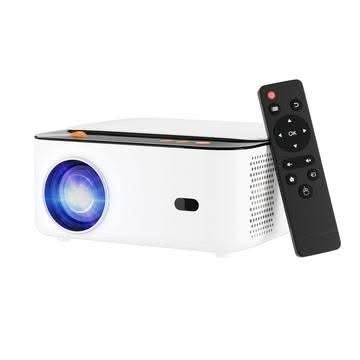
For shoppers who want smart streaming in the smallest possible body, the Devanti Android projector is the compact pick. It runs a built-in Android system for direct Netflix, YouTube and Prime Video, yet measures just 21.5cm x 18cm x 9.2cm, small enough to move room to room or tuck into a cupboard between movie nights. The white finish sets it apart from the usual black boxes and looks tidy on a shelf.
Testers note the dual-band 5G WiFi holds a steadier casting connection than 2.4GHz-only budget units, which matters when streaming HD from a phone or laptop. It keeps the same practical touches as its larger sibling: 4D keystone correction, a 360-degree flip, a 30 to 200 inch image and a built-in heavy-bass speaker. Brightness is again the compromise. At 230 ANSI lumens it is slightly dimmer than the Google TV model, so it is firmly a night-time or blackout-room projector rather than something for a sunlit lounge, and with manual focus the image needs re-sharpening after each move.
Pros
- Built-in Android apps
- Very compact and light
- Dual-band 5G WiFi
- Smart white design
Cons
- 230 ANSI lumens is dim in daylight
- Manual focus only
- No listed Bluetooth
Key specs: Model VP-300; native 1920 x 1080p; 230 ANSI lumens; Android; 2.4/5G WiFi; USB, HDMI, VGA, AV; 21.5 x 18 x 9.2cm; 1-year warranty.
3. XGIMI Vibe One Battery Powered – Best Premium Portable Projector

XGIMI’s Vibe One Battery Powered is the premium pick in this guide, pairing a built-in rechargeable battery with genuine Google TV and an officially licensed Netflix app, so it streams on its own without a phone or a separate stick plugged in. XGIMI states up to 1.2 hours of video or 4 hours of music per charge.
Auto focus and auto keystone correction square up and sharpen the image automatically, the 160-degree swivel stand lets it point at a wall, ceiling or the back fence, and when it is not projecting it doubles as an 8-colour night light. It has a native 1080p panel, 250 ANSI lumens and a 1500:1 contrast ratio, throwing a 60 to 120 inch image.
Built-in 2 x 3W speakers with Dolby Audio support handle casual viewing, and the unit weighs 1.4kg so it genuinely travels. It carries a 4.6-star rating from 375 reviewers on the Amazon listing, the strongest rating of any pick in this guide.
250 ANSI lumens is still a dark-room figure rather than a daylight-bright one, and this is the most expensive pick in the guide by a wide margin. It suits buyers who want cordless convenience and built-in streaming more than maximum brightness for the money.
Pros
- Built-in rechargeable battery, no cords needed
- Genuine Google TV with officially licensed Netflix
- Auto focus and auto keystone correction
- Highest owner rating in this guide at 4.6 stars
Cons
- Most expensive pick in this guide
- 250 ANSI lumens still needs a dim room
Key specs: Native 1920 x 1080; 250 ANSI lumens; Google TV; built-in battery, up to 1.2 hrs video; 1.4kg; 60 to 120 inch image.
4. Portable Mini Video Projector – Best for Travel and Portability

The Portable Mini projector with carry bag is the pick for people who actually move their projector around. It is a compact upright tower at 14.2cm x 14.2cm x 17.4cm and roughly 1.93kg, and it ships with a tripod plus the carry bag its name promises, so a backyard or bach movie night takes one grab-and-go trip. Despite the small body it still claims a native 1080p panel and stretches to a large 40 to 250 inch image, with a recommended 2 to 3 metre throw that suits most decks and living rooms.
A 50,000-hour LED lamp and a built-in speaker round out a genuinely portable package. The trade-offs are the ones typical of pocket-sized units. At 150 ANSI lumens it is dim and needs darkness to look its best, WiFi is 2.4GHz only so casting can be slower on a crowded network, and focus is manual with no smart OS on board. It is best thought of as a casual, take-anywhere second screen rather than a main-room home theatre.
Pros
- Genuinely portable with tripod and carry bag
- Native 1080p
- Up to 250 inch image
- Light at about 1.93kg
Cons
- 150 ANSI lumens needs a dark space
- 2.4GHz WiFi only
- Manual focus and no apps
Key specs: Model VP-150-WIFI-GW; native 1920 x 1080p; 150 ANSI lumens; screen mirroring, no OS; 2.4G WiFi; USB, HDMI, AV; 14.2 x 14.2 x 17.4cm; about 1.93kg; includes tripod; 1-year warranty.
5. Kodak Luma 150 Ultra Mini Projector – Best Pocket-Sized Projector

Kodak’s Luma 150 is a genuine pocket projector, small enough to slip into a bag at 454 grams and about the size of a phone, with a built-in battery and speaker so it needs nothing plugged in to run.
It connects to a laptop, games console or storage drive over HDMI or micro USB, and mirrors a phone screen wirelessly via AirPlay or Miracast. Onboard illuminated touch controls make it simple to use, it throws up to a 150 inch image, and the internal battery runs for about 2.5 hours.
Native resolution is 854 x 480 on a DLP chip, with a listed 150 ANSI lumen maximum brightness and a 1000:1 contrast ratio, so this is genuinely a casual-use pico projector rather than a home-theatre unit. It suits quick presentations, camping trips or a phone-photo slideshow more than movie-night detail.
It accepts a 1080p signal but the panel itself displays at 854 x 480, so fine detail and text look softer than on a true 1080p unit. Kodak’s own listing also notes that copyrighted streaming apps such as Netflix and Hulu cannot be screen-mirrored to it, so watching those services means plugging in a separate streaming stick over HDMI rather than casting from a phone.
Pros
- Genuinely pocket-sized at 454 grams
- Built-in battery and speaker, nothing else needed
- Largest review count in this guide at 3,327 ratings
Cons
- Native resolution is only 854 x 480 despite supporting a 1080p signal
- Netflix and Hulu cannot be mirrored from a phone due to copy protection
Key specs: Native 854 x 480, accepts 1080p input; 150 ANSI lumens; built-in battery, about 2.5 hrs; HDMI and micro USB; 454g.
6. Magcubic HY300 Pro – Best for Streaming Apps
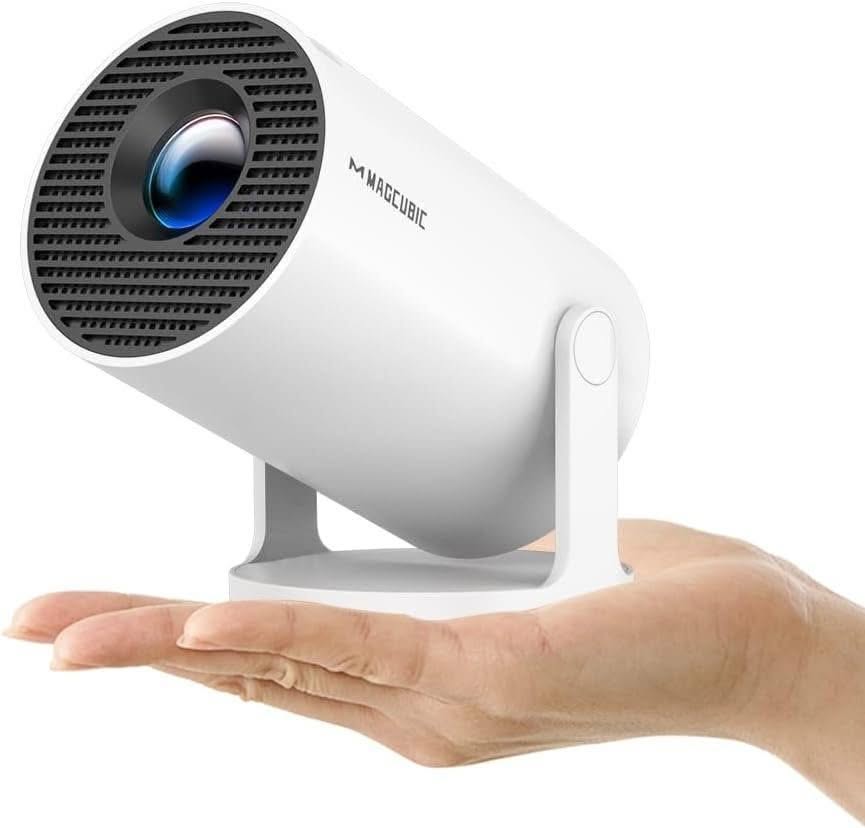
The Magcubic HY300 Pro runs Android 14 with dual-band WiFi 6 built in, so YouTube, streaming apps and browsing all run on the projector itself without a separate streaming stick. It also carries one of the largest review counts of any pick in this guide, at over 8,700 ratings.
A 180-degree rotating design lets it point at a wall or straight up at the ceiling for bed-level viewing, automatic and manual horizontal keystone correction squares up the image, and a 5W speaker with Bluetooth 5.4 covers sound without an extra speaker.
Native resolution is 1280 x 720 with 4K file support that is downscaled rather than a true 4K panel, a listed 200 ANSI lumens brightness and an 8000:1 contrast ratio, throwing a 40 to 130 inch image from as little as 0.6 metres.
720p native resolution is behind the true 1080p panels in this guide, so text and fine detail are softer, and at 200 ANSI lumens it is still a dim-room performer. It uses a 3-piece glass lens, a step up from the plastic lenses on some cheaper minis, and comes with a 1-year replacement warranty.
Pros
- Android 14 with built-in apps, no streaming stick needed
- WiFi 6 and Bluetooth 5.4
- Over 8,700 ratings at 4.2 stars
Cons
- Native resolution is 720p, not true 4K despite file support
- 200 ANSI lumens needs a dim room
Key specs: Model HY300Pro-AU; native 1280 x 720, 4K file support; 200 ANSI lumens; Android 14; 350g.
7. LXJADAP Mini Projector – Best Ultra-Budget Pick
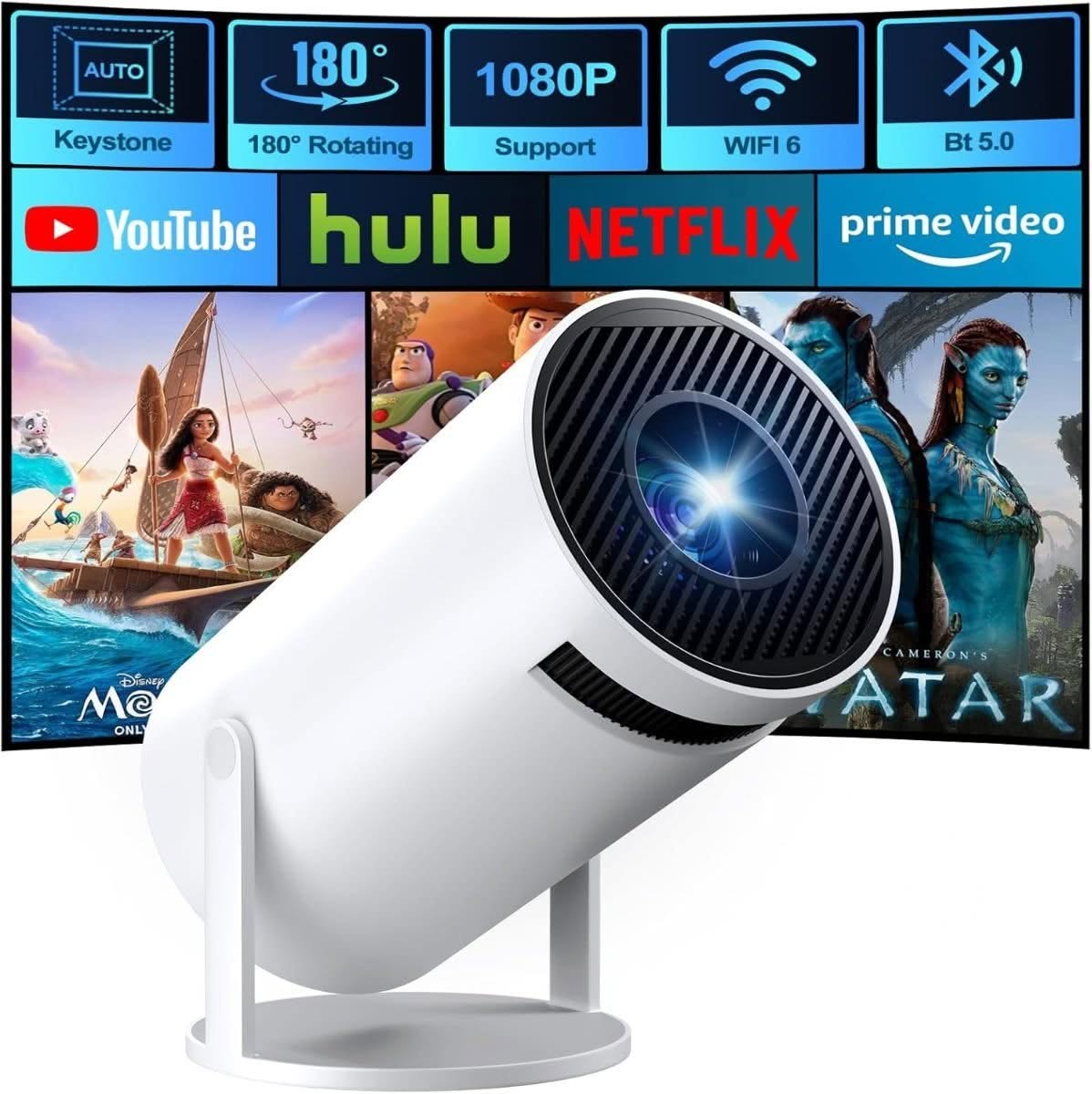
This LXJADAP mini projector is the cheapest pick in this guide, and it still packs WiFi 6, dual-channel Bluetooth 5.3 and a built-in Android TV system with apps including Netflix, YouTube and Prime Video, so it does not need a separate streaming stick to get started.
Built-in automatic keystone correction squares up the image on power-on, and a 181-degree rotating bracket lets it point at a wall, ceiling or camping screen without moving the unit itself.
The listing states Full HD 1080p playback with a 131 inch maximum image, and it connects to games consoles, laptops, phones and USB drives. The brand claims a 50,000 hour LED lifespan.
This listing does not publish an independent ANSI lumens brightness figure, only marketing claims, so treat any brightness claim on the box with caution and expect dark-room use like every other budget mini in this guide. It is a generic-brand listing rather than an established name, though it carries 406 ratings at 4.2 stars on Amazon.
Pros
- Cheapest pick in this guide
- Built-in Android TV apps, no streaming stick required
- WiFi 6 and Bluetooth 5.3
Cons
- No independent ANSI lumens figure published
- Generic brand with no independent reviews outside the Amazon listing
Key specs: Model F300; supports 1080p; WiFi 6, Bluetooth 5.3; 50,000 hour LED life.
How to choose a portable projector in NZ
Brightness (ANSI lumens). This is the single most important number and the one most often exaggerated. Budget portables in the 60 to 260 lumen range are dark-room only, around 550 lumens copes with a little ambient light, and true daytime viewing needs well over 2,000. In NZ long summer evenings, plan on starting outdoor movies after dusk.
Native versus supported resolution. Native resolution is the real pixel count of the panel; supported resolution is only the highest signal it will accept and downscale. A projector that supports 4K can still have a 720p or even 480p native panel, so check the native figure before you buy.
Smart OS or casting. Models with Google TV or Android run streaming apps on their own, while cast-only units need a phone, laptop or a stick such as a Chromecast or Fire Stick. If you would rather not fiddle with mirroring, a built-in OS is worth paying for.
Portability and power. Weight, size and a bundled tripod or bag decide how often a projector actually leaves the shelf. For off-grid backyard or camping nights, run the projector and source device from one of the best power banks so a flat battery does not end the film early.
Sound. Built-in speakers on these units are fine for casual viewing but modest for a crowd. For late-night watching that will not wake the house, connect a pair of noise-cancelling headphones to your streaming device, or add a small Bluetooth speaker.
Screen size and throw distance. Check the quoted throw distance against your room: a unit that needs 2 to 3 metres for a big image will not fill a wall in a tiny bedroom. Match the maximum screen size to how far back you can realistically place the projector.
If you are matching picture and sound together, the guide to portable radios covers the other half.
Projectors need darkness to look good, so for a bedroom or a bright kitchen a 32 inch tv gives a more usable picture at any hour.
Verdict
For most people, the Devanti Google TV projector is the best portable projector in NZ, because built-in streaming and a real native 1080p picture make it the easiest to live with. Shoppers who want cordless setup and built-in streaming should look at the battery-powered XGIMI Vibe One, while frequent travellers will prefer the tripod-equipped Portable Mini. Whatever the pick, buy for genuine native resolution and honest ANSI lumens rather than the 4K on the box, and expect a budget projector to shine after dark.
Related guides: for private listening, see the roundup of the best true wireless earbuds. For a sharper desk display, compare the top computer monitors.
FAQs
How many lumens do you need for a portable projector?
For a portable projector, aim for at least 400 to 500 ANSI lumens for comfortable night-time viewing, and 2,000 lumens or more if you want any chance of watching with ambient light. Most budget minis sit between 60 and 260 lumens, so they need a dark room. In NZ summer evenings, that often means waiting until after dusk.
Do portable projectors work in daylight?
Most portable projectors do not work well in direct daylight. Affordable models in the 60 to 550 ANSI lumen range are designed for dark or dimly lit rooms, and bright sun will wash out the picture. For a daytime backyard session in NZ, either wait until dusk, use heavy shade, or choose a projector rated well above 2,000 lumens.
Are cheap mini projectors any good?
Cheap mini projectors can be good value for casual, dark-room viewing, kids rooms and occasional backyard movies. The trade-offs are real: lower brightness, native resolution below the advertised 4K, and basic speakers. They suit relaxed use rather than a home cinema. Check the native resolution and ANSI lumens on the listing, not just the marketing name, before buying.
Are portable projectors worth it?
Portable projectors are worth it if you want a big image without a big TV, value moving between rooms or outdoors, and mostly watch in the evening. They are less worthwhile if you need daytime brightness or pin-sharp detail for work. For movie nights, gaming and casual streaming after dark, they deliver a lot for the money.
What is the best budget portable projector in NZ?
For most NZ buyers on a budget, a native 1080p mini with a built-in speaker offers the best balance of picture and price, while ultra-cheap 480p units suit only occasional or gift use. Prioritise genuine native resolution and stated ANSI lumens over headline 4K claims, and expect any budget model to need a dark room to look its best.
What is the difference between native and supported resolution?
Native resolution is the actual number of pixels a projector panel displays, such as 1080p or 720p, and it determines real sharpness. Supported resolution is simply the highest signal the projector will accept and downscale, so a unit that supports 4K may still have a 720p or even 480p native panel. Always check the native figure before buying.
Can you watch Netflix on a portable projector from your phone?
It depends on the projector. Models with built-in Google TV or Android can run the Netflix app directly. On projectors without a smart OS, mirroring Netflix from a phone often shows a black screen due to copyright protection, so a Chromecast, Fire Stick or HDMI cable usually works better than screen casting for Netflix.
What should you look for when buying a portable projector?
Focus on native resolution, ANSI lumens for real brightness, and whether it has a smart OS or needs a separate streaming stick. Then check throw distance and maximum screen size for your room, connectivity such as HDMI and WiFi bands, built-in sound, weight for portability, and the warranty. Match those to how and where you will actually watch.
