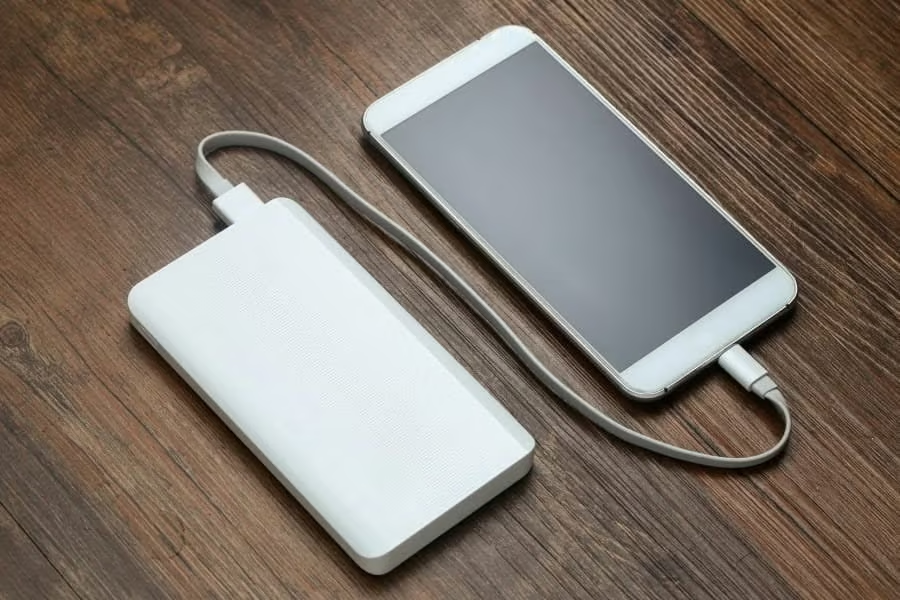
The best power bank in NZ overall is the Anker 10,000mAh 30W model, which has a USB-C cable built into the body and pushes up to 30W, enough for Anker to quote an iPhone 16 Pro Max reaching 50 percent in about 27 minutes. A charged bank is also what you want in the bottom of a bag when a storm takes the power out for a day, which happens often enough here to make capacity worth more than slimness.
A good power bank means you are never caught with a dead phone mid-day, whether that is during travel, at a festival, or just a long day away from a wall outlet. We compared seven power banks, from simple everyday chargers through to a high-wattage laptop-capable bank and magnetic MagSafe-style options, to help match a bank to how you actually use it.
Each pick below is grouped by what it does best rather than by price alone, covering everyday phone top-ups, multi-day capacity, fast laptop charging, and slim or magnetic designs.
Quick comparison
| Power Bank | Best For | Capacity | Max Output |
|---|---|---|---|
| Anker 10,000mAh 30W | Best Overall | 10,000mAh | 30W |
| INIU 20,000mAh 22.5W | Best Compact High-Capacity | 20,000mAh | 22.5W |
| Belkin BoostCharge 20,000mAh | Best for Mixed USB-A / USB-C | 20,000mAh | 15W (USB-C, shared) |
| UGREEN 100W | Best Fast-Charging | 20,000mAh | 100W |
| Anker Nano MagGo 5,000mAh | Best Wireless / MagSafe | 5,000mAh | 15W magnetic, 20W USB-C |
| INIU 10,000mAh 45W | Best Compact 45W | 10,000mAh | 45W |
| INIU Qi2 10,000mAh | Best Slim Magnetic | 10,000mAh | 15W magnetic, 45W wired |
1. Anker Power Bank 10,000mAh 30W – Best Overall
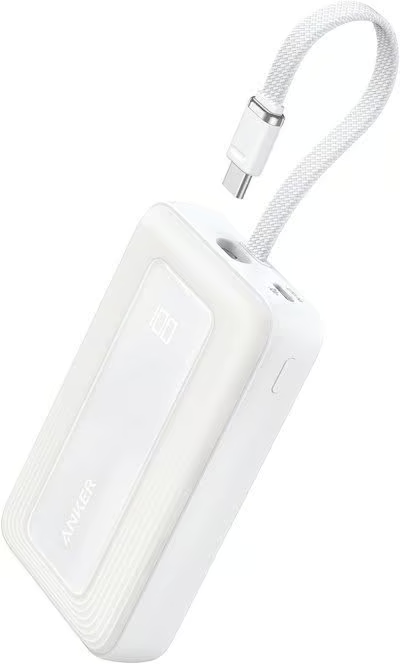
Anker’s 10,000mAh power bank has a 13.7cm USB-C cable built into the body, so a phone, tablet or laptop can be plugged in without carrying a separate lead. The same USB-C connection handles recharging the bank, with up to 30W output and up to 20W input, and Anker quotes an iPhone 16 Pro Max reaching 50 percent in about 27 minutes.
The body measures 11 x 6.6 x 2.5cm and weighs 223 grams, small enough for a jacket pocket. The built-in cable is tested to 10,000 bends, and Anker puts the capacity at about two full charges for an iPhone 15. It is sold as a single unit with an 18-month warranty.
Pros
- Built-in USB-C cable means no separate lead to carry
- Up to 30W output, quick enough to take a recent iPhone to about 50 percent in under half an hour (Anker’s figure)
- Two-way USB-C charging, with up to 20W input to refill the bank itself
- Compact 223g body backed by a large review base (15,460 reviews at 4.6 stars)
Cons
- 10,000mAh is about two phone charges at best, not a multi-day supply
- The built-in cable is short at 13.7cm and cannot be swapped if it wears out
- The 18-month warranty is shorter than the three years offered by some rivals in this list
Key specs: 10,000mAh capacity, up to 30W output and 20W input over USB-C, built-in 13.7cm USB-C cable, 11 x 6.6 x 2.5cm, 223g, 18-month warranty.
2. INIU 20,000mAh 22.5W Power Bank – Best Compact High-Capacity Pick
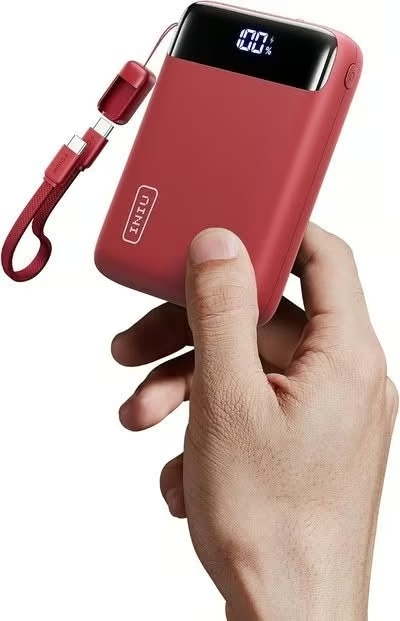
INIU’s 20,000mAh power bank is pitched as a compact take on that capacity, at 10.4 x 7 x 2.9cm and about 314 grams. It has two USB-C ports that work for input and output plus one USB-A output, and a detachable nylon lanyard doubles as its USB-C cable. INIU quotes 22.5W fast charging taking a Samsung S25 to 70 percent in 25 minutes.
A flashlight is built in, the listing mentions a digital display, and the capacity sits within common airline carry-on limits. INIU also notes that a bank delivers roughly 60 to 70 percent of its rated capacity to a phone, so expect about 12,000 to 14,000mAh of real output. The warranty runs for three years.
Pros
- 20,000mAh of capacity in a body 2.9cm thick
- 22.5W fast charging, with two USB-C ports and one USB-A port
- Detachable lanyard cable and a built-in flashlight
- Three-year warranty and a very large review base (31,303 reviews at 4.7 stars)
Cons
- At about 314g it is noticeably heavier than the 10,000mAh banks in this list
- 22.5W is fine for phones and tablets but too slow for a laptop
- The lanyard cable is USB-C, so an iPhone with a Lightning port needs its own cable
Key specs: 20,000mAh capacity, 22.5W fast charging, 2x USB-C (input/output) plus 1x USB-A, detachable USB-C lanyard cable, flashlight, 10.4 x 7 x 2.9cm, about 314g, 3-year warranty.
3. Belkin BoostCharge 20,000mAh – Best for Mixed USB-A and USB-C Devices
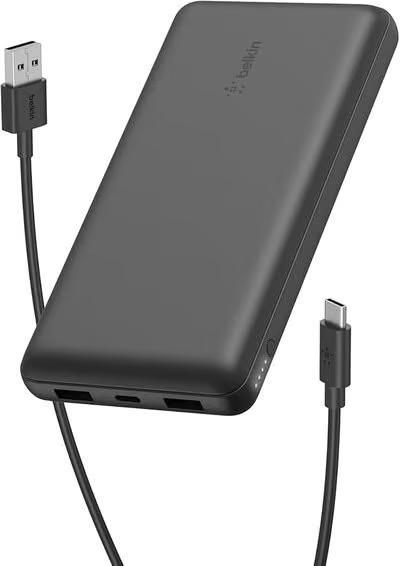
Belkin’s BoostCharge 20,000mAh bank has three ports, one USB-C and two USB-A, so up to three devices can charge at the same time and older USB-A cables stay useful. Belkin quotes about 78 hours of extra smartphone battery life, enough for several days away from a wall socket.
The USB-C port can charge two devices at once with up to 15W shared, while a third device draws from the remaining USB-A port at up to 12W. A 6-inch USB-C to USB-A cable is in the box, an LED indicator shows the charge status, and there is overcharge protection and a 2-year warranty.
Pros
- 20,000mAh capacity with three ports for charging up to three devices together
- Two USB-A ports alongside USB-C, handy for older cables and accessories
- LED indicator and overcharge protection
- Large review base (5,674 reviews) and a 2-year warranty
Cons
- The 15W USB-C output is shared and modest next to the faster banks in this list, and it will not charge a laptop usefully
- The included cable is only 6 inches long and USB-A to USB-C, so a USB-C to USB-C lead is a separate purchase
- At 4.3 stars it has the lowest average rating of the 20,000mAh picks here
Key specs: 20,000mAh capacity, up to 15W on USB-C (shared) plus up to 12W on USB-A, 1x USB-C and 2x USB-A ports, 6-inch USB-C to USB-A cable included, LED indicator, 2-year warranty.
4. UGREEN 100W Power Bank 20,000mAh – Best Fast-Charging Pick
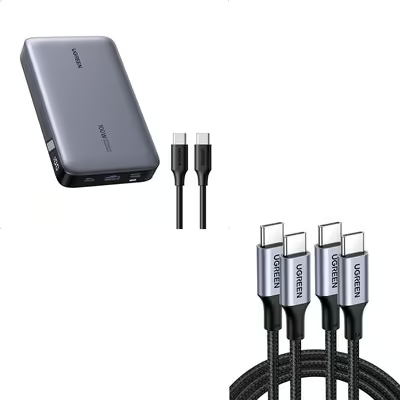
UGREEN’s Nexode 100W bank pairs a 20,000mAh cell with a 100W USB-C port for laptops, a second 30W USB-C port and a 22.5W USB-A port. UGREEN quotes a 16-inch MacBook Pro reaching 42 percent in 30 minutes and an iPhone 15 reaching 60 percent in the same time, and a digital LED screen shows the remaining charge.
This listing is a bundle that adds two 1m 100W USB-C to USB-C cables. The housing is aluminium, and UGREEN describes the bank as about 20 percent lighter than similar power banks. It quotes roughly 4.5 charges for an iPhone 15 Pro or 1.1 charges for a 15-inch MacBook Air.
Pros
- 100W USB-C output can fast-charge a laptop, not just a phone
- Three ports (100W and 30W USB-C, 22.5W USB-A) for charging several devices at once
- Digital display shows the remaining battery level
- Bundle includes two 1m 100W USB-C cables
Cons
- Only 21 reviews so far, a thin sample for a 4.9-star average
- The listing states it does not support video output
- The 20,000mAh and 100W design is bigger and heavier than a slim everyday bank
Key specs: 20,000mAh capacity, 100W max on USB-C1 plus 30W USB-C2 and 22.5W USB-A, LED digital display, aluminium housing, bundled with two 1m 100W USB-C cables, no video output.
5. Anker Nano MagGo Power Bank 5,000mAh – Best Wireless / MagSafe-Style Pick
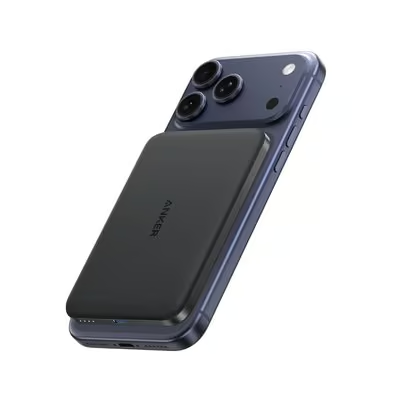
Anker’s Nano MagGo is a 5,000mAh bank only 0.9cm thick (about 10.2 x 7.1cm) that snaps onto the back of an iPhone for Qi2 magnetic charging at up to 15W. In Anker’s own testing an iPhone 16 Pro reaches 25 percent in 42 minutes, so it works as a top-up rather than a quick refill.
A USB-C port with up to 20W output covers wired charging, and a USB-C to USB-C cable is in the box. Anker lists graphene cooling and dual temperature sensors to keep the bank below 40°C in use, and it is built for the iPhone 12 to 17 series.
Pros
- Qi2 magnetic attachment charges an iPhone without a cable, at up to 15W
- Very slim at 0.9cm, easy to carry
- USB-C port for wired charging at up to 20W, with a cable included
- Established brand and a sizeable review base (3,496 reviews at 4.3 stars)
Cons
- 5,000mAh is a light-use capacity, a partial top-up rather than a full extra charge
- Magnetic charging is slower than wired, and Anker’s own figure is 25 percent in 42 minutes
- The magnetic hold is aimed at iPhone 12 to 17, so other phones are limited to the USB-C cable
Key specs: 5,000mAh capacity, 15W Qi2 magnetic wireless charging, up to 20W USB-C, 10.2 x 7.1 x 0.9cm, USB-C to USB-C cable included, for iPhone 12 to 17 series.
6. INIU 10,000mAh 45W Power Bank – Best Compact 45W Pick
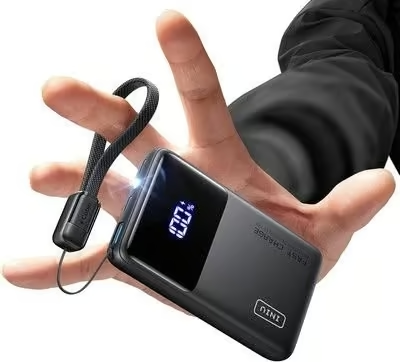
INIU’s 10,000mAh bank puts up to 45W through USB-C, enough to charge phones, tablets and handheld consoles quickly, and INIU quotes an iPhone 17 Pro reaching 65 percent in 30 minutes. It has two USB-C ports and one USB-A port, and a detachable nylon lanyard works as the cable.
The body measures 11.2 x 6.9 x 1.8cm, which INIU describes as 27 percent smaller than comparable banks. A fold-out phone stand and a flashlight are built in, the listing mentions a digital display, and INIU quotes about two iPhone charges from a full bank. The warranty runs for three years.
Pros
- Up to 45W output, fast enough for tablets and handheld consoles as well as phones
- Three ports (2x USB-C, 1x USB-A) and a detachable lanyard cable
- Built-in phone stand and flashlight
- Three-year warranty and a strong review record (1,574 reviews at 4.8 stars)
Cons
- 10,000mAh is about two phone charges, not a multi-day supply
- The 45W peak needs a compatible USB-C device, and most phones will charge more slowly
- It is not a laptop bank in the way the 100W UGREEN is
Key specs: 10,000mAh capacity, up to 45W output, 2x USB-C plus 1x USB-A, detachable USB-C lanyard cable, built-in stand and flashlight, digital display, 11.2 x 6.9 x 1.8cm, 3-year warranty.
7. INIU Qi2 Magnetic Power Bank 10,000mAh – Best Slim Magnetic Pick
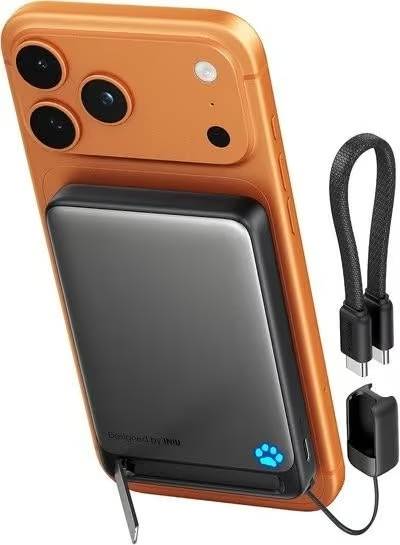
INIU’s Qi2 power bank is a 10,000mAh magnetic model only 1.4cm thick (10.5 x 7cm), with up to 15W Qi2 wireless charging for iPhones. A short USB-C cord (the GoCord) snaps onto the body for wired charging at up to 45W, and INIU quotes an iPhone 17 Pro going from 20 to 54 percent in 25 minutes wirelessly.
A foldable stand lets the phone sit upright for calls or StandBy mode. The bank is optimised for the iPhone 12 to 17 and Air series, while other phones can charge wirelessly but without the magnetic hold or peak speed. A 12cm cord is in the box and the warranty runs for three years.
Pros
- Qi2 magnetic charging at up to 15W with no cable needed
- 10,000mAh of capacity in a body 1.4cm thick
- Wired charging at up to 45W through the snap-on USB-C cord
- Foldable stand, three-year warranty and 2,615 reviews at 4.5 stars
Cons
- The magnetic hold and peak wireless speed are aimed at iPhones, not Android phones
- At 1.4cm it is thicker than the 5,000mAh Anker MagGo above
- The included cord is only 12cm long, so a longer lead is a separate purchase
Key specs: 10,000mAh capacity, 15W Qi2 magnetic wireless charging, up to 45W wired via the USB-C GoCord, foldable stand, 10.5 x 7 x 1.4cm, 12cm cord included, 3-year warranty.
How to choose a power bank
Start with capacity. A 5,000mAh bank is enough for a partial top-up or two, a 10,000mAh bank generally covers one to two extra charges for a phone, and a 20,000mAh bank can get a phone through several days.
Check the output wattage next. A phone charges fine from any of the banks here, but a laptop needs a higher-wattage USB-C port, generally 65W or more, to charge at a useful speed rather than just trickle-charging.
Think about how many ports you need and whether a built-in cable matters to you. A bank with a built-in or attached USB-C cable, like the Anker 10,000mAh or the INIU lanyard models, means one less cable to pack, while a bank with multiple ports lets you charge more than one device from the same bank at once.
One practical point: lithium power banks are often restricted for international shipping, so check that the one you want can be delivered to your address before ordering.
Finally, consider the format. A magnetic MagSafe-style bank like the Anker Nano MagGo or the INIU Qi2 model is convenient for topping up a recent iPhone without a cable, though the magnetic hold is built around iPhones, while a plain bank with several ports suits mixed devices better.
If you are comparing across the range, the guides to phones for seniors, Spark mobile phones and cheap smartphones are worth a look.
For short outages a power bank may be enough, and generators for emergencies is the next step up.
Verdict
For most people, the Anker 10,000mAh 30W power bank is the easiest all-rounder, its built-in cable and up to 30W output covering daily use without an extra lead to lose.
Anyone who also wants to charge a laptop should look at the UGREEN 100W bank. For several days of capacity, the INIU 20,000mAh is the more compact choice, while the Belkin BoostCharge 20,000mAh suits anyone who wants a mix of USB-A and USB-C ports. For a cable-free top-up on a recent iPhone, the Anker Nano MagGo is the thinnest and the INIU Qi2 10,000mAh holds more charge.
FAQs
How many watts is best for a power bank?
15-30W is plenty for charging a phone or tablet at a reasonably fast speed. If you also want to top up a laptop, look for at least 65W, and ideally 100W, on the USB-C port.
Can I carry a 20,000mAh power bank on a flight?
Most airlines allow power banks up to 100Wh (roughly a 27,000mAh bank at 3.7V) in carry-on luggage, but not in checked bags. A 20,000mAh bank sits comfortably under that limit, but always check your specific airline’s rules before flying.
What does mAh actually mean for how many charges I get?
mAh measures the battery’s raw capacity, but the actual number of charges you get is lower than a straight capacity comparison suggests, since some energy is lost converting between the bank’s voltage and your device’s battery. As a rough guide, expect a bank to deliver about 60-70% of its rated mAh to your phone.
Does fast charging damage my phone’s battery over time?
Modern phones and power banks negotiate a safe charging speed automatically, and features like Power Delivery (PD) are designed to protect the battery from excess heat. Consistently keeping a phone at a very low or a full 100% charge tends to affect long-term battery health more than the charging speed itself.
Can I use a power bank while it is charging?
Many modern power banks support pass-through charging, meaning you can plug the bank into the wall and charge a phone from it at the same time. Check the specific listing if this matters, as some banks handle simultaneous charging less gracefully than others.
How long do power banks typically last before the battery degrades?
Most lithium-ion power banks are rated for around 300-500 full charge cycles before their capacity drops meaningfully, which for typical use works out to roughly 1-2 years of regular use. Keeping a bank away from extreme heat and avoiding letting it sit fully drained for long periods helps it last closer to the upper end of that range.

Tһere is definately a lot to learn about this topic.
I love all the points you have made.