
The best all-round security camera in NZ from this lineup is the 4G Solar Dual-Lens PTZ Camera, thanks to its honest 4MP clarity, automatic motion tracking, built-in siren and fully solar, wire-free running. That said, the right camera depends entirely on the job: solar and 4G models win where there is no power or broadband, while wired DVR kits give the most reliable local recording for a whole house.
This guide compares eight security cameras available in New Zealand, from off-grid 4G solar units to a multi-camera NVR system, wire-free battery cameras and a budget indoor monitor. Each pick is rated for what it actually does well, with the honest trade-offs spelled out, so shoppers can match a camera to their property rather than the marketing. Testers and owners of the same hardware informed every verdict below.
A quick reality check runs through the whole category: cheap DVR kits usually ship without a hard drive, several wireless kits are camera-only and need a separate recorder, and 4G models need a data SIM. Those details are flagged clearly for each product so there are no surprises after checkout.
Quick Comparison
| # | Camera | Type | Best for |
|---|---|---|---|
| 1 | 4G Solar Security Camera with Remote Control | 4G solar, single | App-free simplicity |
| 2 | 4G Solar Dual-Lens PTZ Camera | 4G solar dual-lens PTZ | All-round solar pick |
| 3 | 4G LTE Dual-Lens 4K PTZ Camera | 4G LTE dual-lens PTZ | Off-grid rural sites |
| 4 | Hiseeu 4-Camera Wireless NVR System | Wireless NVR kit, 4 PTZ cameras | Whole-home coverage |
| 5 | Tapo C510W Outdoor Pan-Tilt Camera | Outdoor pan-tilt WiFi | Standalone outdoor camera |
| 6 | Tapo C200 Indoor Camera (2-Pack) | Indoor pan-tilt WiFi | Budget indoor monitor |
| 7 | ieGeek 2K Battery Camera (2-Pack) | Battery WiFi, wire-free | Wire-free install |
| 8 | ANNKE 2.5K Solar PTZ Camera | Solar WiFi pan-tilt | Solar WiFi coverage |
1. 4G Solar Security Camera – Best for App-Free Simplicity
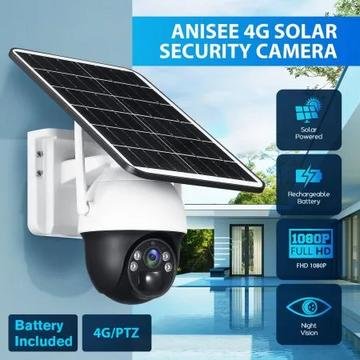
The 4G Solar Security Camera with Remote Control suits the shopper who wants eyes on a driveway or gate without pulling cable or fiddling with a phone app. It is a single wire-free outdoor unit that runs on a rechargeable battery topped up by an attached solar panel, and it talks to the mobile network over 4G rather than home WiFi, so it can sit well away from the house.
The stand-out physical touch is the bundled infrared remote control, which is unusual in this category where almost everything is controlled from a smartphone. That makes basic operation approachable for less tech-confident owners. It carries over the familiar solar-camera hardware: infrared night vision, motion-triggered recording, a microSD slot for local footage, and an optional cloud plan. It is the only solar model in this lineup with genuine buyer reviews on the New Zealand listing, which offers a small measure of reassurance.
The honest trade-off is that this is the oldest and lowest-spec unit here. The retailer does not publish a resolution figure, there is no dual lens or listed pan-and-tilt, and like every cellular camera it needs a data-enabled SIM plus, for many owners, a cloud subscription to unlock full playback.
Pros
- Wire-free solar power, no cabling to run
- Physical remote control for app-free use
- Works over 4G where there is no WiFi
- Has real buyer reviews on the NZ listing
Cons
- No published resolution or dual-lens option
- Needs a data SIM and often a cloud plan
- Oldest, most basic model in this guide
Key specs: Type: single 4G solar/battery outdoor camera. Power: rechargeable battery plus solar panel. Connectivity: 4G LTE (micro-SIM required). Storage: microSD plus optional cloud. Extras: infrared remote control, IR night vision, motion detection. Model reference: bestdeals PID 49806.
2. 4G Solar Dual-Lens PTZ Camera – Best All-Round Solar Camera
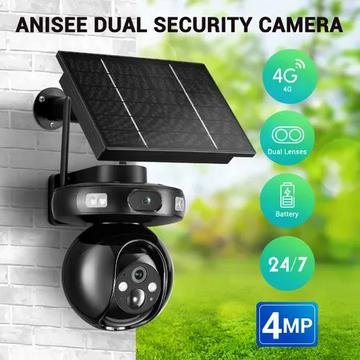
The 4G Solar Dual-Lens PTZ Camera is the most complete off-grid pick in this guide, and its 4MP sensor rating is refreshingly honest rather than the inflated 4K claims common at this price. The pan-tilt head sweeps roughly 355 degrees horizontally and 90 degrees vertically, so one camera can watch a whole yard or driveway instead of a single fixed angle. A dual-lens setup pairs a wide view with a closer secondary lens, and a PIR motion sensor drives AI human tracking that pans to follow movement.
Owners of this V380-family hardware highlight the deterrence features: two-way audio, a built-in siren, and a white-light spotlight that can switch night footage from grey infrared to full colour. Night vision reaches around 35 metres in testing. It runs on solar plus battery with a 12V backup option, and the IP66-rated white plastic body with a black gimbal head is built to shrug off Kiwi weather.
The catch is software. The V380 Pro app draws recurring complaints about lag, ad-heavy logins and occasional offline drops, and the PIR sensor uses a fixed threshold rather than true AI classification, so swaying foliage and shadows can trigger false alerts. Winter sun also slows solar charging.
Pros
- Honest 4MP resolution, not inflated 4K
- PTZ head plus AI human tracking covers a wide area
- Siren, spotlight and two-way audio deter intruders
- IP66 weatherproof, solar with 12V backup
Cons
- V380 Pro app can be laggy and ad-heavy
- PIR motion prone to false alerts from foliage
- Needs a data SIM; solar slows in winter
Key specs: Type: single 4G solar dual-lens PTZ camera. Resolution: 4MP. PTZ: approx 355 degrees pan, 90 degrees tilt. Night vision: IR to ~35m plus colour spotlight. Rating: IP66. Storage: microSD to 128GB plus cloud. App: V380 Pro. Model reference: bestdeals PID 84826.
3. 4G LTE Dual-Lens 4K PTZ Camera – Best for Off-Grid Rural Sites
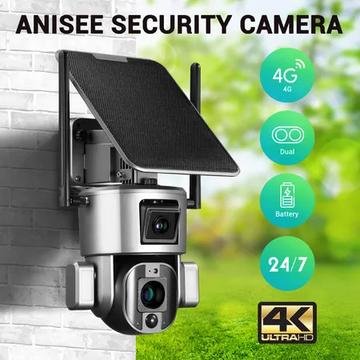
The 4G LTE Dual-Lens 4K PTZ Camera is aimed squarely at properties with no broadband: a rural gate, a bach, a lifestyle block or a worksite. It runs entirely on solar and battery power and connects through a 4G micro-SIM, so it needs neither mains power nor a home router to send live video and alerts. The dual-lens design pairs a wide-angle view with a zoom lens, and the motorised PTZ head lets owners scan across a paddock or long driveway.
Installation is where this camera earns its keep. Owners describe a genuinely quick, no-cabling setup, often mounted and running within minutes using the supplied bracket and screws, with the solar panel on an extension lead so it can chase the sun. Two-way audio, a siren and a spotlight round out the deterrent toolkit.
Be realistic about the 4K badge. The physically identical hardware family uses roughly 3MP sensors, so images soften on heavy zoom and low light is only average despite the marketing. The bigger caution for New Zealand buyers is connectivity: spec sheets for this family list Australian Telstra and Optus bands, so local LTE band support is not guaranteed, SIM and APN setup is the most common complaint, and full replay usually needs a cloud plan.
Pros
- True off-grid running on solar and 4G
- Dual-lens plus PTZ scans large areas
- Fast, no-cabling DIY installation
- Siren, spotlight and two-way audio
Cons
- “4K” is marketing; real sensor is about 3MP
- AU LTE bands listed, so NZ support not guaranteed
- SIM and APN setup can be fiddly; cloud plan for replay
Key specs: Type: single 4G LTE solar dual-lens PTZ camera. Resolution: marketed 4K, hardware approx 3MP. Connectivity: 4G LTE (micro-SIM). Power: solar plus rechargeable battery. Storage: microSD plus optional cloud. Model reference: bestdeals PID 61345.
4. Hiseeu Wireless Security Camera System – Best Complete System for Whole-Home Coverage
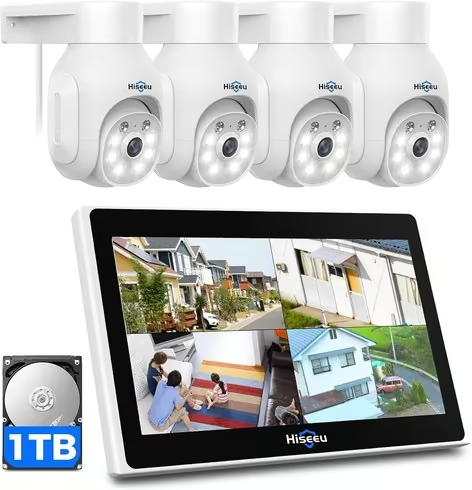
For owners who want several cameras and local recording from one box, the Hiseeu Wireless Security Camera System is the most complete kit in this list. It pairs four 5MP pan-tilt outdoor cameras with a 10-channel wireless NVR that has a 10-inch LCD screen built in, so footage can be checked at the recorder without plugging in a TV or computer. A 1TB hard drive is included, which is unusual for a kit at this level.
Each camera has a 121-degree view, can pan and tilt from the app, and follows a person automatically once it detects them. Night vision switches between colour and infrared modes, and two-way audio plus a light and sound alarm let you talk to or warn off visitors. Recording is continuous, and H.265+ compression stretches the 1TB drive to around a month of loop recording. Remote viewing and alerts run through the Eseecloud app with no monthly fee.
Wireless here means no video cables, not no cables at all. Every camera still needs a power lead to a nearby socket, and the system runs on 2.4GHz WiFi only, so cameras mounted a long way from the NVR or behind several walls can lose signal. The listing also quotes night vision range inconsistently, so treat the longer figure as a best case. The six spare channels leave room to add cameras later.
Pros
- Four 5MP pan-tilt cameras with auto tracking
- NVR with built-in 10-inch screen and 1TB drive
- Two-way audio and light and sound alarm
- No subscription; six spare channels
Cons
- Each camera still needs a power point nearby
- 2.4GHz WiFi only; signal drops through walls
- Night vision range quoted inconsistently
Key specs: Type: 10-channel wireless NVR kit with 4 pan-tilt cameras. Resolution: 5MP. View: 121 degrees, pan and tilt with auto tracking. Night vision: colour and infrared modes. Storage: 1TB HDD included. Screen: 10-inch LCD on the NVR. WiFi: 2.4GHz. Rating: IP66. App: Eseecloud. Model: WK-10VP-4HD405-AT.
5. Tapo C510W Outdoor Pan-Tilt Camera – Best Standalone Outdoor WiFi Camera

The Tapo C510W suits buyers who want one capable outdoor camera that works on its own, with no recorder or hub to buy. It is a TP-Link pan-tilt unit that turns 360 degrees horizontally and 130 degrees vertically, so a single camera on the corner of the house can watch a driveway and a side path.
It records 2K (2304 by 1296) video, and built-in spotlights give full-colour night vision. Person detection and AI tracking are free and keep a moving subject in frame, and the sound and light alarm can play a message you record yourself. Footage saves to a microSD card of up to 512GB, so 24/7 recording works without a cloud plan. The housing is IP65 rated and TP-Link backs it with a two-year warranty.
It runs from a 12V mains adapter, so you need a power point within reach of the mounting spot, and your home WiFi has to reach that far too. The microSD card is not included, and the domed pan-tilt head is bulkier and more obvious on a wall than a small fixed bullet camera.
Pros
- Covers 360 degrees from one mounting point
- Free person detection and AI tracking
- Colour night vision with spotlights
- Local microSD recording, no monthly fee
Cons
- Needs a power point near the mounting spot
- microSD card sold separately
- Bulky, visible pan-tilt body
Key specs: Type: outdoor pan-tilt WiFi camera. Resolution: 2K 3MP (2304×1296). Coverage: 360 degrees horizontal, 130 degrees vertical. Night vision: full colour with spotlights. Storage: microSD up to 512GB (not included). Rating: IP65. Power: 12V adapter. Warranty: 2 years. Model: Tapo C510W.
6. Tapo C200 Pan-Tilt Indoor Camera (2-Pack) – Best Budget Indoor Camera

The Tapo C200 two-pack is the budget pick for watching inside the house, whether that is a nursery, a pet or the front hallway. You get two small white pan-tilt cameras, so two rooms are covered from the start. Each head turns 360 degrees horizontally and 114 degrees vertically, letting one camera sweep most of a room.
Video is 1080p, with infrared night vision to around 9 metres. Free AI detection picks out motion, people and a crying baby, and the camera can follow movement as it happens. Recording goes to a microSD card of up to 512GB, the cameras work with Alexa and Google Assistant, and there is no hub to buy. TP-Link covers them with a two-year warranty.
These are indoor cameras, so they are not a choice for eaves or a driveway. 1080p is fine for checking on a room but turns soft when you zoom in for detail. Each camera needs its own power lead to a socket, and the microSD cards are not included.
Pros
- Two cameras in one box
- Pan and tilt sweeps a whole room
- Free person and baby-cry detection
- Works with Alexa and Google Assistant
Cons
- Indoor use only
- 1080p only; soft when zoomed
- microSD cards sold separately
Key specs: Type: indoor pan-tilt WiFi camera, pack of two. Resolution: 1080p. Coverage: 360 degrees horizontal, 114 degrees vertical. Night vision: IR to ~9m. Detection: motion, person and baby cry, with tracking. Storage: microSD up to 512GB (not included). Warranty: 2 years. Model: Tapo C200P2.
7. ieGeek 2K Battery Camera (2-Pack) – Best Wire-Free Outdoor Camera
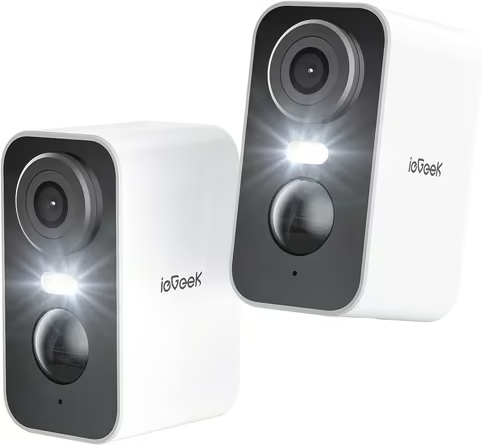
The ieGeek 2K Battery Camera two-pack is the simplest outdoor install here, because there are no cables at all. Each camera runs on a rechargeable battery and joins your home WiFi, so it can go on a fence, a shed or under an eave in a few minutes and be moved later without redoing any wiring.
Video is 2K. A PIR motion sensor works with AI person detection to cut down false alerts, and at night a spotlight switches on with movement so the clip records in colour, with infrared as the other mode. A siren, two-way talk and phone notifications round out the features, and it works with Alexa. Clips save to a microSD card of up to 128GB or to the optional cloud service.
The quoted battery life of up to four months per charge assumes light activity, so a busy driveway will need charging more often. The matching solar panel that would fix that is sold separately, as is the microSD card. Like most battery cameras, these record clips when motion is detected rather than recording around the clock.
Pros
- Completely wire-free install
- Two cameras in one box
- Colour night video with spotlight and siren
- PIR plus person detection cuts false alerts
Cons
- Battery life drops with frequent motion
- Solar panel and microSD card sold separately
- Records motion clips only, not 24/7
Key specs: Type: battery-powered outdoor WiFi camera, pack of two. Resolution: 2K. Power: rechargeable battery (solar panel optional, not included). Detection: PIR with AI person detection. Night vision: colour with spotlight, or infrared. Audio: two-way. Storage: microSD up to 128GB (not included) or cloud. Smart home: Alexa.
8. ANNKE 2.5K Solar Pan-Tilt WiFi Camera – Best Solar WiFi Camera
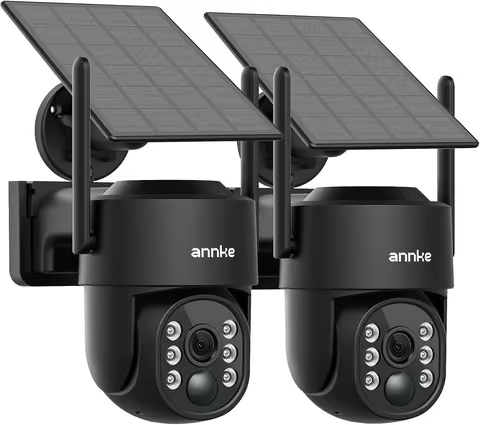
The ANNKE 2.5K Solar Camera is the pick for spots with WiFi coverage but no power point, such as a gate, a garage or the back of a section. A 3W solar panel keeps the built-in battery topped up, so once it is mounted there is no charging routine, and the pan-tilt head turns 270 degrees horizontally and 90 degrees vertically to cover a wide area.
Resolution is 2.5K (2560 by 1440), the sharpest of the WiFi cameras here, and built-in spotlights give colour night vision to around 8 metres. A PIR sensor with adjustable sensitivity triggers recording and alerts, and two-way audio lets you speak through the camera. It connects on 2.4GHz or 5GHz WiFi, is rated IP65 for -20 to 50 degrees Celsius, and saves to a microSD card of up to 256GB or an optional cloud plan.
Unlike the 4G picks above, it still needs your home WiFi to reach the mounting spot, which limits how far from the house it can go. Solar charging slows on short, grey winter days, so place the panel where it gets the most sun. The microSD card is extra, and the listing title says two-pack while its spec table lists one camera, so check the quantity before ordering.
Pros
- Solar powered, no cables to run
- 2.5K resolution with colour night vision
- Dual-band 2.4GHz and 5GHz WiFi
- Pan-tilt covers a wide area
Cons
- Needs home WiFi at the mounting spot
- Solar charging slows in winter
- Pack quantity unclear on the listing
Key specs: Type: solar-powered pan-tilt WiFi camera. Resolution: 2.5K (2560×1440). Power: 3W solar panel plus built-in battery. Coverage: 270 degrees horizontal, 90 degrees vertical. Night vision: colour to ~8m. WiFi: 2.4GHz and 5GHz. Rating: IP65, -20 to 50C. Storage: microSD up to 256GB (not included) or cloud. Model: I81BV.
How to Choose a Security Camera in NZ
Start with power and connectivity, because they narrow the field fastest. If a spot has no mains power or WiFi, a solar-and-4G camera like the picks above is the only realistic option, but it needs a data SIM and, for these models, ideally a New Zealand carrier band check before buying. Where mains power and cabling are available, a wired DVR kit gives the most dependable recording and no subscriptions.
Match resolution to purpose. For identifying faces or plates, aim higher, but be sceptical of 4K claims on budget solar cameras where the real sensor is often around 3MP. For general presence detection, 1080P is fine. Owners weighing portable power for off-grid sites may also find the guides to portable solar panels and power banks useful for keeping gear topped up.
Check the fine print on kits. Many budget DVR and NVR systems do not include a hard drive, and some wireless cameras are sold as add-ons that need an existing compatible recorder. Confirm an IP65 or higher rating for anything mounted outdoors, and remember most budget WiFi cameras join 2.4GHz networks only. For a broader view of weatherproof options, compare this list against a dedicated roundup of outdoor security cameras.
Finally, weigh the ongoing costs and ecosystem. Cloud playback is often a paid add-on, 4G cameras need a data plan, and mixing camera brands and apps can cause pairing headaches. Shoppers who want everything controlled from one phone should also sanity-check compatibility with their smartphones before committing to an app-driven system.
To cover the rest of the house, the guides to smart doorbells, smoke alarms and outdoor security cameras are worth a look.
Security footage is built for evidence rather than photographs, and even a cheap digital camera will out-resolve any of these for anything you actually want to keep.
Verdict
For most New Zealand households wanting genuine flexibility, the 4G Solar Dual-Lens PTZ Camera is the standout: honest 4MP video, pan-tilt tracking, a siren and full solar running make it the easiest camera to place anywhere. Rural and off-grid buyers should look hard at the 4G LTE Dual-Lens 4K PTZ Camera for its no-cabling install, keeping the band-compatibility caveat in mind.
If you want several cameras recording to one box, the Hiseeu Wireless Security Camera System covers a whole property with four pan-tilt cameras, a screen-equipped NVR and a 1TB drive included. Renters and single-room watchers are well served by the Tapo C200 indoor two-pack, while the Tapo C510W, the wire-free ieGeek battery cameras and the ANNKE solar camera suit single outdoor spots within reach of home WiFi.
FAQs
Do home security cameras need WiFi?
Not always. Many cameras use WiFi for live viewing, alerts and cloud backup, but wired DVR and NVR systems record on-site without internet, and 4G models use a mobile SIM instead. If watching a live feed from your phone matters, you need WiFi or 4G; for pure recording, a wired setup works fine.
Are 4G security cameras a good choice for rural NZ?
Yes, for properties without broadband a 4G camera is often the only option, using a mobile SIM like a phone to send video and alerts. They suit farms, baches and gates. Check the camera supports New Zealand carrier bands before buying, and budget for a data plan and usually a cloud subscription for replay.
Are home security cameras legal in New Zealand?
Yes, home security cameras are legal in NZ, but they must comply with privacy law. You can film your own property, but avoid capturing neighbours’ private areas or public spaces. Audio recording is more legally sensitive than video, which is why many CCTV systems disable microphones by default. Use footage responsibly.
What resolution do I need for a security camera?
For general presence detection, 1080P is adequate. To reliably identify faces or number plates, choose higher resolution and place cameras close to entry points. Be cautious with budget 4K claims on solar cameras, as the real sensor is often around 3MP, so image quality softens on zoom and in low light.
Do solar security cameras work through a NZ winter?
Generally yes. Most of New Zealand gets over 2000 hours of sun a year, enough to keep a solar camera charged. Charging does slow in short, overcast winter days, so mount the panel where it catches maximum sun, and choose a model with a large battery or a 12V backup input for reliability.
Do CCTV DVR kits come with a hard drive?
Often not. Many budget DVR and NVR kits ship without a hard drive, so they cannot record until you add one, although the Hiseeu system in this guide comes with a 1TB drive. Kits without one typically accept a standard SATA drive up to 6TB. Factor the extra cost in when comparing prices, and buy a surveillance-rated drive if possible.
