
The best unlocked phone for Spark NZ shoppers overall is the Samsung Galaxy A57 5G, thanks to its flagship-level AMOLED display, six years of security updates and IP68 durability at a mid-range price. Spark shut down its 3G network on 31 March 2026, so any phone bought new needs 4G Band 28 (700MHz) and Band 3 (1800MHz) support, plus VoLTE, to make calls and send texts on Spark’s network, and a 5G-ready handset should also support n78 and n40 for full speed. Every phone below is sold unlocked, meaning it isn’t tied to any one carrier, so it can be set up with a Spark SIM or eSIM straight out of the box. This guide covers nine unlocked phones across every budget, from ultra-cheap 4G basics to near-flagship 5G, with the trade-offs tested to help NZ shoppers pick the right one for Spark.
This guide sits alongside our wider smartphones buying guide for anyone weighing up options beyond Spark compatibility.
Quick Comparison
| Phone | Best for | Display | Battery | Storage |
|---|---|---|---|---|
| Samsung Galaxy A57 5G | Best overall | 6.7″ Super AMOLED+, 120Hz | 5,000mAh | 256GB |
| Samsung Galaxy A36 5G | Best mid-range all-rounder | 6.7″ Super AMOLED, 120Hz | 5,000mAh | 128GB |
| Google Pixel 10a 5G | Best camera & software | 6.3″ OLED, 120Hz | 5,100mAh | 128GB |
| moto g86 Power 5G | Best battery life & durability | 6.7″ pOLED | 6,720mAh | 128GB |
| OPPO A6x 5G | Best budget pick | 6.7″, 120Hz | 6,100mAh | 128GB |
| OPPO Reno13 F 5G | Best design | 6.7″ (under 7.9mm thick) | 5,800mAh | 256GB |
| OPPO A5 4G | Best ultra-budget pick | 6.67″ | 6,000mAh | 128GB |
| Samsung Galaxy A17 5G | Best entry-level 5G | 6.7″ Super AMOLED, 90Hz | 5,000mAh | 128GB |
| Xiaomi Redmi 15 5G | Best battery capacity | 6.9″ FHD+, 144Hz | 7,000mAh | 128GB (expandable) |
1. Samsung Galaxy A57 5G – Best Overall
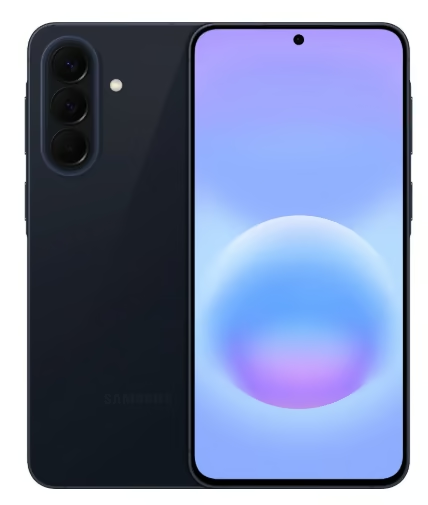
Testers found the Samsung Galaxy A57 5G the best overall pick for Spark shoppers who want near-flagship polish without flagship pricing.
The 6.7-inch frame keeps a slim 6.9mm profile and weighs 179g, so it sits comfortably in one hand despite the large screen. The Awesome Navy finish (also sold in Grey, Icy Blue and Lilac) sits over a Corning Gorilla Glass Victus+ back and aluminium frame, giving it a look closer to Samsung’s flagship S-series than a typical mid-ranger.
IP68-rated dust and water resistance means it shrugs off the odd rain shower or benchtop knock that would mark a cheaper phone, and the 6.7-inch Super AMOLED+ display runs at 120Hz, so scrolling and swiping feel noticeably smoother than on 60Hz rivals. One UI 8.5 on Android 16 brings Circle to Search, Object Eraser and Best Face editing tools that testers found genuinely useful for quick photo touch-ups.
The Exynos 1680 chipset (with Xclipse 550 graphics) and 256GB of storage handle everyday multitasking, streaming and photo editing without lag, and Samsung backs it with 6 years of OS upgrades and security patches, among the longest support windows in this guide.
It’s not built for heavy gaming, and the 45W charging speed trails a few rivals here with faster top-up speeds.
Pros
- IP68 water and dust resistance
- 6 years of OS and security updates
- 120Hz Super AMOLED+ display
- 256GB storage as standard
Cons
- 45W charging is slower than some rivals here
- Premium price for the mid-range segment
Key specs: 50MP OIS main camera, 12MP ultra-wide, 5MP macro, 12MP front camera, 5,000mAh battery, 45W wired charging, model SM-A576B. 5G and VoLTE-ready for Spark’s network.
2. Samsung Galaxy A36 5G – Best Mid-Range All-Rounder
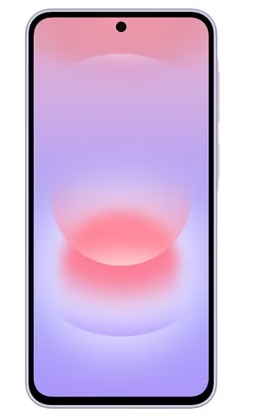
The Samsung Galaxy A36 5G is the best mid-range all-rounder here for shoppers after Samsung’s software polish at a lower price than the A57.
Its 6.7-inch display fills a similarly large frame to the A57, suiting anyone who prioritises screen real estate, and the standout Awesome Lime colourway sets it apart in a market crowded with black and grey handsets.
Samsung Knox Vault handles on-device security, while an IP67 rating protects against splashes and brief submersion, a notch below the A57’s IP68 but still solid for daily use. The 120Hz Super AMOLED display makes browsing and video feel fluid, and testers found the 50MP main camera’s OIS particularly handy for steadier video capture in low light.
A 5,000mAh battery paired with 45W fast charging gets most users through a full day and back to plenty of charge with a quick top-up, and the phone ships with 5G and eSIM support built in, ready to activate on a Spark SIM out of the box.
Android 15 out of the box means it starts one major version behind the A57’s Android 16, and Samsung’s update commitment on the A-series tends to run shorter than its flagships.
Pros
- 120Hz Super AMOLED display
- Samsung Knox Vault security
- OIS on the main camera
- 5G and eSIM support
Cons
- Ships on Android 15, one version behind the A57
- IP67 rating trails the A57’s IP68
Key specs: 128GB storage, model SM-A366B, 50MP OIS main camera, 5,000mAh battery, 45W charging, 24-month manufacturer warranty.
3. Google Pixel 10a 5G – Best Camera & Software Experience
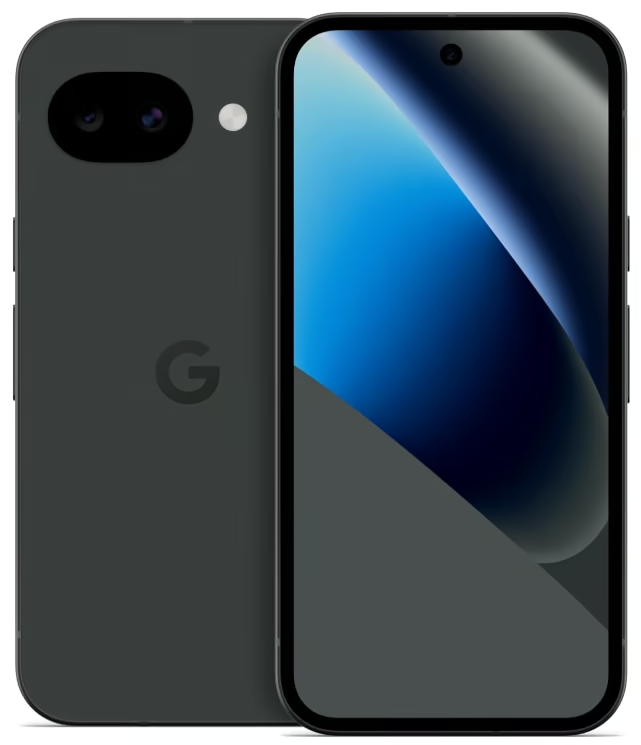
The Google Pixel 10a 5G is the best camera and software pick on this list for shoppers who want Google’s computational photography and clean Android software.
Its 6.3-inch display is noticeably more compact than the Samsung and OPPO phones here, making it the easiest one-handed option in this guide, and the Lavender finish sits behind Corning Gorilla Glass 7i for a soft, premium look Google’s A-series is known for.
The glass-backed build feels dense for its size, and the 120Hz OLED panel makes everyday scrolling smooth. The Tensor G4 chip drives Google’s on-device AI features, and testers found the Pixel’s computational photography noticeably ahead of rivals at this price when shooting indoors or at night.
The 48MP main camera with OIS pairs with a 13MP ultra-wide for genuinely versatile shooting, while the 5,100mAh battery comfortably covers a full day with 30W wired and 10W wireless charging.
The smaller 6.3-inch screen won’t suit shoppers who want a big-screen media phone, and 8GB of RAM is on the leaner side next to some rivals here.
Pairing a new phone with a solid set of wireless earbuds rounds out the everyday setup nicely.
Pros
- Strong low-light camera processing
- Clean, fast Android software
- Compact 6.3-inch size for one-handed use
- Wireless charging support
Cons
- Smaller screen won’t suit media-heavy users
- 8GB RAM is modest for the price
Key specs: 128GB storage, Tensor G4 chipset, 8GB RAM, 48MP OIS main + 13MP ultra-wide camera, 5,100mAh battery.
4. moto g86 Power 5G – Best Battery Life & Durability
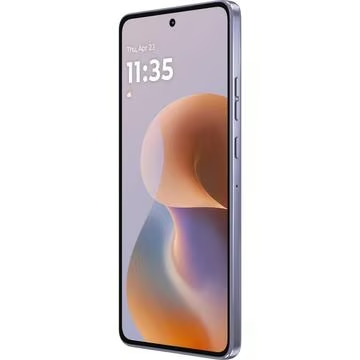
The moto g86 Power 5G is the best battery life and durability pick here for shoppers who hate charging their phone daily.
Its 6.7-inch pOLED display sits in a build motorola rates for 360-degree protection, a step up from the light splash-resistance most budget phones offer, and the Pantone-certified colourway gives it a distinctive matte finish that resists fingerprints better than the glossy backs on some rivals.
motorola’s 360-degree protection claim covers drop resistance and extreme temperature tolerance alongside water resistance, giving it sturdier real-world durability than its price suggests. The 1.5K pOLED display looks sharp for video and browsing, and testers found the Dolby Atmos-tuned speakers noticeably fuller than typical budget-phone audio.
The 50MP Sony OIS camera handles low light better than most phones in this price bracket, and the Dimensity 7400 chipset with 8GB of RAM keeps everyday apps responsive.
33W charging is on the slower side given the size of the battery, so a full charge takes longer than rivals with faster top-up speeds.
Anyone who still runs low by evening might pair a big-battery phone like this with one of our recommended power banks for backup.
Pros
- Huge 6,720mAh battery rated for up to 53 hours
- 360-degree durability protection
- Sharp 1.5K pOLED display
- Dolby Atmos speakers
Cons
- 33W charging is slow for the battery size
- Colourway options limited by retailer
Key specs: 128GB storage, Dimensity 7400 chipset, 8GB RAM, 6,720mAh battery, up to 53 hours rated battery life, 33W TurboPower charging.
5. OPPO A6x 5G – Best Budget Pick
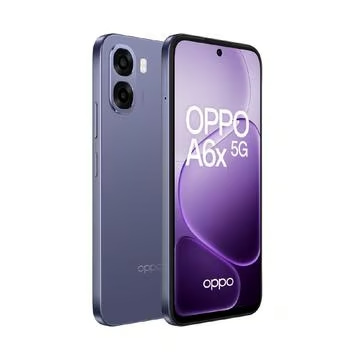
The OPPO A6x 5G is the best budget pick on this list for shoppers on a tight budget who still want 5G.
Its 6.7-inch display keeps the screen size competitive with pricier rivals in a build that doesn’t feel as cheap as the price suggests. The Black Purple colourway has a subtle two-tone finish, and the 120Hz Ultra Bright Display holds up well in direct outdoor light, a detail testers don’t expect at this price.
An IP64 rating covers dust and light splashes, a lower tier of protection than the Samsung and Motorola picks here, so it suits shoppers who won’t be near water often. RAM Expansion technology borrows up to 4GB of the 128GB storage as extra memory, and testers found multitasking between apps stayed smooth despite the 4GB of physical RAM.
The massive 6,100mAh battery is the standout feature here, comfortably running two days of typical use, and the 50MP camera with AI Photo Editor produces sharp daylight shots.
4GB of physical RAM is modest, and the MediaTek Dimensity 6300 chipset is built for efficiency rather than speed, so heavier multitaskers or gamers should look elsewhere on this list.
Pros
- Large 6,100mAh battery
- 5G at a genuinely low price
- Bright 120Hz display
- RAM Expansion boosts multitasking
Cons
- IP64 rating offers only light splash protection
- 4GB of physical RAM is modest
Key specs: 128GB storage, model CPH2783, MediaTek Dimensity 6300, 50MP rear camera, 6,100mAh battery, NFC support, network unlocked.
6. OPPO Reno13 F 5G – Best Design
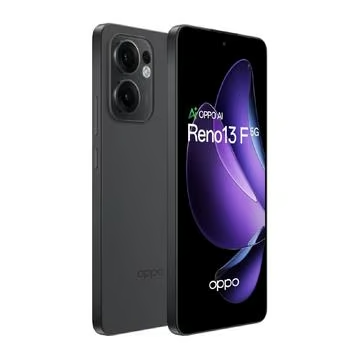
The OPPO Reno13 F 5G is the best design pick here for shoppers who want a phone that looks and feels premium.
At under 7.9mm thick, it’s the slimmest phone in this guide, with a Butterfly Shadow design that stands out from the flat slabs most rivals offer. The Plume Purple finish (also sold in Graphite Grey) pairs a soft-touch back with a genuinely premium feel testers didn’t expect at this price point.
A dual IP68 and IP69 rating gives it both dust and submersion protection and resistance to high-pressure water jets, a tier above most phones in this list bar the Motorola. eSIM support means it’s ready to activate on Spark digitally without waiting on a physical SIM, and testers found the Ultra-Clear Triple Camera System’s AI Livephoto feature a genuinely useful extra for capturing short motion clips.
The 5,800mAh battery paired with 45W SUPERVOOC charging tops up quickly for a phone this slim, and 256GB of storage (with 5GB of virtual RAM available) leaves plenty of room for apps and photos.
The slim design means a smaller battery capacity than the chunkier phones on this list, even though real-world battery life stays solid.
Pros
- Slimmest phone in this guide at under 7.9mm
- Dual IP68/IP69 durability rating
- Fast 45W SUPERVOOC charging
- eSIM support
Cons
- Smaller battery capacity than the chunkier phones on this list
- Higher price than the A-series picks here
Key specs: 256GB storage, 8GB RAM, 5,800mAh battery, 45W SUPERVOOC charging, IP68 & IP69 rating.
7. OPPO A5 4G – Best Ultra-Budget Pick
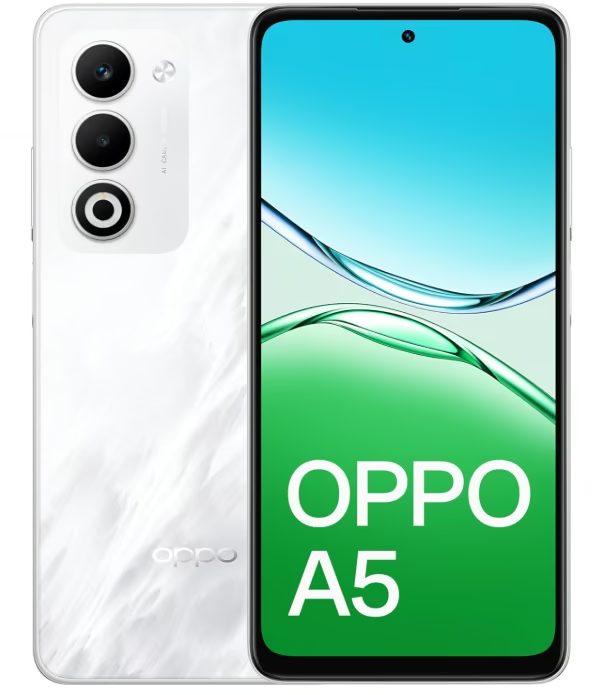
The OPPO A5 4G is the best ultra-budget pick on this list for shoppers who only need calls, texts and basic apps.
The Midnight Purple finish and compact 6.67-inch build make it an easy phone to hold and pocket, aimed squarely at shoppers who want simplicity over spectacle. It doesn’t chase flagship looks, but the finish feels sturdier than the price suggests thanks to OPPO’s shock-resistance testing.
Military-grade shock resistance and an IP65 rating, protecting against dust and low-pressure water jets, make it one of the toughest phones here for the price, built to survive drops in a school bag or work site. OPPO puts every unit through a 48-month smoothness test simulating four years of everyday use, and testers found app launches and video playback stayed responsive even with the 6GB of RAM doing the work.
The 6,000mAh battery is large for a 4G-only phone, easily stretching past a day of typical use, and the 50MP camera with AI Editor handles daylight shots well for the price.
This is the only phone in the guide without 5G, so it’s a poor fit for anyone chasing faster mobile data speeds. It still makes calls and sends texts fine on Spark’s 4G network with VoLTE support.
Pros
- Military-grade shock resistance
- Large 6,000mAh battery for a budget phone
- Cheapest phone in this guide
- Tested over a simulated four years of use
Cons
- No 5G, only 4G
- IP65 rating is lower than the pricier picks here
Key specs: 128GB storage, model CPH2727AU, 6GB RAM, 6,000mAh battery, IP65 rating, network unlocked.
8. Samsung Galaxy A17 5G – Best Entry-Level 5G
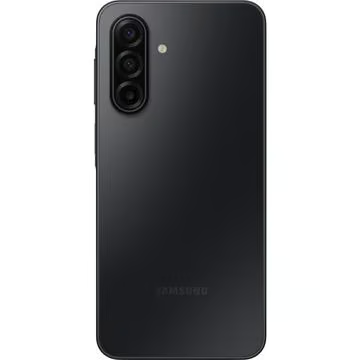
The Samsung Galaxy A17 5G is the best entry-level 5G pick here for shoppers who want 5G on Spark without paying mid-range prices.
Its 6.7-inch display puts it in the same screen-size bracket as pricier phones on this list, in a body backed by Corning Gorilla Glass Victus for scratch resistance. The Black finish keeps things understated, and the Super AMOLED panel gives it richer contrast than the LCD screens typically found at this price.
An IP54 rating covers dust and light splashes only, a clear step down from the A36 and A57’s water resistance, so it’s not the pick for anyone near pools or beaches. The 90Hz refresh rate is a notch below the 120Hz screens elsewhere in this guide, but testers still found everyday scrolling smooth enough for browsing and messaging.
The Exynos 1330 chipset handles calls, texts and social apps without stutter, and the triple rear camera (50MP OIS main, 5MP ultra-wide, 2MP macro) is a genuine step up from typical entry-level single-camera setups.
The Exynos 1330 isn’t built for heavy gaming or demanding apps, so shoppers who multitask hard should look further up this list.
Pros
- 5G at an entry-level price
- Super AMOLED display
- Triple rear camera with OIS
- Corning Gorilla Glass Victus protection
Cons
- IP54 rating offers only light splash protection
- 90Hz refresh rate trails the 120Hz phones on this list
Key specs: 128GB storage, Exynos 1330 chipset, 50MP OIS main camera, 5,000mAh battery, 25W charging.
9. Xiaomi Redmi 15 5G – Best Battery Capacity
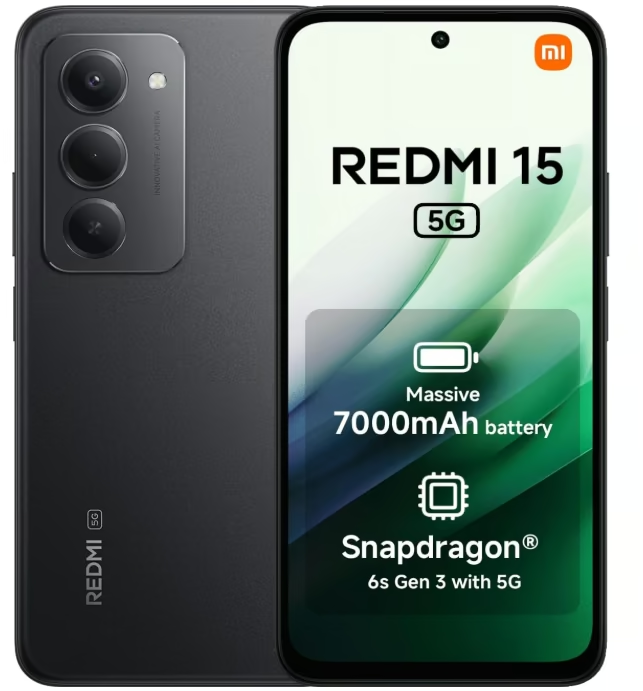
The Xiaomi Redmi 15 5G is the best battery capacity pick here for shoppers who want the biggest battery on this list.
At 217g and 8.4mm thick, it’s noticeably chunkier than the OPPO Reno13 F, a direct trade-off for the size of battery packed inside. The Midnight Black finish is understated, and the 6.9-inch display is the largest screen in this guide, suited to shoppers who stream or read on their phone often.
An IP64 rating protects against dust and light splashes, and expandable storage via microSD up to 2TB is a rare inclusion among the phones tested here. The FHD+ DotDisplay runs at up to 144Hz, and testers found scrolling felt notably smooth for a phone at this price point, even if the Snapdragon 6s Gen 3 chipset is built for efficiency over raw speed.
The headline feature is the 7,000mAh battery with silicon-carbon anode technology, comfortably the largest capacity in this guide and good for well over a day of typical use between charges.
4GB of RAM is the least of any phone here, so heavy multitaskers may notice more app reloading than on the Samsung or OPPO picks.
Shoppers who want an even bigger screen for media might also consider stepping up to a tablet instead of a phone.
Pros
- Biggest battery in this guide at 7,000mAh
- Expandable storage via microSD
- Large 6.9-inch, 144Hz display
- Silicon-carbon battery technology
Cons
- Only 4GB of RAM
- Heavier and thicker than most phones here
Key specs: 128GB storage (expandable), Snapdragon 6s Gen 3, 50MP AI dual camera, 7,000mAh battery, IP64 rating.
How to Choose
Start with network compatibility: any phone on this list must be unlocked and support Band 28 (700MHz) and Band 3 (1800MHz) for Spark’s 4G, plus VoLTE for calls and texts. Since Spark’s 3G network closed on 31 March 2026, a phone that only supports older 3G calling standards won’t work at all. If speed matters, look for 5G support on bands n78 and n40; if it doesn’t, a 4G-only phone like the OPPO A5 still handles calls, texts and everyday browsing fine. From there, match the phone to how it’ll actually get used. Shoppers who stream or read on their phone often will appreciate the larger 6.7-6.9-inch screens here over the more compact Pixel 10a.
Battery capacity varies widely, from 5,000mAh up to the Redmi 15’s 7,000mAh, so heavy users should lean toward the bigger-battery picks. Storage of 128GB comfortably covers apps and photos for most people, while 256GB (on the A57 and Reno13 F) suits anyone who shoots a lot of video. Durability ratings matter too: an IP68 or IP69 rating tolerates real water exposure, while IP54 and IP64 ratings only cover dust and light splashes. Anyone carrying a phone daily might also want a spare power bank on hand for longer days away from a charger.
Shoppers still undecided between models can also compare against our mid-range smartphones picks for more context.
Verdict
For most Spark shoppers, the Samsung Galaxy A57 5G is the easiest overall recommendation: it pairs genuine flagship touches (120Hz AMOLED+, IP68, six years of updates) with a mid-range price and full compatibility with Spark’s 4G and 5G bands. Budget-conscious shoppers are better served by the OPPO A6x 5G, which brings 5G and a huge battery to a genuinely low price point, while anyone who only needs calls, texts and basic apps can save further with the 4G-only OPPO A5. Whichever pick fits the budget, checking VoLTE and band support before buying is the one step that actually determines whether a phone works on Spark’s network at all.
FAQs
Can I use any unlocked phone with Spark?
Most unlocked phones work with Spark as long as they support Spark’s frequency bands, mainly Band 28 (700MHz) and Band 3 (1800MHz) for 4G, plus VoLTE for calling. All nine phones in this guide meet those requirements and are sold unlocked, so they can be set up with a Spark SIM or eSIM straight away.
Do I need to unlock my phone before using it with Spark?
Only if the phone is locked to a different carrier. Phones bought outright and unlocked, like the picks in this guide, don’t need unlocking. A phone locked to another network needs unlocking by its original provider before it will accept a Spark SIM.
What happened to Spark’s 3G network?
Spark shut down its 3G network on 31 March 2026. Phones that only support 3G for calls and data no longer work on Spark at all, so any replacement phone needs 4G with VoLTE as a minimum, and ideally 5G support for faster speeds.
What network bands does Spark use for 4G and 5G?
Spark’s 4G coverage relies mainly on Band 28 (700MHz) and Band 3 (1800MHz), with Band 28 doing most of the heavy lifting for rural and in-building coverage. Spark’s 5G network runs on bands n78 and n40, so a 5G phone needs to support those to get full 5G speeds.
Is it cheaper to buy a phone outright instead of through Spark?
Buying a phone outright and unlocked, rather than bundled into a Spark plan, avoids paying it off through higher monthly plan costs over 24-36 months. It also means the phone isn’t tied to Spark if a shopper later switches providers.
