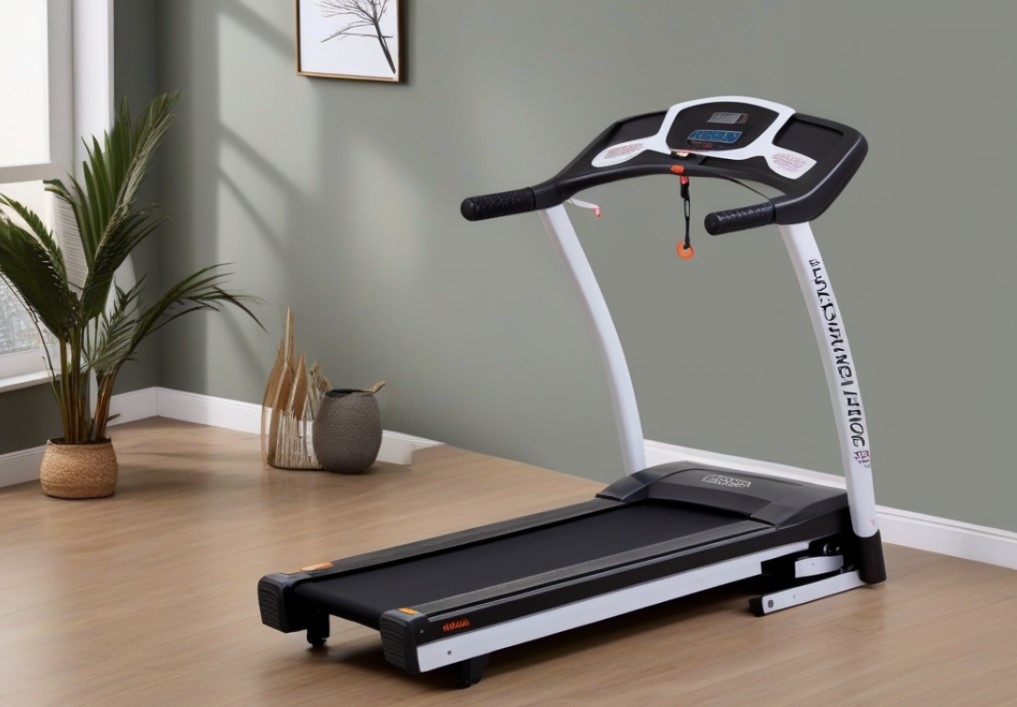
The best treadmill in NZ overall is the Centr Runr-S, a near-commercial machine with a quiet 3.0 HP motor, a full-size 140cm by 51cm belt and a 10-inch streaming touchscreen. For tight budgets and small spaces, the Protrain 45cm Wide Belt treadmill is the standout value, while the Protrain Walking Pad is the easiest way to clock steps in an apartment.
Buying a treadmill in New Zealand comes down to how you will use it: walking and light jogging, or genuine running. That decides the motor size, belt length and width, whether you need a motorised incline, and how easily it folds away. Every pick below was checked on a live retailer page, then researched against owner reviews on New Zealand and Australian sites so the verdicts reflect real use. A treadmill is also a centrepiece of any home gym equipment setup, so it is worth thinking about what else shares the room.
Picks are listed in order, each with a clear “best for” angle. Prices move often at NZ retailers, so they are not listed here; check the live product link under each review for the current deal. A quick note on the budget Protrain models: their belts sit at the compact end, so they are best treated as walking and light-jogging machines rather than dedicated running decks.
Quick comparison
| Treadmill | Best for | Belt (L x W) | Top speed | Incline |
|---|---|---|---|---|
| 1. Protrain 42cm Auto-Incline | Best for incline training | 130 x 42 cm | 16 km/h | 15-level auto |
| 2. Protrain 40cm App Treadmill | Best app training on a budget | 100 x 40 cm | 12 km/h | Manual 4-level |
| 3. Protrain 45cm Wide Belt | Best value walker | 120 x 45 cm | 16 km/h | None |
| 4. Protrain Walking Pad | Best for small spaces | 40 cm wide | 12 km/h | Auto |
| 5. Protrain 32cm Compact | Best compact budget | 32 cm wide | 10 km/h | None |
| 6. Centr Runr-S | Best premium streaming | 140 x 51 cm | 16 km/h | 12% |
| 7. ProForm City L6 | Best brand-name folder | 120 x 45 cm | 14 km/h | Yes (iFit) |
1. Protrain 42cm Auto-Incline Treadmill – Best for Incline Training
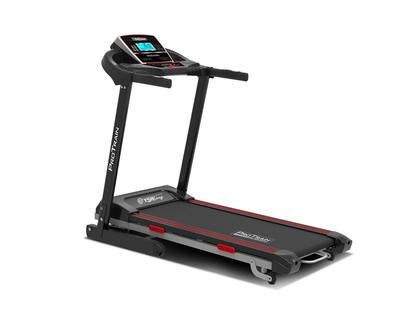
Best for home users who want real incline training without a premium price, this 42cm Protrain treadmill is the most capable of the budget picks. It runs a 2.0 HP continuous motor (3.0 HP peak) over a 130cm by 42cm belt, tops out at 16 km/h and supports users up to 120kg. The headline feature is a genuine 15-level motorised auto incline, rare at this price, so you can simulate hills rather than nudging a manual ramp by hand.
Owners on Harvey Norman NZ, where it sells as the Protrain incline model, call out the sturdy powder-coated steel frame and neighbour-friendly quiet operation. A concrete detail testers liked: it ships mostly pre-assembled, so you only attach the upright posts, connect the console wiring and insert the safety key. Cushioning is a six-zone system with shock-absorbing airbags, and the deck folds hydraulically with transport wheels.
The trade-off is size and stock. At around 42kg boxed and 165cm long unfolded it is the bulkiest pick, and TSB stock has been thin (Christchurch only at the time of writing). The 42cm belt is still on the narrow side for taller runners, so it is best framed as a walking and light-jogging machine with proper incline, not a dedicated runner’s deck.
Pros
- Genuine 15-level motorised auto incline at a budget price
- 2.0HP motor and 16km/h top speed
- Mostly pre-assembled, sturdy steel frame
Cons
- Bulkiest and longest of the budget picks
- 42cm belt is narrow for taller runners
- Limited stock at the time of writing
Key specs: 2.0HP continuous / 3.0HP peak, 130 x 42cm belt, 16km/h, 120kg max user, 15-level auto incline, hydraulic fold with wheels, 12 programs, 5.5-inch LCD, TSB code PR8114.
2. Protrain 40cm App Treadmill – Best App Training on a Budget
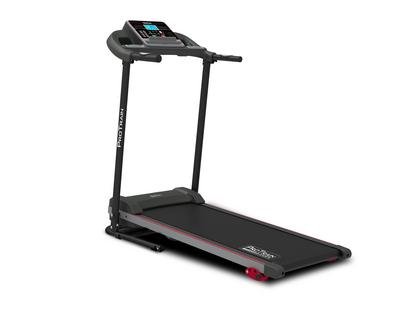
Best for beginners who want interactive app workouts cheaply, this 40cm Protrain treadmill connects over Bluetooth to training apps including Kinomap, FitShow and Zwift, so you can follow guided routes on a phone or tablet. It is the most affordable pick and rates 4.8 out of 5 across 29 reviews at Harvey Norman NZ, where owners praise it as great for beginners and quiet in walking mode.
One owner noted the belt is wide and long enough that they were not clipping the sides while walking, and the deck uses a five-layer cushioned construction. It folds hydraulically to a compact footprint and supports up to 120kg, so it stores easily in a spare room or against a wall.
The honest trade-off is power and size. It carries only a 1.0 HP continuous motor (2.0 HP peak), a 12 km/h top speed, the shortest 100cm deck of the group, and just a manual four-level incline, so it is a walking and light-jog machine rather than anything for running. For someone starting a walking habit who wants the motivation of app-guided sessions without spending much, it is a sensible entry point.
Pros
- Connects to Kinomap, Zwift and FitShow training apps
- Most affordable pick; quiet and beginner-friendly
- Folds compact; 120kg capacity
Cons
- Weak 1.0HP continuous motor
- Shortest 100cm deck and 12km/h ceiling
- Manual incline only, not for running
Key specs: 1.0HP continuous / 2.0HP peak, 100 x 40cm belt, 12km/h, 120kg max, manual 4-level incline, Bluetooth app support (Kinomap/Zwift/FitShow), hydraulic fold, 12 programs, TSB code PR8113.
3. Protrain 45cm Wide Belt Treadmill – Best Value Walker
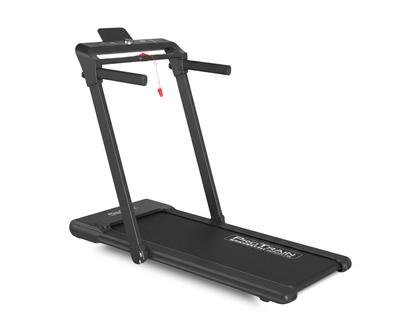
Best for walkers who want the widest, most comfortable belt for the money, this 45cm Protrain has the broadest running surface of the budget picks and the best stock availability (all three TSB branches at high stock). It pairs a 2.0 HP continuous motor (3.0 HP peak) with a 120cm by 45cm belt, a 16 km/h top speed and 16 built-in programs, the most here, plus a colour TFT screen, a device holder and Bluetooth music streaming.
NZ owners on the TSB page rate it 93 percent five-star, with comments like great for home and strong, clean design, and good value for money. The concrete advantage is that wide 45cm belt, which gives a more natural stride, and it folds nearly flat at just 22cm tall on transport wheels for storage.
The trade-off is that there is no incline at all, so you cannot raise intensity without raising speed, and the app is Bluetooth music only, with no Kinomap or Zwift training integration like the cheaper app model. For someone who mainly walks or jogs lightly and values belt width and easy storage over hills, it is the standout value buy.
Pros
- Widest 45cm belt for a natural stride
- 16 programs and 16km/h top speed
- Folds nearly flat; excellent stock and reviews
Cons
- No incline at all
- “App” is music streaming only
- Not built for serious running
Key specs: 2.0HP continuous / 3.0HP peak, 120 x 45cm belt, 16km/h, 120kg max, no incline, 16 programs, colour TFT, Bluetooth music, quick-fold with wheels, TSB code PR65020.
4. Protrain Walking Pad – Best for Small Spaces
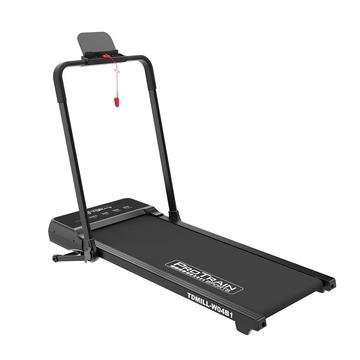
Best for apartments and under-desk walking, this Protrain walking pad strips a treadmill back to essentials: a 40cm belt, a 1.0 HP ultra-quiet motor and a foldable frame with a fold-down handle, so it slides away when not in use. It ships ready to go with no assembly required and includes a small bottle of belt lubricant, and owners report it sets up in minutes, runs smoothly and takes up very little space.
A concrete touch testers liked is the wireless remote for speed and emergency stop, alongside an LED readout for time, speed, distance and calories. It tops out at 12 km/h, supports up to 110kg and includes an auto-adjustable incline and six preset programs, which is generous for the category.
The trade-offs are inherent to a walking pad. Control depends on the remote, so a few owners flagged concern about replacing it if it breaks, and some needed extra oiling to keep it running quietly. It is not a running machine and the deck is short, but as a quiet, store-anywhere way to clock steps while working or watching TV, it does exactly what it sets out to do.
Pros
- No assembly, folds away, very compact
- Quiet 1.0HP motor with remote control
- Auto incline and six programs, rare for a walking pad
Cons
- Controls depend on the remote
- Needs regular lubrication to stay quiet
- Walking only, short deck
Key specs: 1.0HP motor, 40cm belt, 12km/h, 110kg max, auto incline, 6 programs, folds with handle and transport wheels, ships about 30kg, TSB code PR13142.
5. Protrain 32cm Compact Treadmill – Best Compact Budget Buy
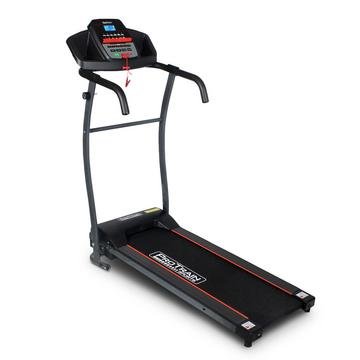
Best for the tightest budgets and smallest spaces, this 32cm Protrain is the simplest, cheapest motorised treadmill here. It uses a 500W motor, a narrow 32cm belt and a 10 km/h top speed across 10 speed levels, with a device holder but no Bluetooth or app. It rates 4.74 out of 5 from 38 reviews and supports up to 120kg.
A compact, foldable design with transport wheels makes it easy to tuck away, though one owner noted the handles sit too high to slide it under a bed. For a renter or a small home office, that store-anywhere footprint is the main appeal.
The concrete trade-off is the belt. At 32cm it is the narrowest of the group, comfortable for walking and the occasional light jog but tight for running, which is exactly why TSB sells the wider 40cm and 42cm models for more active use. There is no incline either. For anyone who just wants to walk indoors on bad-weather days without spending much or losing floor space, it is a no-frills, well-reviewed option, as long as you expect a walker rather than a runner.
Pros
- Cheapest motorised pick
- Compact and foldable with wheels
- Strong owner rating; 120kg capacity
Cons
- Narrowest 32cm belt
- 10km/h cap and no incline
- No app or Bluetooth
Key specs: 500W motor, 32cm belt, 10km/h, 120kg max, no incline, 12 programs, foldable with wheels, ships about 23.5kg, TSB code PR2815.
6. Centr Runr-S – Best Premium Streaming Experience
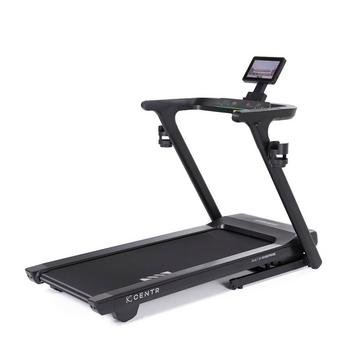
Best for buyers who want a premium, entertainment-loaded machine, the Centr Runr-S, from Chris Hemsworth’s Centr brand, is the most capable treadmill in this guide. It runs a quiet 3.0 HP brushless DC motor over a proper 140cm by 51cm belt, reaches 16 km/h, climbs to a 12 percent motorised incline in 1 percent steps and supports up to 136kg.
The standout is the 10-inch multimedia touchscreen with pre-loaded Netflix, Disney+, YouTube, Prime and Spotify, plus a secondary LED display for heart rate and settings, and 25 built-in programs. Independent testers at Garage Gym Reviews praise it as durable, sturdy and barely audible even at speed and incline, with an easy 30-minute setup and a small footprint thanks to the soft gas-assist fold. Warranty is strong: lifetime frame and motor, two years parts, one year labour.
The trade-offs are real. Testers note the stop button sits where users accidentally knock it, the 16 km/h top speed is lower than some dedicated runners, and the return policy is poor. It is also sold here through an Australian retailer, so confirm shipping and after-sales support into New Zealand before buying. For a near-commercial home treadmill with the best screen here, though, it leads the field.
Pros
- Quiet 3.0HP brushless motor and large 140 x 51cm belt
- 12% motorised incline and 25 programs
- 10-inch streaming touchscreen; lifetime frame and motor warranty
Cons
- Stop button is easy to knock by accident
- 16km/h ceiling is modest for sprinters
- Sold via an Australian retailer; check NZ shipping and support
Key specs: 3.0HP brushless DC, 140 x 51cm belt, 16km/h, 12% incline, 136kg max, 25 programs, 10-inch touchscreen, fold-up with wheels, lifetime frame/motor warranty, model RUNR-S.
7. ProForm City L6 – Best Brand-Name Folding Walker
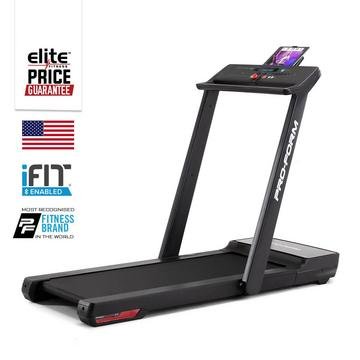
Best for buyers who want a recognised brand and iFit workouts from a New Zealand retailer, the ProForm City L6 is sold by Elite Fitness and built around space saving. It uses a 1.6 CHP motor over a 45cm by 120cm belt, reaches 14 km/h, and folds flat via ProForm’s SpaceSaver and EasyLift design, with the console folding down too.
ProShox cushioning is claimed to cut impact by around 28 percent, and the deck rides on 1.9-inch precision-balanced rollers. It is iFit-enabled over Bluetooth, so with a separate subscription and your own tablet you get guided, trainer-led sessions. Reviewers at Treadmill Review Guru and Garage Gym Reviews describe it as quiet and easy to use and well suited to walking and light jogging.
The concrete trade-off comes from that lightweight 57kg frame: it transmits more impact noise when you run, and a heavier reviewer reported extra motor noise at a jog. With a small 1.6 CHP motor, a 14 km/h cap and a basic 5-inch display whose smart features depend on a paid iFit plan, it is a walker and light jogger, not a runner’s treadmill. Warranty is reassuring for the price: ten years on frame and motor, two years parts, one year labour, all back-to-base.
Pros
- Trusted ProForm brand sold in NZ by Elite Fitness
- Folds flat with SpaceSaver design
- iFit-enabled; long 10-year frame and motor warranty
Cons
- Small 1.6CHP motor and 14km/h cap
- Lightweight frame transmits running noise
- Smart features need a paid iFit plan and your own tablet
Key specs: 1.6CHP motor, 45 x 120cm belt, 14km/h, 110kg max, ProShox cushioning, SpaceSaver fold, iFit-enabled, 5-inch display, 10-year frame/motor warranty, model City L6.
How to choose a treadmill in NZ
Match the motor to your use. For walking, 1.5 to 2.0 HP is fine; for regular jogging aim for 2.5 to 3.0 HP continuous; and only a 3.0 HP-plus continuous motor is built for daily running. The budget Protrain models here sit at the walking and light-jog end, while the Centr Runr-S is the only true running-grade motor in this guide.
Belt size decides comfort. Walking is comfortable on a 110 to 120cm by 40cm belt; jogging wants 120 to 140cm by 42 to 45cm; and running, especially for taller users, needs 140cm-plus by 45cm or wider. If you mostly walk, low-impact options like the best elliptical trainers are worth weighing up too.
Incline, folding and space. A motorised incline adds intensity without more speed and is the most useful extra. If floor space is tight, a folding deck or a walking pad that stores upright or under a bed matters more than raw specs. Measure the room, including clearance behind the belt, before buying.
Max user weight and stability. Check the user weight limit and leave headroom; running near the ceiling causes wobble and wear. Pair cardio with some strength work using adjustable dumbbells, and track pace and heart rate with one of the fitness trackers for a more complete routine.
Warranty and NZ servicing. This is the most overlooked factor. Brands sold through established NZ retailers (like ProForm at Elite Fitness) have local parts and service, whereas some cheap or imported lines are hard to repair once out of warranty. Check the frame, motor, parts and labour terms, and confirm whether service is back-to-base. After a session, recovery tools like massage guns for recovery help with sore legs.
Budget tiers in NZ. Compact walkers and walking pads start at the bottom of the range, capable folding walkers and light joggers sit in the middle, and running-grade machines with big screens are the premium tier. Spend to match how hard and how often you will actually use it, not the top speed on the sticker.
Verdict
For a true running-grade machine with the best screen, the Centr Runr-S is the one to beat, with the caveat that it sells through an Australian retailer. On a budget, the Protrain 45cm Wide Belt is the best all-round value for walkers, the Protrain 42cm Auto-Incline adds real hill training, and the Protrain Walking Pad is the pick for apartments. If you want a recognised brand with NZ servicing and iFit workouts, the ProForm City L6 is the safe choice. Match the motor, belt and incline to how you will actually train, and check the live product link for current stock and pricing.
FAQs
What size motor (HP) do I need for a treadmill?
Match the motor to your use. Around 1.5 to 2.0 HP is enough for walking, 2.5 to 3.0 HP continuous suits regular jogging, and a 3.0 HP-plus continuous motor is best for daily running. Peak HP figures look bigger but mean less, so always compare the continuous rating when buying in New Zealand.
What belt length and width do I need for running versus walking?
For walking, a belt around 110 to 120cm long by 40cm wide is comfortable. Jogging wants 120 to 140cm by 42 to 45cm, and running, especially if you are tall, needs 140cm-plus by 45cm or wider so your stride is not cramped. Narrow budget belts are best kept to walking and light jogging.
Treadmill versus walking pad: which is better for home?
A walking pad is slimmer, quieter and stores under a bed or desk, ideal for steps while working in a small space, but tops out around 6 to 12 km/h with little or no incline. A full treadmill is larger and pricier but handles jogging or running with a longer belt and stronger motor. Choose by space and intensity.
Are folding treadmills any good, or do they compromise performance?
Folding treadmills are fine for walking and light jogging and save a lot of space, which is why most home models fold. The trade-off is that lighter folding frames can transmit more impact noise and feel less planted than heavy fixed-frame machines. For serious daily running, a sturdier, heavier deck is worth the floor space.
Are cheap treadmills worth it?
For walking and occasional light jogging, a well-reviewed budget treadmill is good value and far cheaper than a gym membership. The compromises are smaller motors, narrower belts, shorter warranties and harder servicing. If you plan to run regularly or are a heavier user, spending more on motor size, belt width and local parts support pays off over the machine’s life.
What is the maximum user weight a treadmill can support?
Most home treadmills list a maximum user weight between 100 and 140kg. Always leave a margin below the limit, because running near the ceiling causes wobble, faster belt wear and motor strain. Heavier users should prioritise a sturdy frame, a strong continuous motor and a higher weight rating rather than the cheapest model.
How much incline do I need on a treadmill?
A motorised incline of up to 10 to 15 percent is plenty for home use; it adds intensity and burns more calories without raising speed, and is gentler on the body than faster running. A manual incline is cheaper but you must stop to change it. If hill training matters to you, choose a motorised auto incline.
How long do treadmills last and how often should I lubricate the belt?
A good home treadmill lasts roughly 7 to 12 years, and premium machines longer, if maintained. Most belts need silicone lubricant about every three months or every 50 hours of use, though some come with self-lubricating belts. Regular lubrication keeps the motor quieter and prevents premature belt and motor wear.
What is the best treadmill for a small space or apartment?
For apartments, a walking pad or a slim folding treadmill is best. Look for a low-noise motor, a deck that folds upright or slides under furniture, and transport wheels. Check the folded dimensions, not just the in-use footprint, and consider a cushioned deck and quiet operation so you are not disturbing neighbours below.
Is running on a treadmill bad for your knees?
Running on a treadmill is generally easier on the knees than hard pavement, because a cushioned deck absorbs some impact. Good deck cushioning, correct footwear and a gradual build-up matter most. If you have joint concerns, walking with an incline or a low-impact machine like an elliptical can deliver cardio with less stress on the knees.
