
The best microwave in NZ overall for most households is the Panasonic 27L Flatbed Inverter, because it combines inverter power for more even cooking with a flatbed cavity that fits larger dishes and wipes clean in seconds. For big families, the Midea 34L Inverter 1200W and the Sharp 34L Inverter give the most capacity and power, while the Sheffield 20L Digital is the compact, budget choice for small kitchens, flats and dorms.
Three things decide which microwave suits you: capacity (roughly 20 L for one or two people, 25–32 L for most homes, 34 L+ for families and big plates), wattage (around 700 W reheats slowly, 1000–1200 W cooks faster and more evenly), and type — solo for reheating and defrosting, grill for browning, and convection for baking and roasting. Inverter and flatbed designs are upgrades worth understanding before you buy, and both are covered below. Every pick is grouped by who it actually suits, with honest trade-offs. Prices are not listed here — check the linked retailer for current pricing.
Quick comparison
Product | Capacity | Power | Type | Best for |
Panasonic 27L Flatbed Inverter | 27 L | 1000 W | Inverter, flatbed, solo | Everyday all-rounder |
Midea 34L Inverter 1200W | 34 L | 1200 W | Inverter, solo | Big families |
Sharp 34L Inverter | 34 L | 1200 W | Inverter, solo | Value family pick |
Samsung 32L (Home Dessert) | 32 L | Not listed | Solo, preset cooking | Preset & dessert cooking |
Breville LMO550 Flatbed Noir | 30 L | 1000 W | Inverter, flatbed, solo | Premium flatbed (discontinued) |
Toshiba 34L Solo Stainless | 34 L | 1200 W | Solo | Big solo, stainless look |
Panasonic NN-CD88 34L Combination | 34 L | 1300 W (listed) | Inverter, convection + grill + air fry | Combination cooking |
Sheffield/ProLink 20L Digital | 20 L | ~650-700 W | Standard, turntable | Compact & budget |
1. Midea Microwave Inverter – Best high-power pick for big families
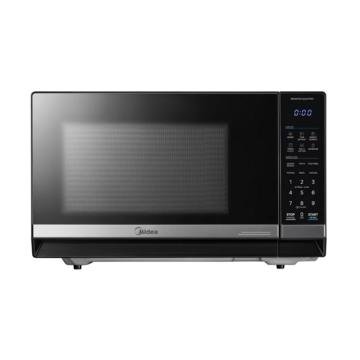
Best for large households that reheat and cook in volume: this Midea pairs a generous 34 L cavity with a strong 1200 W output and inverter technology, so it can handle big plates and batch portions while delivering steadier, more even power than a standard microwave. It is one of the higher-wattage options in this guide, which means faster reheating and more confident cooking from cold.
It is controlled by a membrane digital touch panel with 10 power levels, and the external footprint is 519 mm wide, 407 mm deep and 318 mm high — a sizeable unit that needs real bench space, as you would expect for 34 L. The cavity has a grey painted interior, and at the retailer it is sold delivery-only rather than for in-store pickup. The honest trade-off is that this is a solo microwave: there is no grill or convection, so it is built for reheating, defrosting and straightforward cooking rather than browning or baking. The listing is also light on detail, leaving turntable-versus-flatbed and defrost specifics unstated.
- Pros: Large 34 L capacity for families; high 1200 W inverter output for fast, even cooking; 10 power levels; simple touch controls.
- Cons: Solo only — no grill or convection; large bench footprint; retailer lists it delivery-only; spec sheet omits turntable/defrost detail.
- Key specs: 34 L · 1200 W · inverter · solo · 10 power levels · touch control · 519 × 407 × 318 mm (W×D×H).
2. Toshiba Solo Microwave – Best big solo for a stainless kitchen
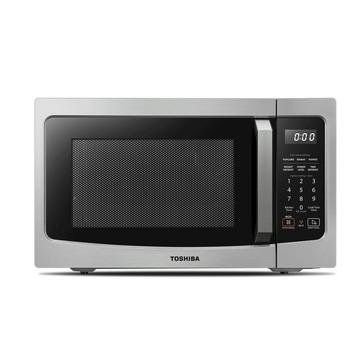
Best for shoppers who want maximum capacity and a brushed stainless look without paying for grill or convection extras. Toshiba is a trusted name in microwaves, and this 34 L solo model offers a strong 1200 W output, putting it among the most powerful family-sized units here. Finished in black with a stainless-steel front, it is designed to sit comfortably in a modern kitchen and is operated through a membrane digital touch panel.
At 519 mm wide, 407 mm deep and 317.5 mm high, it has the same large footprint as other 34 L units, so it needs dedicated bench space. The big cavity easily takes dinner-plate and casserole-dish loads, and the high wattage means quick reheating across larger portions. The clear trade-off is that, like the Midea above, it is solo only — there is no grill or convection, so it focuses on reheating, defrosting and basic cooking rather than crisping or baking. Stock also varies by region at the retailer, and the listing leaves power-level count and defrost type unstated.
- Pros: Big 34 L family capacity; powerful 1200 W output; smart stainless-steel finish; trusted brand; touch controls.
- Cons: Solo only — no grill or convection; large footprint; regional stock varies; sparse listing detail.
- Key specs: 34 L · 1200 W · solo · stainless front · touch control · 519 × 407 × 317.5 mm (W×D×H) · model ML3-EM34PF(SS).
3. Panasonic 34L Combination Microwave — Best for convection, grill and air fry
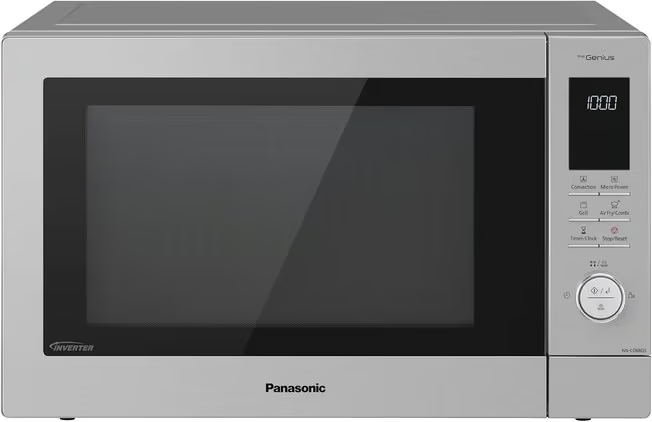
Best for anyone who wants one benchtop appliance to microwave, bake, grill and air fry. This Panasonic 34L combination microwave (model NN-CD88QSQPQ) is the most versatile cooker in the guide: inverter microwave power for even reheating, convection baking and roasting up to 220°C, a grill for browning, and an air fry mode that uses an included raised basket so hot air circulates around the food. Combination mode runs microwave and convection together, which Panasonic says can roast a whole chicken in about 40 minutes.
It has a stainless-steel finish, a 360 mm turntable, 30 auto programs, a Genius Sensor that reads the food’s humidity and adjusts cooking time, and Turbo Defrost. It measures 56 cm wide, 45 cm deep and 34.3 cm high and weighs about 18 kg, so it needs a deep, sturdy bench with room to vent. The honest trade-offs: it is a benchtop unit, not a built-in, so it won’t give the flush look of a cabinet install; it is big and heavy; the listing quotes 1300 W without separating microwave output from the grill and convection elements; it uses a turntable rather than a flatbed cavity; and it carries a 1-year warranty.
- Pros: Microwave, convection, grill and air fry in one; inverter for even reheating and defrosting; Genius Sensor auto-cooking; 30 auto programs; air fry basket included.
- Cons: Benchtop only, not a built-in; large and heavy (about 18 kg); listing doesn’t separate microwave output from grill/convection power; turntable, not flatbed; 1-year warranty.
- Key specs: 34 L · inverter · convection to 220°C + grill + air fry · 1300 W (listed) · 360 mm turntable · 30 auto programs · Genius Sensor · 560 × 450 × 343 mm · approx. 18 kg · model NN-CD88QSQPQ.
4. Panasonic Flatbed Inverter Microwave — Best everyday all-rounder
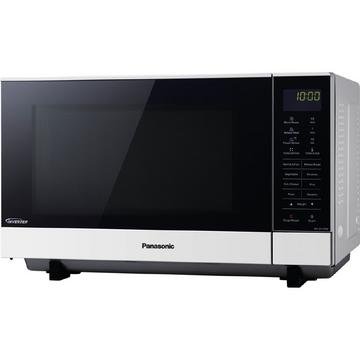
Best for the typical NZ household that wants one microwave to do everything well. This Panasonic is the pick of the guide because it brings together two genuine upgrades: inverter power, which holds a steady lower output instead of pulsing full power on and off for gentler defrosting and more even reheating, and a flatbed cavity with no turntable, which fits larger and rectangular dishes and wipes clean in seconds with no spindle or ring to remove.
At 27 L it is a practical mid-size that suits couples and families alike, with 1000 W output, a four-digit green backlit display, six power levels, 14 auto-reheat menus and a push-button glass door. It measures 529 mm wide, 422 mm deep and 326 mm high, and comes with a 24-month warranty. The flatbed design is the everyday hero — fewer parts to clean and more usable space than the litre count suggests. The honest trade-off is that, despite its premium positioning, it is solo: there is no grill or convection, so the value is in the flatbed and inverter combination rather than cooking versatility.
- Pros: Flatbed cavity fits big dishes and cleans easily; inverter for even reheating and gentle defrost; 14 auto menus; 24-month warranty; trusted brand.
- Cons: Solo only — no grill or convection; mid-size 27 L rather than a full 34 L; premium positioning for a reheat-focused unit.
- Key specs: 27 L · 1000 W · inverter · flatbed (no turntable) · 6 power levels · 14 auto menus · white · 529 × 422 × 326 mm · model NN-SF564W.
5. Sharp Inverter Microwave — Best value family inverter
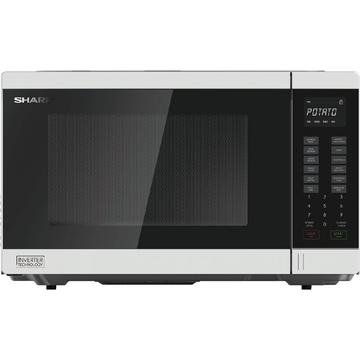
Best for families who want big capacity and inverter cooking without stepping up to premium money. Sharp has sold microwaves in NZ for decades, and this 34 L model combines a strong 1200 W output with inverter technology that the brand describes as delivering even cooking and accurate power control. That pairing of large size and high, steady wattage makes it well suited to cooking for the whole family.
It has an LED text display, auto-cook and auto-weight defrost menus, two-stage programme cooking, a kitchen timer, interior LED lighting, a child lock and an easy push-button door, in a clean white finish measuring 519 mm wide, 410 mm deep and 315 mm high. The auto-weight defrost and two-stage cooking add genuine everyday convenience over a basic dial microwave. Two honest trade-offs stand out: it is a solo microwave with no grill or convection, and it carries only a 12-month warranty, which is shorter than the 24-month cover on several rivals here, including the Panasonic and the Samsung.
- Pros: Large 34 L family capacity; 1200 W inverter for even cooking; auto-weight defrost and two-stage cooking; child lock; established NZ brand.
- Cons: Solo only — no grill or convection; only a 12-month warranty; large bench footprint.
- Key specs: 34 L · 1200 W · inverter · solo · auto-weight defrost · 2-stage cooking · child lock · white · 519 × 410 × 315 mm · model R342FW.
6. Samsung 32L Microwave – Best for preset cooking
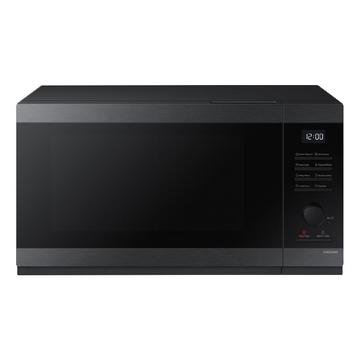
Best for people who want to lean on built-in recipes rather than guess times and power levels. This Samsung 32 L microwave is pitched around its preset programs — including Home Dessert and Healthy Cooking modes plus Auto Cook — designed to take the thinking out of simple dishes and quick meals. With a roomy 32 L cavity, it sits in the family-sized bracket and suits busy kitchens that value one-touch convenience.
It offers seven power levels, Power Defrost for faster thawing and a ceramic enamel interior, which Samsung promotes as more scratch-resistant and easier to wipe down than standard linings, with a 24-month warranty. The preset cooking and durable enamel cavity are the real draws here. The honest trade-off is transparency: the retailer listing is unusually sparse for a brand-name unit, with no microwave wattage and no external dimensions published, so buyers cannot confirm power output or whether it will fit a tight space from the listing alone. It is also a solo microwave, without grill or convection.
- Pros: Family-sized 32 L; Home Dessert, Healthy Cooking and Auto Cook presets; Power Defrost; scratch-resistant ceramic enamel interior; 24-month warranty.
- Cons: Listing omits wattage and dimensions (power not confirmed); solo only — no grill or convection.
- Key specs: 32 L · wattage not listed · solo · 7 power levels · Power Defrost · ceramic enamel interior · Home Dessert/Healthy Cooking presets · model MS32DG4504AG.
7. Breville Inverter Flatbed Noir – Best premium flatbed
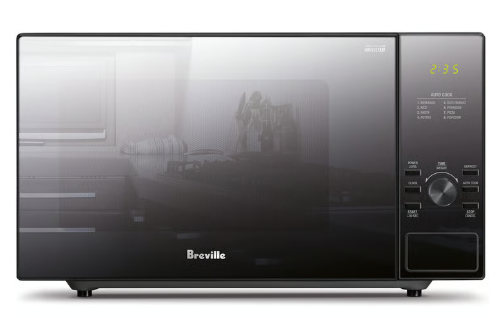
Best for design-led buyers who want a flatbed inverter with a striking black-mirror finish. Breville’s LMO550 is a 30 L flatbed microwave with a 1000 W output and a Power Smoothing Inverter, and Breville claims its flatbed cavity gives around 60% more usable cooking area than a traditional 34 L turntable microwave — because there is no spinning plate eating into the space. The black mirrored door is the visual centrepiece, and the flatbed is genuinely easier to clean and better for large rectangular dishes.
It is well equipped, with a dial-and-button control panel and LED display, 10 power levels, eight auto-cook menus (from rice and pasta to pizza and popcorn), a child lock, and defrost by both time and weight up to 1800 g. Verified cavity dimensions are 354 × 358 × 240 mm inside an external 539 × 409 × 312 mm body. The important caveat to flag: Breville’s own site lists this model as discontinued, with retail availability through Noel Leeming, so stock is shrinking and you should confirm it is still available before relying on it. At 1000 W it is also lower-powered than the 1200 W 34 L solo units, and it has no grill or convection.
- Pros: Flatbed inverter with ~60% more usable space than a 34 L turntable; premium black-mirror design; 10 power levels; weight defrost; child lock.
- Cons: Listed as discontinued by Breville (confirm stock before buying); 1000 W is lower than the 1200 W rivals; solo only.
- Key specs: 30 L · 1000 W · inverter · flatbed · 10 power levels · 8 auto menus · weight defrost to 1800 g · child lock · 539 × 409 × 312 mm · model LMO550.
8. Sheffield Digital Microwave — Best compact for small space
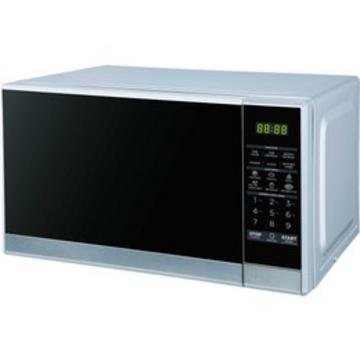
Best for small kitchens, flats, dorms, offices and anyone who mainly reheats and defrosts. This Sheffield (sold by Prolink Brands) is the compact, value option in the guide: a 20 L turntable microwave with a 255 mm turntable and a small 440 mm-wide footprint that tucks easily onto a crowded bench or into a tight cabinet. Despite the budget positioning, it is digitally controlled rather than dial-only, with soft-touch electronic controls, 11 power levels, six auto-cooking menus, auto defrost, a 90-minute timer and a child safety lock.
It comes with a 24-month warranty and ships within a few business days from the retailer. For one or two people reheating leftovers, warming drinks and cooking quick snacks, it covers the essentials at the lowest cost here. The honest trade-offs are straightforward: at roughly 650–700 W output it is the least powerful microwave in this guide, so reheating and cooking are noticeably slower than the 1000–1200 W units; the 20 L turntable cavity limits dish size; and there is no inverter, grill or convection.
- Pros: Compact, bench-friendly size; budget-friendly; digital soft-touch controls; 11 power levels; child lock; 24-month warranty.
- Cons: Lowest power (~650-700 W) means slower cooking; small 20 L turntable limits dish size; no inverter, grill or convection.
- Key specs: 20 L · ~650-700 W · standard · turntable (255 mm) · 11 power levels · 6 auto menus · auto defrost · child lock · 440 × 259 × 330 mm (W×D×H) · model PLA0920.
How to choose a microwave in NZ
Start with capacity. A 20 L microwave suits one or two people and small spaces; 25–32 L fits most households and a standard dinner plate; and 34 L or more is best for families, big casserole dishes and entertaining. Bigger cavities mean bigger external footprints, so measure your bench or cabinet first — most 34 L units are around 519 mm wide.
Next, weigh wattage. Around 700 W reheats and defrosts but slowly; 1000–1200 W cooks faster and more evenly and is the sweet spot for families. Then choose a type: solo for reheating and defrosting, grill for browning and crisping, and convection for baking and roasting like a small oven. Two design upgrades are worth knowing — an inverter holds steady power for gentler, more even results (though independent testers note the real-world difference can be modest), and a flatbed removes the turntable for more usable space and far easier cleaning.
If you cook beyond reheating, it is worth seeing where a microwave fits among your other benchtop appliances. Our guides to the best air fryers, the best pizza ovens and the best deep fryers cover the crisping and high-heat jobs a solo microwave can’t, while the best electric frypans and the best food processors round out a busy kitchen.
The verdict
For most NZ kitchens, the Panasonic 27L Flatbed Inverter is the best all-round microwave — its flatbed cavity and inverter power make everyday reheating, defrosting and cleaning genuinely better. Families wanting maximum size and power should choose the Midea 34L Inverter 1200W or the value-focused Sharp 34L Inverter. If you want one appliance that also bakes, grills and air fries, the Panasonic 34L Combination is the versatile choice, while the Sheffield 20L Digital covers small spaces and tight budgets. The Breville LMO550 remains a stylish flatbed pick, but confirm availability first as it is being discontinued.
Microwaves reheat but never brown, so households that want a crust on last night’s pizza usually end up with benchtop ovens sitting beside them. Flatbed cavities and induction hobs share the same appeal, which is a flat surface with nothing to work around, and an induction hob wipes clean the same way.
FAQs
What size microwave do I need?
For one or two people or a small kitchen, a 20–23 L microwave is plenty. Most households are well served by 25–32 L, which fits a standard dinner plate comfortably. Families, or anyone heating large casserole dishes and big plates, should look at 34 L or more. Remember larger capacities also mean larger external footprints.
Are inverter microwaves better than regular ones?
Inverter microwaves hold a steady lower power instead of pulsing full power on and off, which generally means more even reheating and gentler defrosting, plus more usable interior space. The benefit is real but, as independent testers note, often modest in everyday use. They tend to cost more, so weigh the upgrade against how much you cook versus simply reheat.
What is the difference between solo, grill and convection microwaves?
A solo microwave only reheats, defrosts and does basic cooking. A grill microwave adds a heating element for browning and crisping, useful for toasties or grilled cheese. A convection microwave adds a fan and element so it can bake and roast like a small oven. Versatility, price and footprint all rise as you move up.
Is a flatbed or turntable microwave better?
Flatbed microwaves have no rotating plate, so they fit larger and rectangular dishes, use the cavity more efficiently and are much easier to clean with no spindle or ring to remove. Turntable models are usually cheaper, more compact and more widely available. If easy cleaning and usable space matter most, a flatbed is the better long-term choice.
How many watts should a good microwave be?
Around 700 W will reheat and defrost but cooks slowly and less evenly. For most homes, 800–1000 W is a comfortable middle ground, while 1000–1200 W cooks faster and more evenly and is ideal for families and meal prep. Higher wattage generally means quicker, more reliable results across larger portions.
What wattage and size is best for a family?
For families, look for at least 30 L of capacity and 1000–1200 W of power. That combination handles big plates, casserole dishes and batch reheating quickly and evenly. The 34 L, 1200 W inverter models in this guide are good examples, balancing roomy cavities with strong, steady output for cooking across a whole household.
Do I need a microwave with a grill or convection?
Only if you want it to do more than reheat. A solo microwave is fine for warming food, defrosting and quick cooking. Choose a grill model if you want browning and crisping, or a convection model if you want to bake and roast like a compact second oven. Each step up adds versatility, cost and size.
Which microwave brand is best in New Zealand?
There is no single best brand — it depends on your needs. Panasonic is known for flatbed inverters, Sharp for value and a wide range, Samsung for presets and smart features, Breville for design and flatbed cavities, and Midea and Sheffield for affordable value. Match the brand to the capacity, wattage and type that suit your kitchen.
