
The best portable air conditioner in NZ for most homes is the Midea 2.5kW Cooling, a compact, in-stock unit that drops the temperature in a 12 to 18 square metre room without any permanent installation. Households that also want winter heating should look at the reverse-cycle Midea 3.25kW WiFi model, while shoppers watching the budget can weigh up the Sheffield PL619. This guide compares five portable coolers sold in New Zealand right now, with real specs, honest trade-offs and clear buying advice.
A quick reality check for the local climate: New Zealand summers are often humid, so a refrigerative portable air conditioner that removes moisture will usually cool more reliably than an evaporative cooler, which works best in dry heat. If your main problem is winter cold rather than summer heat, our guide to portable heaters may be a better starting point.
Quick comparison
| Model | Best for | Cooling | Room size | Type |
|---|---|---|---|---|
| Midea 2.5kW Cooling | Small to medium rooms | 2.5 kW | 12-18 m2 | Refrigerative |
| Midea 3.25kW WiFi | Year-round use | 3.25 kW | 16-23 m2 | Reverse cycle |
| DeLonghi Pinguino 2.4kW | Trusted brand | 2.4 kW | up to ~25 m2 | Refrigerative |
| Sheffield PL619 | Dehumidifying | 2.05 kW | small rooms | Refrigerative |
| Goldair GCEV160 | Dry-day cooling | n/a | medium-large | Evaporative |
1. Midea Portable Air Conditioner – Best Overall for Small to Medium Rooms

Best for small to medium NZ rooms, the Midea 2.5kW Cooling is the pick most households will get the most out of, cooling a bedroom, home office or studio without any wall work. It is a cooling-only refrigerative unit, so it genuinely lowers air temperature and pulls out moisture rather than just moving air around.
The cabinet is a tidy white tower measuring 355 x 345 x 703 mm, which tucks neatly into a corner and takes up about the same floor space as a small pedestal fan base. At 24.7 kg it is not light, but built-in castors let one person roll it between rooms. Controls sit on a simple top panel and the included remote handles temperature, fan speed and the 24-hour timer from across the room.
Cooling capacity is rated at 2.5 kW with a 1200 W power draw on a standard 220 to 240V socket, and Midea rates it for spaces of 12 to 18 square metres. Like most of Midea’s portable range it recycles condensate through the exhaust, so in normal conditions there is no bucket to empty. A flexible exhaust hose and window kit vent the hot air outside.
The honest trade-offs: it only cools, so it does nothing for a cold winter night, the 24.7 kg body is a two-hand lift up stairs, and like every single-hose portable it needs a window or vent opening to work properly. Noise sits in the low-50s decibel range, which is fine for daytime but noticeable overnight for light sleepers.
Key specs: Model MPPH26CB. 2.5 kW cooling, 12-18 m2, 1200 W, 355 x 345 x 703 mm, 24.7 kg, remote control, 24-month warranty.
Pros
- Genuine refrigerative cooling plus dehumidifying in one compact unit
- Self-recycling condensate means little to no manual draining
- Small footprint and castors make it easy to reposition
Cons
- Cooling only, with no heating for winter
- 24.7 kg is awkward to carry up stairs
- Needs a window or vent for the exhaust hose
2. Midea Portable Air Conditioner With WiFi – Best for Year-Round Use

Best for year-round comfort, this reverse-cycle Midea both cools in summer and warms in winter, which makes it the most flexible unit on the list. It pairs 3.25 kW of cooling with 2.81 kW of heating, so a single appliance covers a heatwave in February and a cold snap in July.
It is the largest cabinet here at 467 x 397 x 765 mm and 31.8 kg, so it reads as a serious appliance rather than a fan replacement. The finish is the same clean white as the smaller Midea, with castors underneath for moving it room to room. Beyond the remote, it adds WiFi through the MSmartHome app, letting owners start cooling from a phone before they get home and set schedules. Reviewers at Australia’s CHOICE have tested this exact MPPD33H model.
Rated for 16 to 23 square metre rooms, it uses R290 refrigerant and draws up to 1450 W. Measured noise sits around the low-50s dBA depending on fan speed, and condensate is auto-recycled in cooling mode. TSB Living backs it with 24 months plus a further 12 months extended warranty, which is reassuring for a unit doing double duty all year.
The trade-offs are size and logistics: at 31.8 kg it is the heaviest here, it is dispatched directly from the distributor as a delivery-only item, and portable heating is less efficient than a fixed heat pump. It still needs window venting for cooling, and the wider body needs a little more corner space than the smaller models.
Key specs: Model MPPD33H. 3.25 kW cooling, 2.81 kW heating, 16-23 m2, R290, 1450 W, 467 x 397 x 765 mm, 31.8 kg, WiFi plus remote, 24 + 12 month warranty.
Pros
- Cools and heats, so it earns its keep all year
- WiFi app control with scheduling and remote start
- Longest warranty cover of the group at up to 36 months
Cons
- Heaviest unit here at 31.8 kg
- Delivery only, with no store collection
- Portable heating is less efficient than a fixed heat pump
3. DeLonghi Portable Air Conditioner – Best Trusted-Brand Pick
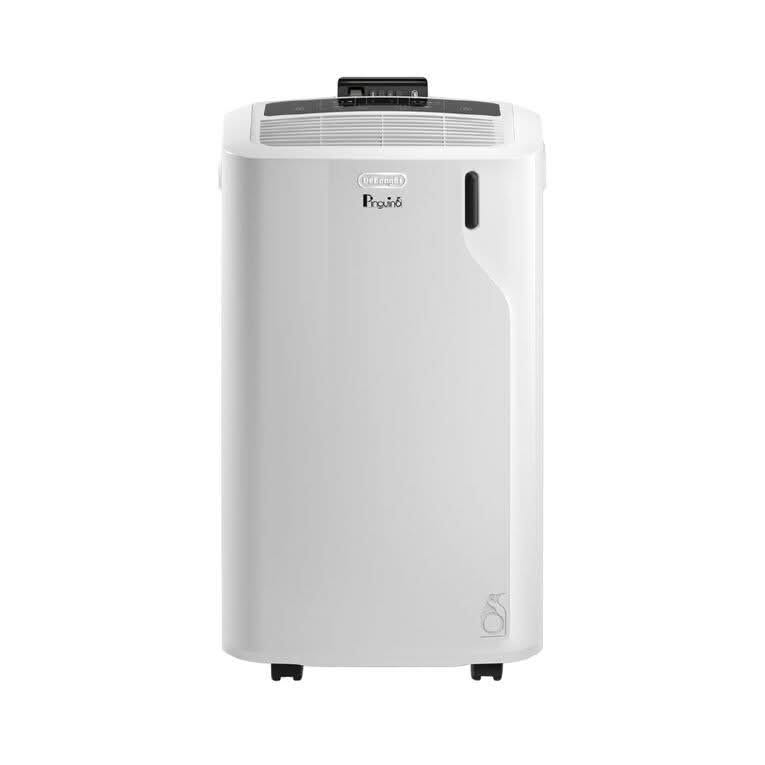
Best for buyers who want a well-known brand, the DeLonghi Pinguino is a 2.4 kW cooling unit from a maker with a long track record in portable climate gear. It leans on DeLonghi’s condensate recirculation system, which reuses collected moisture to boost efficiency and cut down on draining.
The white cabinet carries the rounded Pinguino styling and rolls on castors with moulded handles, so shifting it between rooms is straightforward. A soft-touch control panel sits on top and the supplied remote has its own LCD display, making it easy to read the set temperature from the sofa. A 24-hour electronic timer and thermostat handle scheduling and hold a target temperature.
Performance is solid for its size: DeLonghi quotes an energy efficiency ratio of 2.6, three fan speeds let owners trade maximum power for quieter running, and independent testing found a comparable Pinguino can take a 25 square metre room from about 35 degrees down to the low 20s within an hour. It uses R290 gas and offers a dehumidifying mode alongside straight cooling and fan-only ventilation.
The trade-offs are worth knowing: on maximum fan it runs at roughly 63 decibels, so it is present rather than silent, and in very humid conditions the internal tank can fill and pause the unit until it is drained despite the continuous gravity drainage option. It is also cooling only, with no heating mode.
Key specs: Model PACEM82. 2.4 kW cooling, EER 2.6, R290, 3 fan speeds, dehumidifying, 24-hour timer and thermostat, remote with LCD, continuous gravity drainage.
Pros
- Established brand with condensate recirculation for efficiency
- Remote with LCD plus soft-touch panel and 24-hour timer
- Three fan speeds and a dehumidifying mode
Cons
- Around 63 dB on maximum fan, so not a quiet unit
- Tank can fill and pause the unit in high humidity
- Cooling only, with no heating
4. Sheffield Portable Air Conditioner – Best for Dehumidifying

Best for damp rooms, the Sheffield PL619 pairs cooling with a strong 19 litre per day dehumidifying function, which is genuinely useful in New Zealand’s muggy summers and shoulder seasons. Its 7000 BTU (about 2.05 kW) output suits smaller spaces such as a bedroom, study or apartment living area.
The cabinet measures 67.3 x 30.3 x 28.9 cm and weighs around 20 kg, making it the lightest of the compressor units here and the easiest to move on its four all-directional castor wheels. An LED colour display shows the settings clearly, and a 24-hour timer lets owners set it to switch off after they fall asleep. The box includes the ducting kit and window bracket needed to vent it, so there is nothing extra to buy on day one.
It runs a self-evaporating system, so most of the condensate is expelled through the exhaust rather than collected in a tank. Sheffield rates noise at under 65 decibels, and there are two fan speeds plus a remote control. A 24-month warranty backs it, and it is stocked by several NZ retailers including Noel Leeming.
The trade-offs: only two fan speeds means less fine control than rivals with three, the under-65 decibel rating puts it at the louder end of this group, and at 7000 BTU it is best kept to smaller rooms rather than open-plan areas. It also shows as on special order rather than always in stock.
Key specs: Model PL619. 7000 BTU (2.05 kW) cooling, 19 L/day dehumidifying, self-evaporating, LED display, 24-hour timer, 2 fan speeds, window kit included, approx 20 kg, 24-month warranty.
Pros
- Strong 19 L/day dehumidifying, ideal for damp NZ rooms
- Lightest compressor unit here at around 20 kg
- Window kit and ducting included in the box
Cons
- Only two fan speeds
- Under 65 dB puts it at the louder end
- 7000 BTU best suits small rooms only
5. Goldair Evaporative Cooler – Best Low-Cost Cooler for Dry Days

Best for cheap, low-effort cooling on dry days, the Goldair GCEV160 is an evaporative cooler rather than a refrigerative air conditioner, so it works differently to the other four picks. It draws warm room air across a 7 litre tank of water or ice and blows cooler air back out, which is why it needs no exhaust hose and costs very little to run. For a fuller look at this category, see our guide to evaporative air coolers.
It is a slim white floor unit on wheels, so it moves easily and stores away out of season. Controls are electronic with an included remote, there are three fan speeds, oscillating louvres to spread the air, and a timer function. Filling is as simple as topping up the tank, and adding ice gives a short-term boost to the chill of the airflow.
Because there is no compressor, running costs and noise are low, and there is nothing to vent, which makes it the least hassle to set up. It suits medium to large rooms where the goal is a cooling breeze rather than a set temperature, and it is handy on a covered deck or in a garage workshop.
The big trade-off is climate: evaporative coolers add moisture to the air and are most effective in dry heat, so in New Zealand’s often humid summer they can leave a room feeling damp and cool far less than a compressor unit. Owner reports note indoor humidity can climb noticeably during use. Treat it as a low-cost comfort fan with a chill boost, not a replacement for refrigerative cooling.
Key specs: Model GCEV160. Evaporative cooler, 7 L water tank, 3 fan speeds, oscillating louvres, electronic controls, remote, timer, castors, 12-month warranty.
Pros
- Very low running cost and no venting required
- Light, wheeled and simple to set up and store
- Ice boost and oscillation for a refreshing breeze
Cons
- Adds humidity and struggles in NZ’s damp summer air
- Does not lower temperature like a compressor AC
- Needs regular refilling of the water tank
How to choose a portable air conditioner
Match the capacity to the room. As a rough guide, a 2.5 kW unit suits 12 to 18 square metres, while larger open-plan spaces need more power. Buying too small means the unit runs flat out and still struggles; too large wastes money.
Plan the venting. Every refrigerative portable here uses a single exhaust hose that has to reach a window or vent, so the hot air leaves the room. If you cannot vent, an evaporative cooler is the only no-hose option, but with the humidity caveat above. In damp homes, also consider pairing cooling with home humidifiers or dehumidifying settings to keep indoor air comfortable.
Think about running costs. Portable air conditioners are among the thirstier cooling options and are less efficient than a fixed heat pump, so a reverse-cycle model that also heats can be better value if you will use it across seasons. Check the rated power draw before buying.
Consider noise, weight and drainage. Look for three fan speeds and a sleep mode if bedroom use matters, castors if you will move it, and self-evaporating or condensate-recycling designs to avoid constant draining. If your real need is winter warmth, electric blankets and heaters are cheaper to run than cooling gear pressed into heating duty.
Verdict
For most New Zealand homes, the Midea 2.5kW Cooling is the sensible all-rounder: compact, in stock and genuinely cooling. Buyers who want one appliance for summer and winter should step up to the reverse-cycle Midea 3.25kW WiFi model, while the Sheffield PL619 is the value pick for damp rooms thanks to its strong dehumidifying. The DeLonghi Pinguino is the safe trusted-brand choice, and the Goldair evaporative cooler makes sense only as a low-cost option for dry conditions.
FAQs
Do portable air conditioners need a window?
Refrigerative portable air conditioners produce hot air that must be vented outside the room, usually through a window using the included exhaust hose and window kit. Without venting, the unit simply recirculates its own heat and will not cool. Evaporative coolers are the exception and need no hose.
Are portable air conditioners expensive to run?
Portable air conditioners are among the thirstier cooling options and are generally less efficient than a fixed heat pump, which can use far less power for the same cooling. Running cost depends on capacity, room size, set temperature and insulation, so choose the smallest unit that suits your space.
What size portable air conditioner do I need?
Match capacity to room size. A 2.5 kW unit suits roughly 12 to 18 square metres, such as a bedroom or small office, while a 3.25 kW model covers around 16 to 23 square metres. Larger open-plan rooms need more power, and undersized units run constantly without cooling well.
Do you have to drain a portable air conditioner?
Many modern units, including the Midea models here, recycle condensate and expel it through the exhaust, so they rarely need draining. In very humid conditions the internal tank can still fill and pause the unit until emptied. Self-evaporating systems reduce, but do not always eliminate, manual draining.
Are evaporative coolers or portable air conditioners better in NZ?
For New Zealand’s often humid summers, a refrigerative portable air conditioner is usually the better choice because it removes both heat and moisture. Evaporative coolers work best in dry heat and can raise indoor humidity, leaving damp rooms feeling muggy rather than cool, so they suit only drier conditions.
Can a portable air conditioner also heat a room?
Yes, reverse-cycle models such as the Midea 3.25kW WiFi unit both cool and heat, making them useful all year. Cooling-only units like the Midea 2.5kW, DeLonghi Pinguino and Sheffield PL619 do not heat. Portable heating is handy but less efficient than a fixed heat pump for regular winter use.