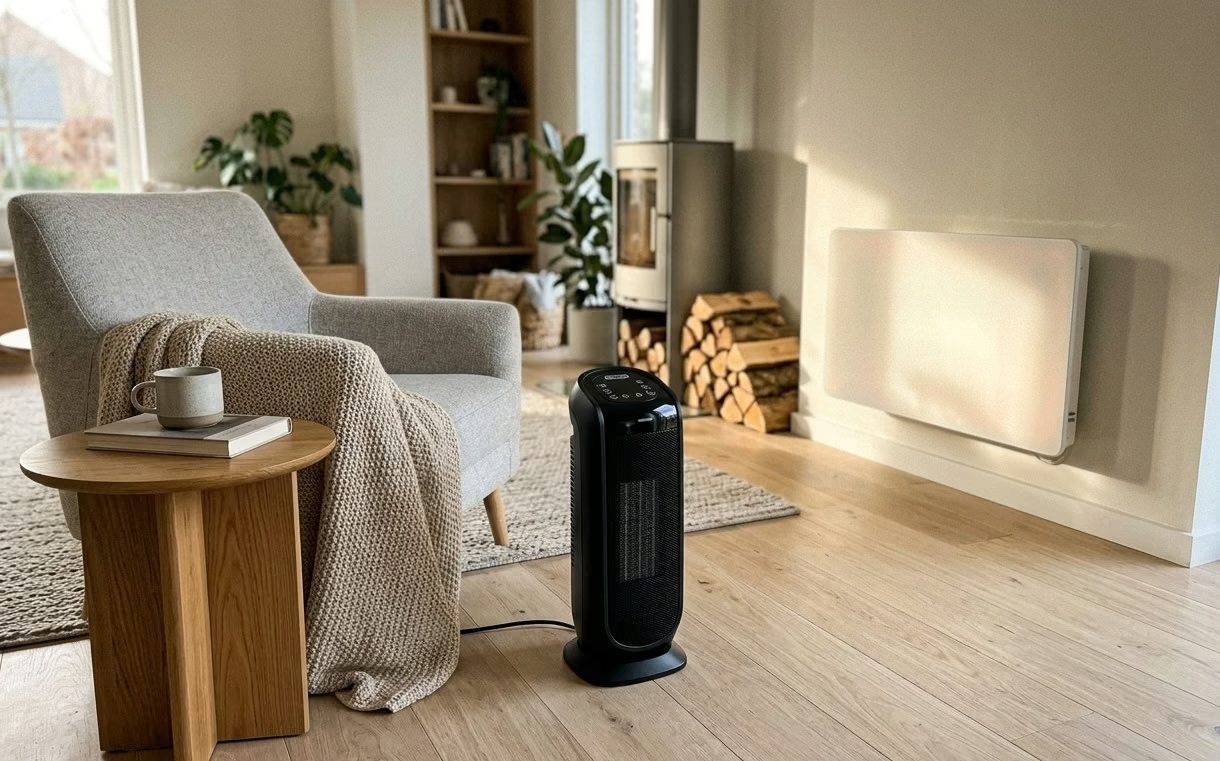
The best heater in NZ for most homes right now is a ceramic tower heater with a wide thermostat range and genuine tip-over protection, such as the Devanti 2000W Ceramic Tower Heater, since it heats a bedroom or small lounge quickly without the running-cost or safety trade-offs of a cheap fan heater. This guide rounds up 11 heaters available from New Zealand retailers for 2026, covering ceramic, fan, convector, fireplace-style and outdoor infrared options, so shoppers can match the right type to the room rather than buying on price alone.
Every pick below was checked for live NZ stock, researched against other retailer listings and owner feedback for genuine detail, and written up with real trade-offs rather than blanket praise. Heating a large, draughty lounge calls for a different heater to warming a desk or a covered deck, so the comparison table and “How to choose” section further down cover which type suits which room. For extra winter comfort alongside a heater, see the guide to the best humidifiers.
Quick Comparison
| Pick | Best for | Type | Power |
|---|---|---|---|
| 1. 2-in-1 Bladeless Fan Heater and Cooler | Year-Round Use | Bladeless fan heater/cooler | N/A (fan/heat modes) |
| 2. Devanti Ceramic Tower Heater (White) | Simple, No-Fuss Bedroom Heating | Ceramic tower heater | 1200W/2000W |
| 3. Devanti Ceramic Tower Heater (Black) | Fine-Tuned Temperature Control | Ceramic tower heater | 40W/1200W/2000W |
| 4. Devanti Electric Fan Heater | Fast, Cheap Spot Heating | Fan heater | 1000W/2000W |
| 5. Midea Convector Electric Heater | Silent Background Heat | Convector heater | 800W/1200W/2000W |
| 6. Portable Mini Desk Heater | a Single Desk or Personal Space | Mini desk heater | Not disclosed |
| 7. Small Portable Electric Heater | Tight Budgets | Small portable electric heater | Not disclosed |
| 8. Devanti Ceramic Fan Heater | Desks and Small Offices | Ceramic fan heater | 600W/1200W |
| 9. PTC Graphene Portable Fan Heater | Near-Instant Heat | PTC graphene fan heater | 1200W |
| 10. Electric Fireplace Stove Heater | Fireplace Ambience on a Budget | Electric fireplace/stove heater | 900W/2000W |
| 11. Maxkon Carbon Fibre Infrared Heater | Outdoor Patios and Decks | Carbon fibre infrared heater (outdoor) | 1000W/2000W |
1. 2-in-1 Bladeless Fan Heater – Best for Year-Round Use
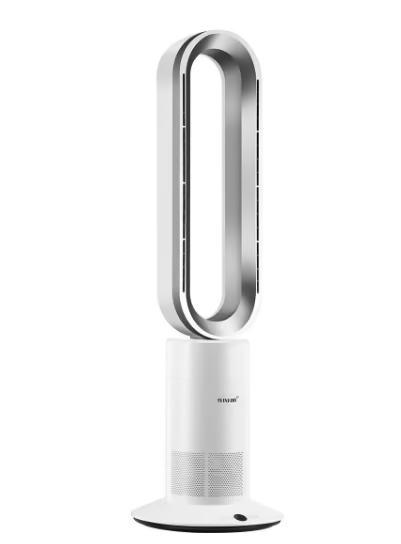
Best for households that want one appliance covering both winter heating and summer cooling without blade safety concerns, this bladeless tower unit earns its spot by switching from a heater in July to a fan in January without a second appliance taking up cupboard space.
The design follows the familiar bladeless tower format: a slim, freestanding column with an open loop head that draws air in at the base and pushes it out through the ring, rather than visible spinning blades. Towers in this product family typically stand around 60 to 66cm tall with a footprint under 25cm square, light enough for one person to reposition between rooms, which suits a bedroom, home office or lounge corner in a typical NZ home rather than a large open-plan living area.
Finished in white with a silver-grey trim, the unit has a glossy plastic shell and a small LED touch display on the upper body, backed by a remote control for adjusting from the couch or bed. The look sits closer to budget-appliance than premium, but the absence of visible blades gives it a tidier profile than a standard pedestal fan.
Setup is plug-in-and-go with no assembly. The touch panel and remote handle switching between fan and heat, oscillation, and a timer that runs up to nine hours for automatic overnight shutoff. Owners of similar bladeless hot-and-cold units report the fan mode as genuinely quiet at low speeds but noticeably whirrier at top speed, and note that heat felt right next to the unit is stronger than air felt a metre or two away, so it works best as a personal-space heater rather than a whole-room solution. Cleaning is straightforward with no blades or grille to dismantle.
The trade-off: this is not a strong whole-room heater and should not replace a heat pump or panel heater in a large lounge; it heats the person nearby quickly but loses effect further away.
Pros
- Doubles as a heater and a cooling fan, useful year-round
- No exposed blades, a safer pick around kids and pets
- Simple touch panel plus remote, up to 9-hour timer
- Easy to wipe clean with no grille to remove
Cons
- Heat output drops off noticeably more than a metre or two away
- Fan noise increases at the top speed setting
- Not a substitute for a proper whole-room heater
Key specs: Bladeless tower fan heater/cooler; oscillating; LED touch display and remote; 9-hour timer; white with silver-grey trim.
2. Devanti Ceramic Tower Heater – Best for Simple, No-Fuss Bedroom Heating
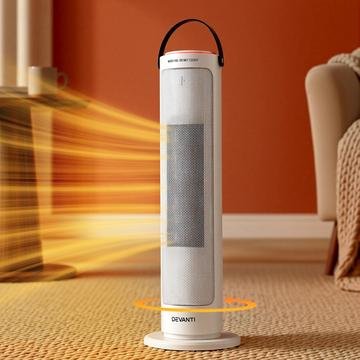
Best for a straightforward bedroom or living room heater that does not ask the owner to think too hard about settings, this ceramic tower gets warm fast and gets out of the way.
It is a slim vertical tower measuring 18cm by 18cm at the base and standing 54cm tall, small enough to tuck into a corner of a bedroom or lounge without becoming a trip hazard, with a 150cm cable that reaches most wall sockets without an extension cord.
Finished in plain white with a moulded ABS-and-metal body, it has a leather-look carry handle and a touch-control LED display set into the top of the tower. It reads as a functional, budget-tier appliance rather than a design piece, but the white finish blends into most NZ bedrooms and rental furnishings.
The outer shell is ABS plastic over a metal chassis, with a ceramic PTC heating element inside and a dense anti-scald mesh over the heat outlet, which matters for households with children or pets nearby. It also has a tip-over safety switch and overheat protection.
Setup needs no assembly. The touch panel controls thermostat, oscillation and heating mode across four modes (fan, warm air, hot air, ECO), and a separate remote allows adjustment without getting up; ECO mode cycles heat around 24 degrees to trim running costs. Wide-angle oscillation spreads warmth more evenly through a room. The one quirk worth flagging: the remote and touch buttons emit an audible beep on every press, which some owners of this model line find intrusive late at night near someone sleeping.
It runs at 1200W or 2000W, with electronic thermostat control from 15 to 35 degrees and a 9-hour timer with auto shut-off.
The trade-off: there’s no NZ-specific warranty term stated on the TSB Living listing, and as a dropship item from Australia, delivery is quoted at up to 15 working days rather than next-day.
Pros
- Reaches temperature quickly for a bedroom or small lounge
- Electronic thermostat from 15-35°C with an ECO mode for running costs
- Touch panel plus remote, four heat modes, 9-hour timer
- Tip-over switch and overheat protection built in
Cons
- Touch and remote buttons beep on every press, with no way to silence it
- No stated NZ warranty term on the retailer listing
- Delivery can take up to 15 working days as a dropshipped item
Key specs: SKU PR14025; 1200W/2000W; 18cm x 18cm x 54cm; thermostat 15-35°C; 4 modes; 9-hour timer; ABS and metal body; white.
3. Devanti Ceramic Tower Heater – Best for Fine-Tuned Temperature Control
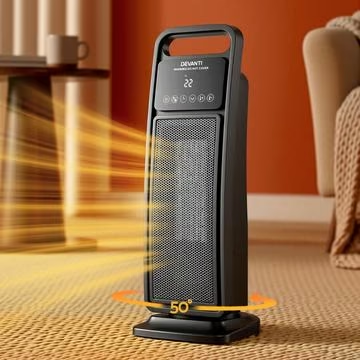
Best for someone who wants finer control over exact room temperature rather than just low and high settings, this version’s wider 18 to 45 degree thermostat band is the detail that sets it apart from a basic two-setting heater.
Built as a compact vertical tower, it measures 18cm by 18cm at the base and 51cm tall, marginally shorter than its white sibling, with a 150cm power cord. That footprint suits a bedside table, a desk under a window, or a narrow gap beside a couch, and it is light enough to carry between rooms with the built-in handle.
Finished in matte black with an ABS-and-metal housing, it has the same top-mounted LED touchscreen panel rather than physical dials, giving it a slightly more modern look than the white version, and the dark finish hides scuffs and dust better over time.
The body combines ABS panels with a metal frame, a ceramic PTC heating element, and the same anti-scald mesh, tip-over cut-off and overheat protection as the white model.
No assembly is needed. Day-to-day control runs through the LED touchscreen or included remote, covering thermostat, oscillation and mode. Oscillation on this version is a narrower 50-degree sweep than the white model’s wide angle, so it throws heat in a tighter arc rather than sweeping a whole room. Worth flagging: TSB Living’s own listing shows a specification inconsistency, with the description text quoting power settings of 2000W, 1400W and 40W while the specifications table lists 40W, 1200W and 2000W, so the exact middle wattage setting is not entirely clear from the retailer’s own page.
It runs a low fan-only setting near 40W, a mid heat setting, and a top 2000W setting, with the 18-45°C thermostat and an 8-hour timer.
The trade-off: the conflicting wattage figures on the retailer’s own spec sheet mean the exact mid-setting output shouldn’t be taken as gospel, and the narrower 50-degree oscillation covers less width than a wide-angle model if the goal is heating a whole room.
Pros
- Wider 18-45°C thermostat range for finer temperature control
- Compact footprint suits a bedside table or desk
- Black finish hides scuffs and dust
- 1-year warranty stated on the listing
Cons
- Retailer’s own spec sheet lists conflicting mid-setting wattage figures
- Narrower 50-degree oscillation than the white model, less whole-room spread
- Dropshipped from Australia, up to 15 working days delivery
Key specs: SKU PR14026; 40W/1200W (spec table) or 1400W (description)/2000W; 18cm x 18cm x 51cm; thermostat 18-45°C; oscillation 50°; 8-hour timer; 1-year warranty; black.
4. Devanti Electric Fan Heater – Best for Fast, Cheap Spot Heating
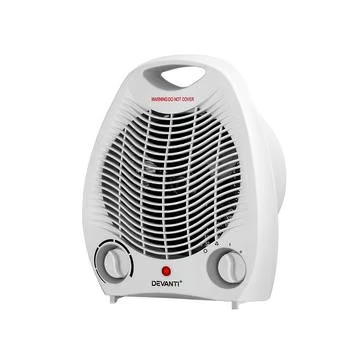
Best for fast, cheap spot-heating in a small room or office, this fan heater will not win design awards, but it earns its place by warming a cold room in minutes without costing much to buy or run.
It is a compact upright box measuring 21cm by 13.5cm by 27cm and weighing just 1.1kg, with a moulded carry handle and a 130cm cord, small enough to tuck under a desk or move between rooms without effort. The finish is plain white ABS plastic with a rounded, slightly boxy silhouette that disappears easily into a home office or bathroom corner. Controls are a simple physical thermostat dial rather than a digital display, which keeps things straightforward but feels budget-grade next to pricier heaters with touch panels.
Build quality is what it appears to be: light plastic housing rather than metal, so it feels more disposable than durable, though a tip-over safety switch and overheat protection cover the basics. Setup needs no assembly; plug in, turn the dial, done. There are three modes (cool, warm, hot) and two power settings (1000W/2000W), so output can be scaled down for a small room.
The trade-off: there’s no digital timer, no remote, and no oscillation, and being a fan heater it runs noticeably louder than a convector or ceramic heater, though no official decibel figure is published. It comes in white only.
Pros
- Warms a small room quickly for a low upfront cost
- Compact and light enough (1.1kg) to move between rooms
- Two power settings and three modes for flexibility
- Tip-over switch and overheat protection included
Cons
- No digital timer, remote, or oscillation
- Runs louder than a ceramic or convector heater
- Only available in white, no colour choice
Key specs: SKU PR12922 (Devanti FH-A-2000-WH); 1000W/2000W; 21cm x 13.5cm x 27cm; 1.1kg; ABS plastic; 1-year warranty.
5. Midea Convector Electric Heater – Best for Silent Background Heat
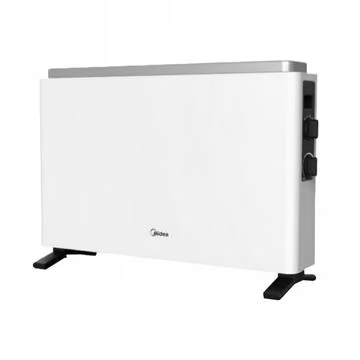
Best for silent background heat in a bedroom or living room, this convector pushes warmth out through natural airflow rather than a fan, so there is no whirring noise to talk over or fall asleep to.
It is a slim upright panel measuring 523mm by 170mm by 357mm and weighing 2.7kg, freestanding rather than wall-mounted, light enough to lift and reposition but not designed to roll around the house. The look is plain white with a silver-painted vent grille on the front face, giving it a neat but unmistakably budget-appliance appearance. Controls are mechanical dial-type knobs on the side rather than a digital display.
The housing is a painted metal-and-white finish typical of convector panels in this price bracket, with overheat protection and a tip-over safety switch that cuts power if knocked. Setup is plug-and-play with no assembly. Because it heats by convection, the outer casing gets warm to the touch during use, worth knowing around young children or pets, and heat-up is gradual rather than instant compared with a fan heater.
It runs on three heat levels, 800W low, 1200W medium and 2000W high, suited to rooms of roughly 10 to 15 square metres. Verified owner reviews on the same model line describe it as heating well and being well suited to small to medium rooms.
The trade-off: convection heating is slower to warm a cold room than a fan heater, and there is no oscillation, timer, or remote control on this model.
Pros
- Genuinely silent operation, no fan noise
- Three heat levels (800W/1200W/2000W) for flexibility
- Simple mechanical controls, nothing to learn
- Overheat protection and tip-over safety switch
Cons
- Slower to warm a room than a fan heater
- Outer casing gets warm to the touch during use
- No timer, remote, or oscillation
Key specs: Model NDK20-21A; 800W/1200W/2000W; 523mm x 170mm x 357mm; 2.7kg; white with silver grille; 12-month warranty.
6. Portable Mini Desk Heater – Best for a Single Desk or Personal Space
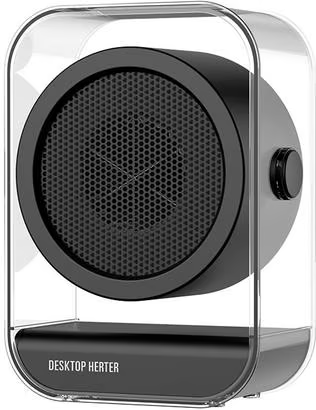
Best for warming a single desk or small personal space, this compact unit is built for keeping one person’s hands or feet warm at close range, not for heating a whole room.
Its design leans into the desk-accessory idea rather than a traditional heater shape, with a see-through, dust-proof outer casing paired with a minimalist black cover, giving it a more gadget-like look than the average boxy plastic heater. No official dimensions or weight are published by the retailer, but it is marketed and photographed as a compact desktop unit rather than a floor-standing tower, and described as lightweight enough to carry between rooms. Controls are kept simple, with two temperature settings and no digital display.
The retailer does not specify the housing material beyond the transparent panel and black cover, so it should be assumed to be light plastic construction. Setup is plug-and-play, and the listing claims the heating element reaches temperature instantly on startup, with overheating protection as the only stated safety feature.
The trade-off: TSB Living does not publish wattage, dimensions, weight, or warranty length for this heater anywhere on the product page, and no independent reviews or other NZ retailers stocking the same unit could be found. Buyers who want a heater with a clear power rating and a track record of reviews should look elsewhere on this list; this one suits someone happy to buy on the strength of its compact desk-friendly footprint alone.
Pros
- Compact, gadget-like design suited to a desk or nightstand
- Simple two-setting operation, nothing to configure
- Transparent dust-proof casing is a distinctive look
- Lightweight and easy to move between rooms
Cons
- Wattage, dimensions and weight are not published anywhere
- No independent owner reviews could be found
- Only one stated safety feature (overheat protection), no tip-over switch mentioned
Key specs: SKU PR14024; 2 temperature settings; transparent casing with black cover; overheat protection; wattage, dimensions and warranty not disclosed.
7. Small Portable Electric Heater – Best for Tight Budgets
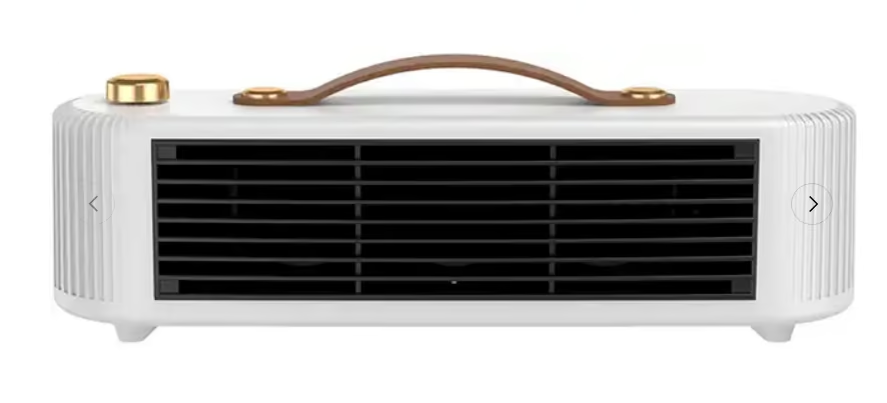
Best for tight budgets and small personal spaces such as a desk, bedside table or small office nook, this compact plug-in heater does one job: taking the chill off a small area without asking for much in return. Despite “solar” appearing in the product listing name, this is a standard mains-powered electric heater, not a solar-powered unit.
It is a small, boxy unit built for a single spot rather than a whole room, the kind of heater that lives permanently under a desk or on a bedside table rather than getting wheeled between rooms. TSB Living does not publish dimensions or weight, so buyers should judge size from the product photography rather than exact measurements. It comes in a single colourway, finished in plain moulded plastic rather than anything with a premium feel.
There is no dial or digital display described on the product page; the listing leans on marketing language such as rapid heating technology and a smart thermostat system rather than spec-sheet detail. Setup is plug-and-go, with automatic overheat protection and an anti-scald housing design mentioned specifically for households with kids or pets. No noise rating is published, and there are no owner reviews attached to this specific listing.
The trade-off: without a published wattage, output area, or thermostat range, buyers are taking more on faith than with the brand-name alternatives on this list, and it will not touch a room larger than the space right around it.
Pros
- Genuinely compact, suited to a desk or bedside table
- Anti-scald housing and overheat protection for use around kids or pets
- Simple plug-and-go operation
- Budget-friendly option for spot heating
Cons
- Wattage, dimensions and thermostat range are not disclosed
- No independent owner reviews exist for this listing
- Marketed with “solar” in the name despite being a standard mains-powered heater
Key specs: SKU PR13758; smart thermostat system and rapid heating technology claimed; automatic overheat protection; anti-scald housing; wattage and dimensions not disclosed.
8. Devanti Ceramic Fan Heater – Best for Desks and Small Offices
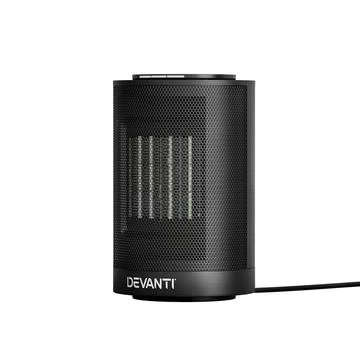
Best for desks and small offices needing fast, directional heat, this Devanti-branded ceramic fan heater trades room-filling ambition for quick, focused warmth exactly where it is aimed.
It is a small standing tower, 13.8cm by 13.8cm by 21.8cm, narrow enough to tuck beside a monitor stand or under a desk without eating into legroom, and light at roughly 1.5kg to shift between rooms. Finished in matte black ABS plastic, it looks utilitarian rather than premium, but touch controls and an LED thermostat display (16-37°C) give it a slightly more finished feel than a bare mechanical dial.
Setup is genuinely no-fuss: no assembly required, straight out of the box and onto a desk. It runs two heat settings across three modes (cool, warm, hot) with a 70-degree oscillation sweep, plus a 9-hour timer with auto shut-off. Verified owner reviews on the identical model are largely positive for small bedrooms, studios and office use, praising the easy touch controls, though feedback is mixed on noise, with several owners calling it fine for sleeping near and at least one finding it a little too noisy on the higher setting. One verified review also flagged that the tip-over safety switch feels thin and does not always engage reliably on carpet.
The trade-off: it will not heat anything beyond a small room; one owner using it in a larger kids’ room found it fell short.
Pros
- Compact footprint suits a desk or small office
- LED thermostat display (16-37°C) plus touch controls
- Wide 70-degree oscillation and 9-hour timer
- Real verified owner reviews back up everyday performance
Cons
- Noise is a mixed bag; some owners find it too loud on high
- Tip-over switch reportedly doesn’t always engage reliably on carpet
- Not powerful enough for a room larger than small-to-medium
Key specs: Model Devanti FH-A-1200-BK; 600W/1200W; 13.8cm x 13.8cm x 21.8cm; approx. 1.5kg; oscillation 70°; 9-hour timer; 1-year warranty.
9. PTC Graphene Portable Fan Heater – Best for Near-Instant Heat
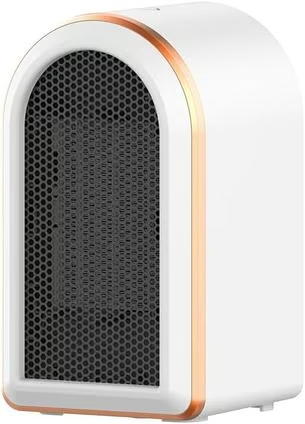
Best for near-instant heat in a small bedroom or office without the usual fan-heater racket, this graphene-element heater leans on faster heat transfer and a genuinely low noise claim rather than raw power.
It is described by the retailer as compact and lightweight enough to sit on a desk or nightstand, though TSB Living publishes no exact dimensions or weight, so buyers are working from product photography rather than a spec sheet. It ships with a built-in carrying handle, pitching it as something to move from room to room. No colourways are listed beyond the single default option, and there is no stated display or control type on the product page.
The headline feature is the PTC graphene heating element: graphene’s higher thermal conductivity versus standard ceramic PTC material means heat should transfer into the airflow faster, and the retailer claims a 3-second warm-up time. The listing also claims operation under 30dB, which would be genuinely quiet for a fan heater if accurate, though this figure comes from the manufacturer and has not been independently verified for this specific unit. Two temperature settings are offered rather than a continuous dial, and 360-degree internal air circulation is meant to spread heat evenly. Tip-over and overheat protection are both included.
The trade-off: no dimensions, weight, timer, oscillation detail, or genuine owner reviews exist anywhere for this exact listing, so buyers are relying more heavily on manufacturer claims than with a heater that has an established review history.
Pros
- Claimed 3-second warm-up thanks to the graphene element
- Claimed sub-30dB operation, genuinely quiet if accurate
- 360-degree air circulation for more even heat spread
- Tip-over and overheat protection included
Cons
- Dimensions, weight and noise figures are manufacturer claims, not independently verified
- No timer or oscillation detail published
- No genuine owner reviews found for this exact listing
Key specs: SKU PR14081; 1200W; 2 temperature settings; PTC graphene element; claimed 3-second heat-up; claimed under 30dB.
10. Electric Fireplace Stove Heater – Best for Fireplace Ambience on a Budget
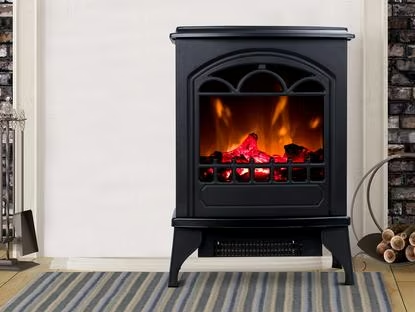
Best for fireplace ambience on a budget, this freestanding stove heater delivers the look of a real log fire without the mess, making it a sensible pick for anyone who wants cosy visual warmth in a small NZ living room or bedroom.
The design follows a classic pot-belly stove silhouette scaled down to apartment size, standing 56.5cm tall on a 42cm by 25.5cm footprint, with four angled metal legs lifting the body clear of the floor. It is compact enough to tuck into a corner or against a hallway wall rather than needing a dedicated hearth space.
Finished in matte black metal with a glass-fronted viewing window, it reads more like a decorative stove than a bare bar heater, and the log-effect display gives it a warmer visual presence than a plain heating element sitting in the room.
Build is a metal body over a plastic internal housing, with a wire heating element and a fan to push warm air outward. It ships flat-packed with four feet and a screw pack that need to be attached before first use, so budget a few minutes with a screwdriver rather than expecting it fully assembled. Controls are manual switches rather than a digital panel, which keeps operation straightforward: pick a heat setting, flick it on, and the LED log effect can run independently of the heating element if only the ambience is wanted. TSB Living rates it for a 30-second heat-up.
Performance is modest but tidy for the price bracket: 2000W maximum output with a lower 900W setting, rated to heat up to 30 square metres.
The trade-off: this is a fan heater with a flame skin rather than genuine radiant infrared, so output in a large or draughty open-plan room will feel thinner than the wattage suggests, and there is no remote control or timer.
Pros
- Realistic log-effect flame display that can run independent of the heat
- Compact pot-belly stove footprint suits a corner or hallway
- Two power settings (900W/2000W) with a fast 30-second heat-up
- Overheat cut-off for safety
Cons
- Requires basic flat-pack assembly (feet and screws) before first use
- No remote control or timer
- Output feels thinner than the wattage in large or draughty rooms
Key specs: Model EFL-2000W-01-BK; 900W/2000W; 42cm x 25.5cm x 56.5cm; black metal with LED log effect; manual switches.
11. Maxkon Carbon Fibre Infrared Heater – Best for Outdoor Patios and Decks
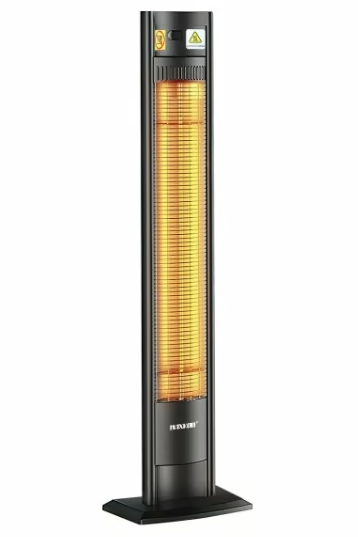
Best for heating an outdoor patio or deck, this is the one to shortlist specifically for outdoor use, not the living room; it is built and rated for weather exposure in a way the indoor picks on this list are not.
Design-wise it is a slim freestanding strip heater on a stand, measuring roughly 26cm by 20cm by 106cm and weighing 7.6kg gross, standing about waist height and light enough for one person to reposition around a deck or under a patio roof without a trolley. The tall, narrow profile takes up little floor space compared with a bar heater, which matters on a NZ deck where outdoor furniture already eats into the area.
Finished in black with a mesh grille front over the carbon fibre element, it has a utilitarian, tradesman-shed look rather than a decorative one; function over form is the clear design brief. There is no digital display; the remote handles power level and a 0 to 24-hour timer, with the unit itself running on simple physical controls.
Set-up is genuinely quick: unbox, attach the freestanding base, plug in. Carbon fibre infrared means near-instant heat in 5 to 10 seconds rather than the slow warm-up of a fan heater, and Maxkon states it runs quietly since there is no fan pushing air. It carries anti-tilt shut-off (power cuts if tipped past 45 degrees) and overheat protection, both sensible extras with kids or pets around an outdoor heater.
On power, it runs two settings (1000W and 2000W) via remote, is IP55-rated for wet weather, and covers roughly a 1.8 metre radius at a 120-degree spread.
The trade-off: this is a spot heater, not a room heater. On an open, exposed patio in wind, effective warmth is limited to whoever is sitting close and in its throw path, not the whole outdoor area.
Pros
- IP55 weatherproof rating, genuinely built for outdoor use
- Near-instant heat (5-10 seconds) from the carbon fibre element
- Remote control with a 0-24 hour timer
- Anti-tilt shut-off and overheat protection
Cons
- Spot heater only; open, windy patios lose effectiveness quickly
- No digital display, controls are basic
- Optional mounting accessories reportedly fiddly to source and fit
Key specs: Model BD-TORNADO2000 (PID 39750); 1000W/2000W; 26cm x 20cm x 106cm; 7.6kg; IP55 rated; remote with 0-24h timer.
How to Choose a Heater in NZ
Room size and wattage matter more than any single feature. NZ heating guides generally suggest around 100 watts per square metre for an averagely insulated room, so a 1000W heater suits roughly 10 square metres and a 2000W heater suits a medium bedroom or small lounge. Poorly insulated rooms, high ceilings and large windows all push that number up, which is why several picks above offer multiple wattage settings rather than a single fixed output.
Heater type changes how the warmth feels. Fan heaters (like the Devanti Electric Fan Heater above) warm a room fastest but run the loudest. Ceramic heaters run quieter and suit longer use in a bedroom or office. Convector heaters like the Midea NDK20-21A are silent but slower to warm a room. Infrared and carbon fibre heaters, such as the Maxkon patio heater, heat people and objects directly rather than the air, which is why they work outdoors where wind disperses warm air before a fan or ceramic heater can build it up.
Safety features are worth checking before price. A tip-over cut-off switch and overheat protection are standard on most heaters in this guide, and neither should be skipped, especially in a household with kids or pets. No plug-in heater should be left running unattended overnight regardless of what safety features it has.
Running cost is roughly the same across resistance heaters of the same wattage, whether fan, ceramic or convector, since they all convert electricity to heat at close to a 1:1 ratio. A heat pump is far cheaper to run long-term, but for a rental, a single room, or a covered deck where installing a heat pump isn’t practical, a portable heater with the right wattage for the space, paired with a timer, is the more realistic option.
For a cold bedroom specifically, pairing a smaller heater with the best electric blanket is often cheaper to run overnight than a heater left on high. Once the room is warm rather than cold, the best air coolers cover the opposite job for summer using a similarly portable format. And for shoppers deciding between a portable heater and a fixed appliance, the best portable air conditioners offers heating and cooling in one unit for a bigger up-front spend.
Ceramic units heat a room fast and lose it just as fast, whereas oil heaters stay warm long after they switch off, which suits a bedroom overnight far better. Anything on castors gets moved around the house constantly, which is exactly how the best portable fan earns its keep at the other end of the year. The same appliance rarely does both jobs well, so plan on a cooling fan for January rather than hoping a reverse-cycle unit covers it.
Verdict
For most NZ households, the Devanti 2000W Ceramic Tower Heater (White) is the best all-round pick: it heats a bedroom or small lounge quickly, has a wide thermostat range, and includes the tip-over and overheat protection that matter most in everyday use. Shoppers on a tight budget who just need to take the chill off a desk or bedside table are better served by the Devanti Electric Fan Heater or the small portable electric heater, while anyone heating a covered deck or patio should go straight to the Maxkon Carbon Fibre Infrared Heater, since it is the only pick on this list actually rated for outdoor weather exposure. None of these portable heaters will beat a heat pump on running cost, but for rentals, single rooms and outdoor spaces where a heat pump isn’t an option, the picks above cover the realistic range of NZ heating needs for 2026.
FAQs
What size heater do I need for a room in NZ?
As a rough guide, NZ heating guides suggest around 100 watts per square metre for an averagely insulated room, so a 1000W heater suits roughly 10 square metres. Poorly insulated rooms, high ceilings or large windows need more. A 2000W heater generally covers a medium bedroom or small lounge comfortably.
What’s the cheapest type of heater to run in NZ?
All plug-in resistance heaters (fan, ceramic, convector, oil column) convert electricity to heat at roughly the same 1:1 ratio, so running costs are similar for the same wattage. Heat pumps are far cheaper long-term, but among portable heaters, choosing the lowest wattage that still warms the space and using a timer keeps costs down.
Is a ceramic heater better than a fan heater?
Neither is universally better. Fan heaters warm a room fastest and suit quick bursts of heat, but run louder. Ceramic heaters are generally quieter and better suited to longer use in bedrooms or offices, since their element self-regulates once the room reaches temperature. Choose based on noise tolerance and how long it will run.
Is it safe to leave a heater on overnight?
Most manufacturers and safety experts advise against leaving any plug-in heater unattended overnight, due to fire risk from tip-overs or nearby bedding and fabric. Heaters with tip-over cut-off switches and overheat protection, like most models in this guide, reduce risk, but a timer that switches the unit off after a few hours is the safer approach.
How much does it cost to run a 2000W heater in NZ?
At around 30 to 35 cents per kWh, a 2000W heater running flat-out for one hour costs roughly 60 to 70 cents, or about $3 to $4 for a typical five-hour evening. Running it on a lower setting, or only until the room reaches temperature, cuts this substantially, which is why a heater with multiple wattage settings is worth choosing.
Are infrared patio heaters good for outdoor use in NZ?
Yes, for outdoor decks and patios, carbon fibre or infrared strip heaters are generally a better fit than indoor fan or ceramic heaters, since they heat by direct radiant warmth rather than relying on airflow that wind disperses. Look for a weatherproof, IP-rated design built for freestanding outdoor use.
