
The best walking pad in NZ overall is the TSB Living W04 Walking Pad Treadmill, thanks to its quiet 1.0 HP motor, slim 12.5 cm deck and wireless remote -,enough for most people who just want to clock steps at home or under a standing desk. For walkers who want a handrail and faster speeds, the T Walking Pad with Handle reaches 12 km/h, and runners who want a premium folding deck should look at the KingSmith WalkingPad X21.
Walking pads are slim, low-profile treadmills built for walking and light jogging rather than running. They slide under a desk, sofa or bed and let you add steps while you work, take calls or watch TV. New Zealand demand has climbed sharply, with one major retailer reporting a 270% jump in walking pad sales in June 2024 versus a year earlier, so there are now plenty of models at every price. This guide ranks 14 walking pads available from NZ retailers, with verified speeds and weight limits. Each pick is matched to a different shopper, and the trade-offs are spelled out so the list is genuinely useful rather than all-positive.
Pairing daily steps with strength work makes a real difference, so it is worth reading alongside the best home gyms and the best adjustable dumbbells if a full home setup is the goal.
The Best Walking Pads NZ
1. Pro Trainer W04 Walking Pad (with Remote) — Best overall value
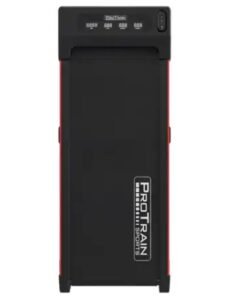
Verdict:The best-value walking pad in NZ for everyday home use — quiet, slim and remote-controlled.
The W04 is a flat under-desk pad with a powder-coated steel frame in matte black and a 125 cm long, 12.5 cm high body, so it tucks under most standing desks and slides under a sofa between sessions. The running surface is 40 cm wide, which is fine for a natural walking stride but narrows the margin for error if attention drifts to a screen.
Setup is genuinely plug-and-walk: it ships fully assembled, and speed is set from 1 to 6 km/h using the included wireless remote, which also has an emergency stop. An LCD readout tracks time, speed, distance and calories. The 1.0 HP motor is built for walking, not running, and owners choose this type of pad precisely because it runs quietly enough for calls. Transport wheels and overload and short-circuit protection round it out.
- Pro:Quiet 1.0 HP motor and a wireless remote with emergency stop
- Pro:Arrives fully assembled with transport wheels; slim 12.5 cm deck
- Pro:Currently discounted and in stock
- Con:Walking only — tops out at 6 km/h with no incline
- Con:40 cm belt is narrower than premium pads, and there is no handrail
Key specs:1–6 km/h; 1.0 HP; 100 kg max user weight; 125 × 52 × 12.5 cm; 40 cm belt width; powder-coated steel; LCD display; wireless remote; transport wheels.
2. DS Walking Pad with Handle — Best for walk-and-jog with a handrail
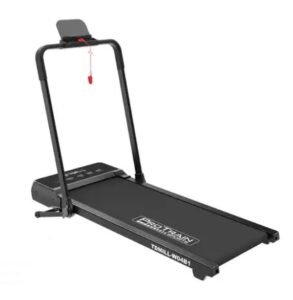
Verdict:The pick for anyone who wants a handrail and faster speeds — it reaches 12 km/h, so brisk walking and light jogging are both on the table.
Unlike the flat pads, this model adds a folding handlebar with its own control panel, giving a sense of balance that matters once the pace climbs. It measures 126 × 60 × 114 cm with the handle up and folds down to roughly 134 × 60 × 15 cm for storage on its transport wheels. The frame is the same powder-coated black steel as the rest of the TSB range.
The dual-speed mode runs from 1 to 12 km/h, six preset programs add some structure, and the listing notes an auto-adjusting incline — unusual at this size. Speed is controlled from both the handle panel and a wireless remote, with a bright LED display for the metrics. it is the priciest of the TSB pads, which is the trade-off for the extra speed and the handrail.
- Pro:Reaches 12 km/h, so light jogging is possible, not just walking
- Pro:Handlebar with panel controls plus a wireless remote; six programs
- Pro:Higher 110 kg weight capacity and an auto-adjust incline
- Con:Most expensive TSB option
- Con:Running belt is still 40 cm wide
Key specs:1–12 km/h; 1.0 HP; 110 kg max user weight; 126 × 60 × 114 cm (folds to ~134 × 60 × 15 cm); 40 cm belt; handle + remote; LED display; 6 programs; transport wheels.
3. TSB Living Walking Pad – Best for app tracking with a handle
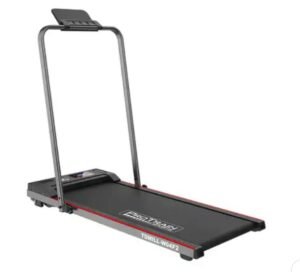
Verdict:The TSB pad to choose if Bluetooth app tracking matters — it pairs a support handle with a fitness app.
This handled pad is built around connectivity: it offers Bluetooth and a companion fitness app, so steps, speed, distance and calories can be logged and reviewed on a phone rather than only on the onboard LED. A wireless remote handles speed changes, and the handle adds stability for less confident walkers.
It keeps the familiar 40 cm anti-slip belt, foldable frame and transport wheels of the range. The honest caveat is that TSB’s page does not publish a confirmed top speed or weight capacity for this exact model, so anyone who needs a specific figure should check with the retailer before buying.
Note:Some specs (speed, weight limit) are not published, and stock showed as “unavailable” — verify both before publishing.
- Pro:Bluetooth fitness app for logging walks — a genuine differentiator in this range
- Pro:Support handle plus wireless remote, foldable with wheels
- Pro:Mid-range price
- Con:Top speed and weight capacity are not published on the listing
- Con:Stock showed as “unavailable” at the time of writing
Key specs:1.0 HP; 40 cm anti-slip belt; Bluetooth + app; LED display; wireless remote; support handle; foldable with transport wheels.
4. DS Walking Pad with Remote — Cheapest slim remote pad
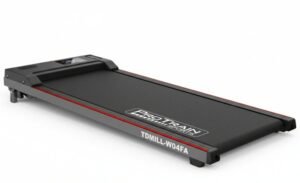
Verdict:Effectively the W04’s cheaper twin — the same slim, remote-controlled walking pad, with a slightly higher 110 kg capacity.
The DS pad shares the W04’s flat, no-handle layout: a 125 cm long, 11.5 cm high powder-coated steel deck with a 40 cm belt, an LCD for time, speed, distance and calories, and a wireless remote for speed. It arrives assembled with transport wheels and the same overload and short-circuit protection.
The practical difference is a slightly higher 110 kg weight limit and a marginally slimmer 11.5 cm profile, at a few dollars less than the W04. It is walking-only at 1 to 6 km/h with no incline, so it suits step-counting rather than training.
Note:Stock showed as low / “unavailable” at the time of writing — confirm before publishing.
- Pro:Lowest-priced TSB pad
- Pro:Slightly higher 110 kg capacity and a slim 11.5 cm deck
- Pro:LCD plus wireless remote, fully assembled with wheels
- Con:Walking only at 6 km/h, no incline or handrail
- Con:Showed low stock / “unavailable” at the time of writing
Key specs:1–6 km/h; 1.0 HP; 110 kg max user weight; 125 × 52 × 11.5 cm; 40 cm belt; LCD; wireless remote; transport wheels.
5. DS Walking Pad — Handle + button variant
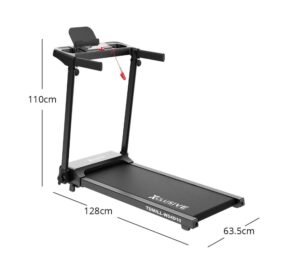
Verdict:A handle-and-button variant of the DS pad sold by TSB Living — list it once availability and specs are confirmed.
This listing appears to be a button-and-handle edition of the DS walking pad, combining the slim DS deck with a support handle and panel buttons. It was supplied as a partner product to feature, but the page would not render its full details at the time of writing and the exact specification could not be independently confirmed.
Because bestreview.co.nz never publishes fabricated specs, this entry is held as a placeholder: once the live page confirms the price, speed range, weight capacity and stock, write it up to the same depth as the other DS pads above. If the URL turns out to redirect to the standard DS handle model, fold it into that entry instead.
Note:This URL could not be verified as a live, in-stock product page — confirm it before featuring, or merge it into pick #2/#3 if it duplicates them.
- Pro:Adds a support handle and physical buttons to the slim DS pad
- Pro:Sold by partner retailer TSB Living
- Con:Specs and price could not be verified at the time of writing
- Con:Confirm the page is live and in stock before publishing
Key specs:To be confirmed from the live product page (price, speed, weight capacity, dimensions).
6. Genki Folding Treadmill — Most powerful, with a folding desk

Verdict:More treadmill than pad — a 1.8 HP folding unit with 12 programmes, a foldable table and support for users up to 120 kg.
The Genki blurs the line into a full treadmill, with a 1.8 HP drive system, 12 programmes that shift between aerobic and slower sessions, and a foldable table over the deck. The wider belt suits a natural stride, and the 120 kg capacity is the joint-highest among the legacy picks.
- Pro:Stronger 1.8 HP motor with 12 workout programmes
- Pro:Folding table and a higher 120 kg weight capacity
- Con:Bulkier and heavier than a true under-desk walking pad
Key specs:1.8 HP motor; 12 programmes; up to 120 kg; wide belt; foldable frame with table.
7. KingSmith WalkingPad X21 — Best premium pad
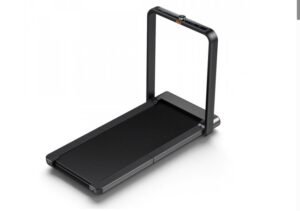
Verdict:The premium choice and the only true runner here — a 0.5–12 km/h aluminium deck that double-folds for upright storage.
The X21’s headline trick is a 180-degree double fold (an award-winning design) that lets the 110 × 80 cm deck collapse to roughly 27 cm thick and stand upright in a wardrobe. The all-aluminium-alloy frame and four-layer 121 × 46 cm running belt feel a clear step above the budget pads, and a concealed LED keeps the lines clean.
A 918 W brushless motor drives speeds from 0.5 to 12 km/h at a quoted 75 dB, an OLED panel sits on the armrest, and the KS Fit app pairs over NFC for tracking. It is the most capable pick for genuine jogging and running. The trade-offs are real: at 42 kg it is heavy to move despite folding, it is by far the dearest option, and the 5-year motor warranty is back-to-base, so freight for any service is the owner’s cost. A fitness tracker pairs well with the app for monitoring heart rate on faster sessions.
- Pro:Real running speeds to 12 km/h with a premium 4-layer belt
- Pro:180-degree double fold stores upright in minimal space
- Pro:Aluminium build, NFC app pairing and a 5-year motor warranty
- Con:Heaviest pick at 42 kg, and by far the most expensive
- Con:Warranty is back-to-base — the owner pays freight for service
Key specs:0.5–12 km/h; 918 W brushless motor; 110 kg max user weight; 121 × 46 cm belt; folds to 110 × 80 × 27 cm; 42 kg; aluminium frame; OLED armrest panel; KS Fit app; 75 dB.
8. GymJunkie Walking Pad — Best ultra-compact
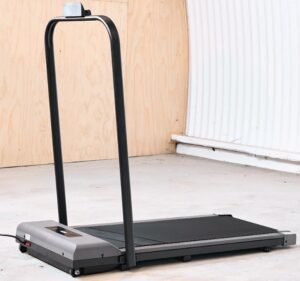
Verdict:The lightest, easiest pad to live with day to day — 18.2 kg, remote-controlled and well reviewed.
At 111 × 50 × 13 cm and 18.2 kg, this is the pad to pick if it will be dragged out and put away daily; one reviewer specifically praised how easy it is to reposition. The 100 × 41.5 cm running area and 1 to 6 km/h range cover walking comfortably, controlled by a wireless remote, and it carries a clean run of 5-star reviews.
It is a low-profile, no-fold design, so rather than folding it simply slides under a desk or bed. Two honest caveats come straight from owner feedback: the motor is on the small side (2.0 HP peak but only 0.65 HP continuous, 100 kg limit), and one reviewer found it “quite loud,” with a support bar that does not collapse.
- Pro:Light at 18.2 kg and easy to reposition daily
- Pro:Wireless remote and a strong run of 5-star reviews
- Pro:Sharp price with same-day shipping
- Con:Does not fold — it slides away rather than folding flat
- Con:A reviewer found it “quite loud”; walking only with a modest continuous motor
Key specs:1–6 km/h; 2.0 HP peak / 0.65 HP continuous; 100 kg max user weight; 100 × 41.5 cm belt; 111 × 50 × 13 cm; 18.2 kg; wireless remote; 2-year guarantee.
9. MERACH Walking Pad — Best app experience
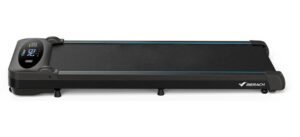
Verdict:The pick for heavier users and app fans — a 120 kg capacity and a 1,000-plus-workout app, on sale.
The MERACH stands out on two fronts: a 120 kg weight limit, the highest in this guide, and the MERACH fitness app, which adds more than 1,000 workouts plus real-time distance, speed and calorie tracking and even fitness games. The one-piece ABS and PC shell over an alloy frame is shock-absorbing and, MERACH says, fully recyclable, and it runs quietly at around 50 dB.
It is foldable and light to move, with a 30-night money-back guarantee and a 12-month warranty behind it. The catch is the listing itself: several specs conflict (top speed appears as both 6.0 and 6.4 km/h, and weight is quoted as both 13 kg and 20 kg), so the exact numbers should be confirmed with the retailer before relying on them.
Note:The retailer listing contains conflicting figures (speed 6.0 vs 6.4 km/h; weight 13 vs 20 kg) — confirm exact specs before quoting.
- Pro:Highest weight capacity here at 120 kg
- Pro:MERACH app with 1,000-plus workouts and live tracking
- Pro:Quiet (~50 dB), foldable, with a 30-night money-back guarantee
- Con:The product listing has several conflicting specs to verify
- Con:No display or remote detail given, and no customer reviews yet
Key specs:~2–6 km/h; 2.5 HP; 120 kg max user weight; ~110 × 47 × 11.5 cm; ~13–20 kg; alloy frame with ABS/PC shell; MERACH app; ~50 dB; foldable; 12-month warranty + 30-night money-back.
How to choose the right walking pad
Purpose.For step-counting under a desk, a flat 1–6 km/h pad like the TSB W04 or GymJunkie Compact is plenty. For brisk walking or jogging, choose a model that reaches 10–12 km/h, ideally with a handrail.
Footprint and folding.Measure the space under the desk or bed first. Flat pads (12–13 cm high) slide away easily; folding units like the KingSmith X21 stand upright but are heavier to move.
Weight capacity.Most pads here handle 100–110 kg; the MERACH reaches 120 kg and the Centra only 90 kg. Pick one with clear headroom over your body weight.
Controls.Decide between a simple remote (W04, DS), a handrail panel (T Pad with handle) or full app tracking (MERACH, KingSmith). A handle adds balance once the pace rises.
Noise.Quiet operation (around 50–75 dB) matters for calls and apartments — the MERACH (~50 dB) is the quietest verified here, while one GymJunkie reviewer found that pad loud.
If joint comfort or recovery is a concern, a massage gun helps after longer sessions, and an elliptical trainer is worth comparing for a lower-impact cardio option that also works the upper body.
Walking covers cardio and step count but adds no resistance at all, and vibration plates work the stabilising muscles that a flat treadmill never touches.
Walking pad FAQs
Is a walking pad worth it?
For most home and hybrid workers, yes. A walking pad lets you add low-impact steps while you work, take calls or watch TV, and its slim, foldable design suits small NZ homes. Research on treadmill-desk use links it to better mood, focus and work satisfaction, so it earns its space for many people.
Can you run on a walking pad?
Most walking pads are built for walking and light jogging, not running, and running on a basic pad can damage the motor and void the warranty. If you want to run, choose a sturdier unit such as the KingSmith X21 (up to 12 km/h) or a full treadmill rather than a flat under-desk pad.
How fast does a walking pad go?
Basic flat pads usually top out around 6 km/h, which suits steady walking. More capable models reach 8.8 to 12 km/h, enough for brisk walking and light jogging. In this guide, the TSB W04 and GymJunkie run to 6 km/h, while the TSB handle model and KingSmith X21 reach 12 km/h.
How many calories does a walking pad burn?
It depends on body weight, speed and time, but a typical 30-minute walk burns roughly 100 to 260 calories. Walking pads burn fewer calories per minute than running, yet because they are used more often — several hours across a work week — the weekly total can be substantial.
What is the weight limit on a walking pad?
Most walking pads in NZ support between 80 kg and 120 kg. In this guide, capacities range from 90 kg (Centra) to 120 kg (MERACH), with 100–110 kg most common. Always pick a pad rated comfortably above your body weight, as the limit is listed on each product page.
What is the difference between a walking pad and a treadmill?
A walking pad is a slim, low-profile treadmill made for walking and light jogging, with no incline and a lower top speed, designed to fold or slide away. A full treadmill is larger, faster and often has incline and a handrail for running, but takes up far more permanent floor space.
Do you need a handrail on a walking pad?
A handrail is not essential for slow desk walking, but it adds balance and spatial awareness, especially at higher speeds or for less confident users. Flat pads like the TSB W04 have none; models such as the TSB T Pad with Handle and the KingSmith X21 include one.
How often should you use a walking pad?
Aim for at least 30 minutes of walking most days. Beginners or time-pressed users can start with 10 minutes on three days a week and build up. Because a walking pad sits under your desk, breaking the time into several short walks across the day is an easy way to reach the total.
For most NZ shoppers the TSB Living W04 is the best all-round walking pad: quiet, slim, remote-controlled. Step up to the TSB T Walking Pad with Handle if you want a handrail and 12 km/h speeds, or the KingSmith WalkingPad X21 if you genuinely want to run and can fold it away upright. The GymJunkie Compact is the easiest to live with day to day, and the MERACH suits heavier users who want app tracking. Whichever you pick, check the current price and stock before buying, and track your progress with a bathroom scale and a fitness tracker.