
The Roborock Qrevo L is the best all-round robot vacuum for most New Zealand homes in 2026, thanks to strong 10,000Pa suction, tidy LiDAR mapping and an all-in-one dock that empties itself and washes its own mop pads. This guide ranks 10 robot vacuums sold in NZ and AU, from hands-off flagships to slim budget models, so you can match one to your floors, your pets and your space.
Quick comparison of the best robot vacuums in NZ
| Model | Best for | Suction | Navigation | Self-emptying dock |
|---|---|---|---|---|
| Roborock Qrevo L | Overall best | 10,000Pa | LiDAR | Yes (bagged) |
| Roborock Qrevo L Pro | Hands-off hygiene | 18,500Pa | LiDAR | Yes (heated wash) |
| dreame F10 | Long runtime | 13,000Pa | LiDAR | No |
| Lefant M210 Plus | Ultra-slim | 6,000Pa | ToF laser | Yes (bagged) |
| Eureka E20 Evo Plus | Bagless value | 10,000Pa | LiDAR | Yes (bagless) |
| Ecovacs Deebot T30S Pro | Edges and corners | 11,000Pa | dToF | Yes (10-in-1) |
| Roborock Q7B | Mid-range mapping | 8,000Pa | LiDAR | No |
| Xiaomi Robot Vacuum S40C | Entry LiDAR | 5,000Pa | LDS laser | No |
| Lefant M1 | Small apartments | 5,500Pa | dToF LiDAR | No |
| Monsga MR1 | Tight budget | 3,000Pa | Sensor/gyro | No |
1. Roborock Qrevo L
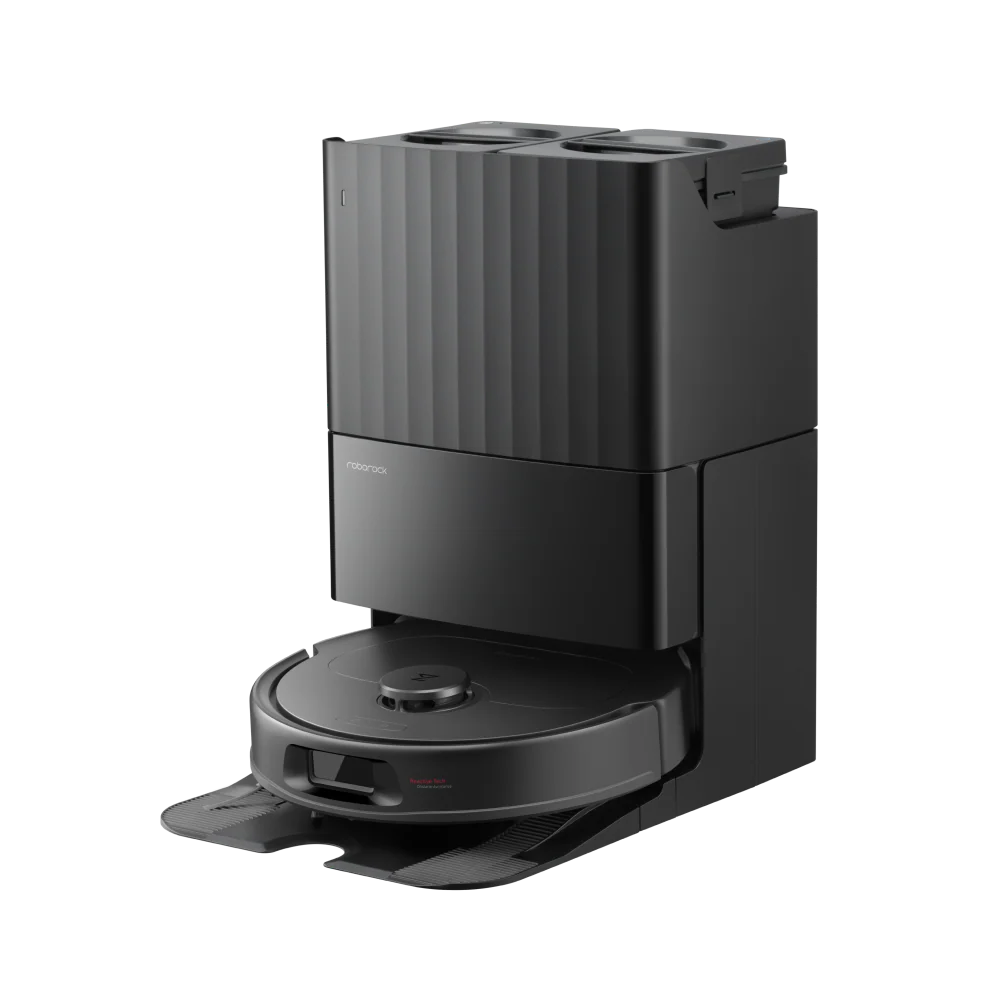
Best for: Best overall for most NZ homes.
The Roborock Qrevo L pairs 10,000Pa suction with LiDAR mapping and a multifunction dock, so it vacuums, mops, empties itself and washes its own mop pads with little input. Roborock lists dual spinning mop pads turning at around 200 RPM and a 10mm auto-lift that raises them when the robot detects carpet, which helps stop damp pads dragging across rugs.
The dock handles auto dust emptying (Roborock quotes up to about seven weeks between bag changes), mop self-washing and air drying, plus automatic water refilling. Standing 96.5mm tall, it clears most Kiwi couches but can be tight under low-set NZ furniture, so measure first. Reviewers note the anti-tangle side brush and all-rubber main brush cope well with long and pet hair, and the app supports Alexa, Google and Siri shortcuts.
The main trade-off is that the L uses a cool-water mop wash rather than the heated wash on the pricier L Pro, so stubborn dried spills may need a second pass. Its structured-light obstacle avoidance is also less sophisticated than camera-AI rivals, meaning small cables and socks are best cleared before a run.
Pros:
- Strong 10,000Pa suction with reliable LiDAR mapping
- All-in-one dock empties, washes mops and refills water
- Anti-tangle side brush and rubber main brush suit pet hair
Cons:
- Cool-water mop wash only, unlike the L Pro
- Obstacle avoidance can nudge thin cables and socks
Key specs: Model: Roborock Qrevo L (Black). Suction: 10,000Pa. Navigation: LiDAR with reactive obstacle sensing. Height: 96.5mm. Dock: auto-empty, mop self-wash, air dry, auto refill.
2. Roborock Qrevo L Pro
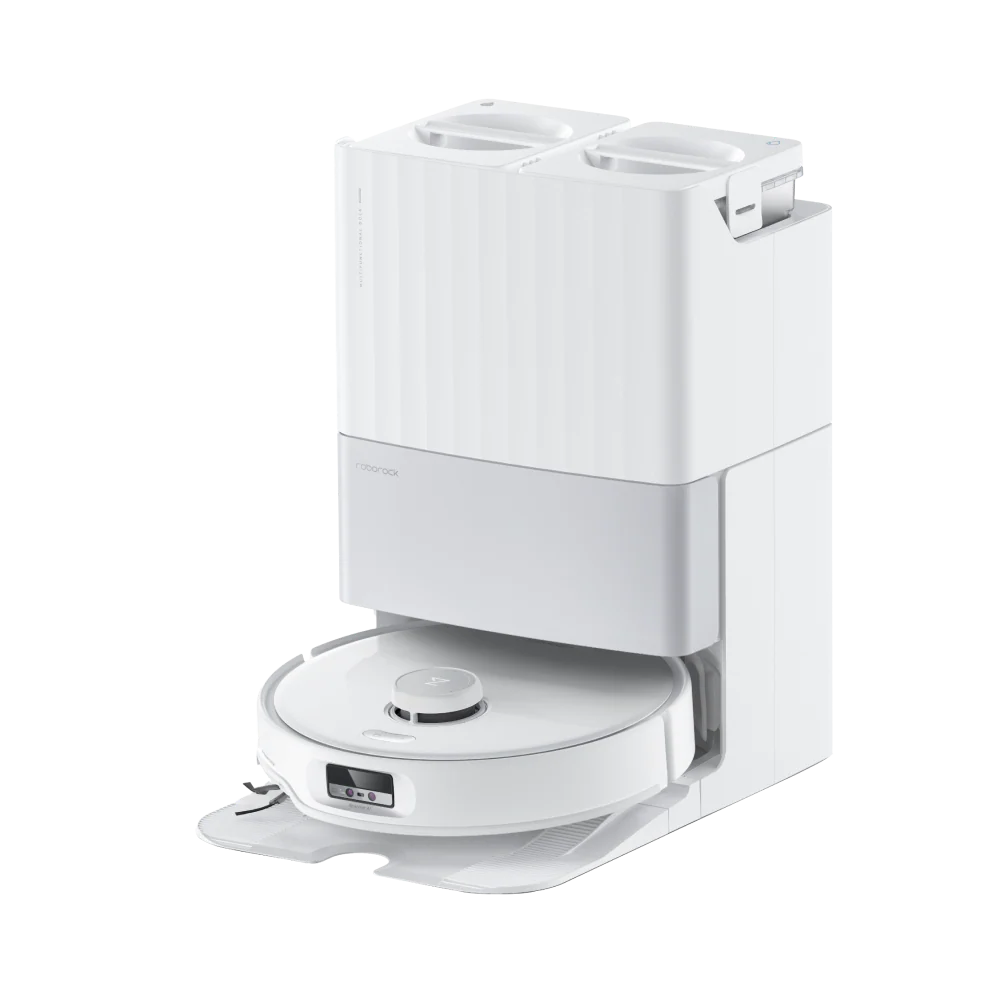
Best for: Best for hands-off hygiene.
The Qrevo L Pro steps suction up to a headline 18,500Pa and adds a heated dock that washes its mop pads at up to 75C and dries them with 45C warm air, which owners report leaves pads fresher between cleans and cuts the damp-cloth smell. Roborock notes the 75C figure is measured at the heater outlet rather than the mop face, so treat it as a hygiene aid, not a sterilising claim.
The all-in-one dock also empties the dustbin (Roborock quotes up to 65 days), refills the clean-water tank and charges around 30% faster than the standard dock. Dual liftable spinning mops and a 10mm lift keep carpets dry, while an arc-shaped anti-tangle side brush earned an SGS zero-tangle result in the brand’s testing.
At 96.5mm tall the robot is slim, but the dock has a sizeable footprint (about 340 x 487 x 519mm), so you will need a clear corner with a power point nearby. The trade-off is size and complexity: the tall dock dominates a small laundry, and structured-light navigation is not full camera AI, so it can still nudge thin cables.
Pros:
- Very high 18,500Pa suction
- Heated 75C mop wash and 45C warm-air drying
- Auto-empty up to 65 days, auto refill and faster charging
Cons:
- Tall dock has a large footprint
- Premium pricing and structured-light avoidance, not camera AI
Key specs: Model: Roborock Qrevo L Pro (White). Suction: 18,500Pa. Navigation: LiDAR plus reactive obstacle sensing. Dock: 75C mop wash, 45C dry, auto-empty (65 days), auto refill.
3. dreame F10
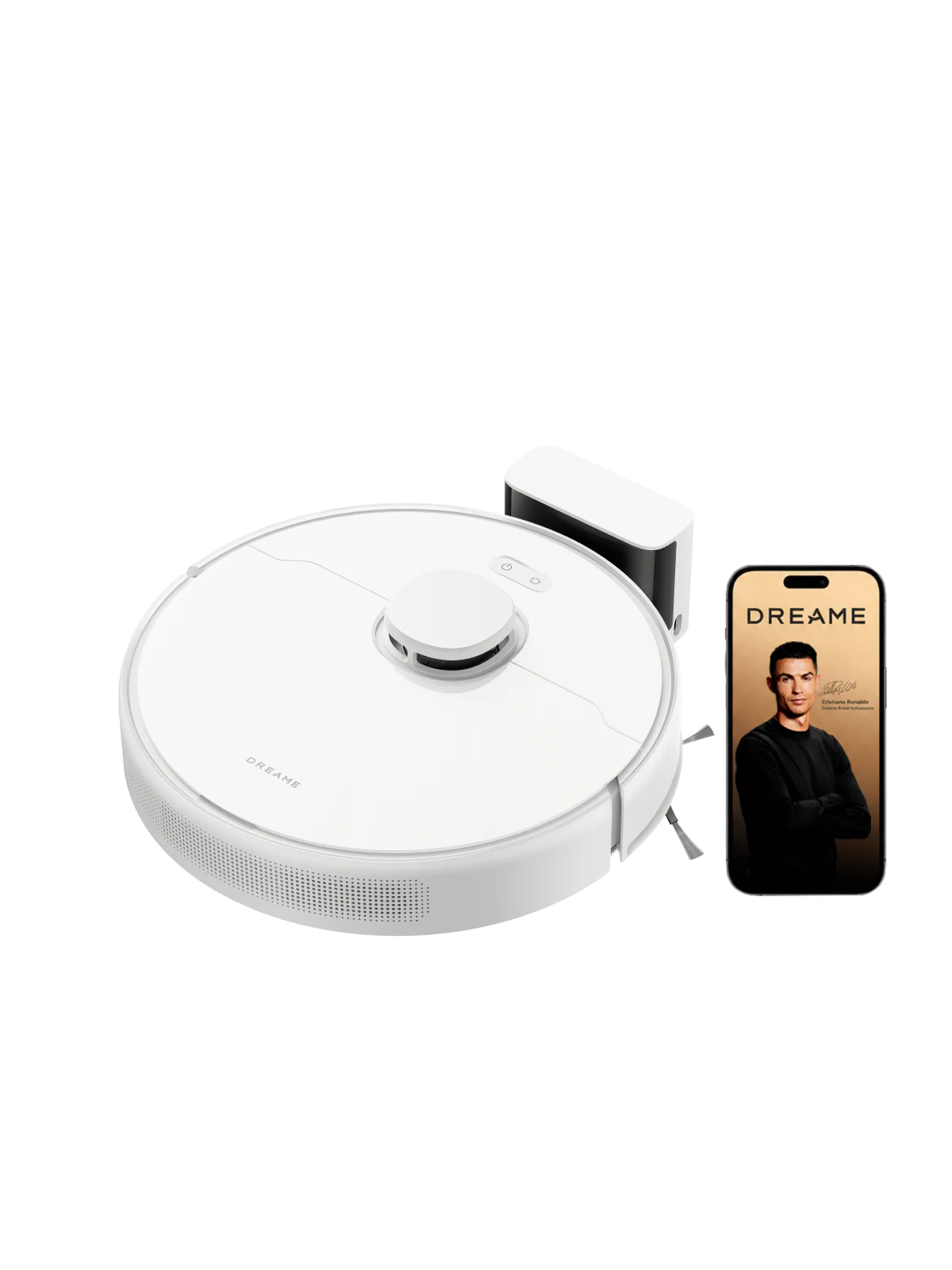
Best for: Best for long runtime on a budget.
The dreame F10 (sometimes listed as F10 Plus) is built around a 5,200mAh battery that dreame rates at up to 300 minutes, with recharge-and-resume so it can finish a big floor plan across several charges. Suction is quoted at 13,000Pa and LiDAR handles the mapping, including multi-floor maps and cliff sensors. It is a 2-in-1 vacuum and mop with a detachable pad and a 235mL water tank.
The clear limitation is the dock: the F10 ships with a plain charging base, so there is no self-emptying or mop washing, and you empty the bin and rinse the pad by hand. The small 235mL tank also needs refilling on larger mopping jobs. Reviewers note the all-rubber floating main brush helps reduce hair wrap, though there is no dedicated anti-tangle side brush.
Editorial note: confirm current NZ or AU stock before buying, as this model appears to be winding down on some official stores. At 96.2mm tall and 3.28kg it is a standard-height robot that fits under most furniture.
Pros:
- Long runtime rated up to 300 minutes
- LiDAR mapping with multi-floor maps
- 13,000Pa suction for the price
Cons:
- Charging base only, no self-emptying or mop washing
- Small 235mL water tank; check current NZ stock
Key specs: Model: dreame F10. Suction: 13,000Pa. Navigation: LiDAR. Battery: 5,200mAh, up to 300 min. Height: 96.2mm. Dock: charging base only.
4. Lefant M210 Plus
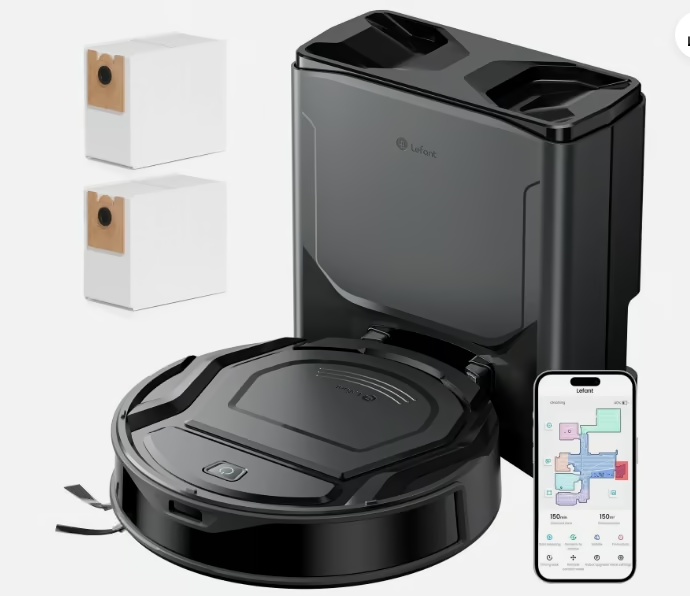
Best for: Best ultra-slim for low furniture.
The Lefant M210 Plus stands out for an ultra-slim 80mm body that slides under beds and cabinets many taller robots cannot reach. It uses ToF laser navigation with multi-level mapping, a V-shaped roller brush to limit hair tangle, and a self-emptying station that Lefant says holds up to 75 days of debris across two 2.5L bags.
Suction is listed at 6,000Pa and runtime at around 140 minutes, with 2.4G and 5G WiFi plus Alexa and Google support. Mopping is the simple 2-in-1 type with app-controlled water levels, so it wipes hard floors rather than scrubbing.
Editorial note: we could not confirm this exact M210 Plus name on a New Zealand or Australian retailer or on Lefant’s own site, where the closest match is the M2 Plus; verify the model and local stock before publishing, and add a manufacturer image. The trade-offs are modest raw suction next to the flagship picks and a drag-pad mop that will not tackle dried-on messes.
Pros:
- Ultra-slim 80mm body reaches under low furniture
- Self-emptying station rated up to 75 days
- V-shaped roller brush helps limit tangling
Cons:
- Model name and local stock could not be confirmed on a non-Amazon NZ/AU source
- Modest suction and basic drag-pad mopping
Key specs: Model: Lefant M210 Plus. Suction: 6,000Pa. Navigation: ToF laser. Height: about 80mm. Dock: self-empty, two 2.5L bags, up to 75 days.
5. Eureka E20 Evo Plus
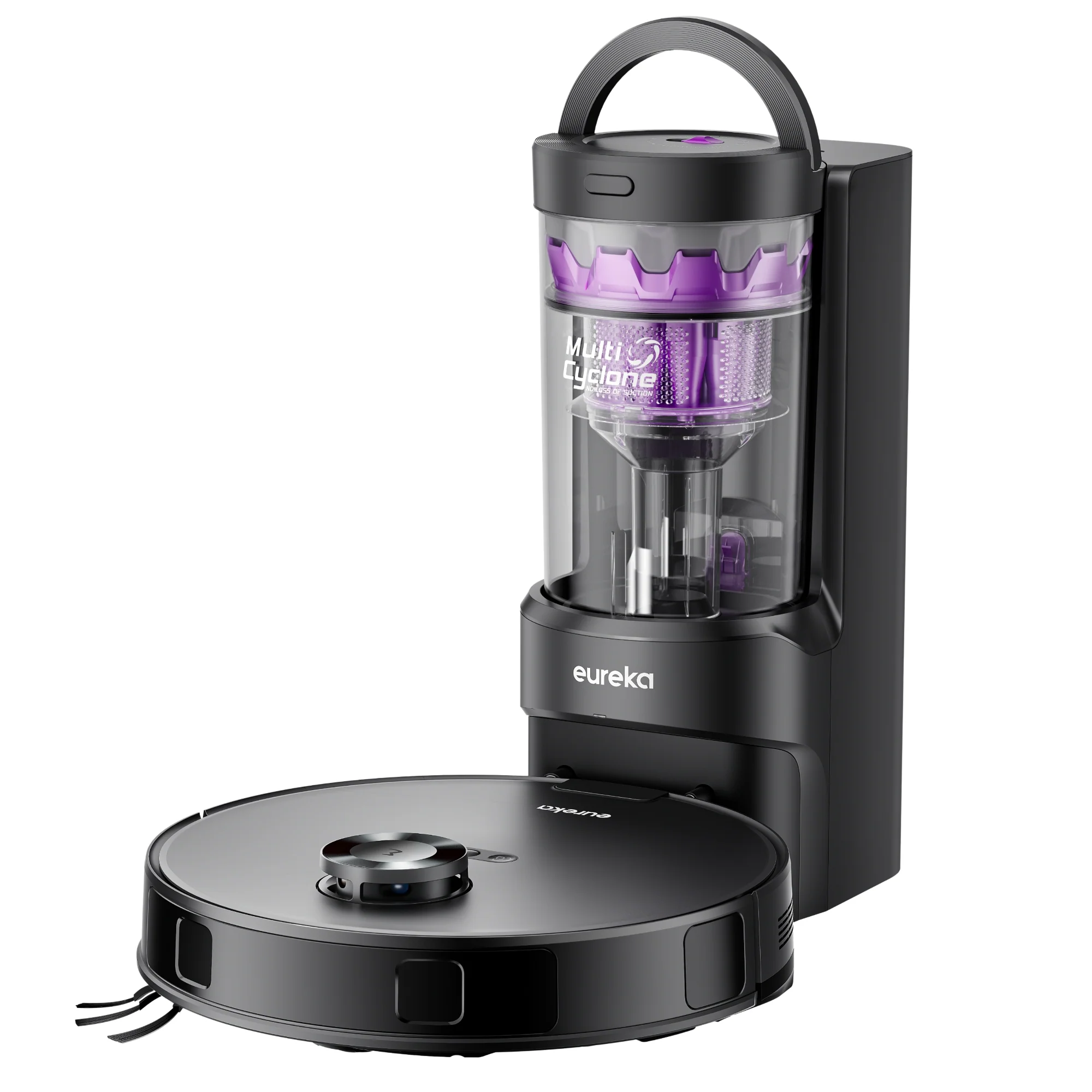
Best for: Best bagless self-emptying value.
The Eureka E20 Evo Plus uses a bagless self-emptying station with a transparent 2L dust cup, which Eureka says holds up to 45 days of debris and uses a 13-cone multi-cyclonic system for around 98% dust separation. Emptying a washable cup instead of buying disposable bags keeps running costs down over time.
Navigation is LDS LiDAR with a right-side sensor for obstacle avoidance, and the mop pad auto-lifts about 10mm when carpet is detected. Suction is rated at 10,000Pa and the 5,200mAh battery runs to roughly 180 minutes. Owners report the DragonClaw V-shaped side brush and V-shaped anti-tangle roller handle hair well.
The clear trade-off is mopping: the dock empties dust but does not wash or refill the mop, and the pad is a simple drag design, so it is for maintenance wiping rather than deep scrubbing. The app covers Alexa and Google, with Siri support flagged for a future update.
Pros:
- Bagless self-emptying dock, no bags to buy
- 10,000Pa suction with LiDAR navigation
- Anti-tangle side brush and roller for pet hair
Cons:
- Dock does not wash or refill the mop
- Simple drag-pad mopping only
Key specs: Model: Eureka E20 Evo Plus (White, NERE20EVOWHPLUS). Suction: 10,000Pa. Navigation: LDS LiDAR. Dock: bagless self-empty, 2L cup, up to 45 days.
6. Ecovacs Deebot T30S Pro
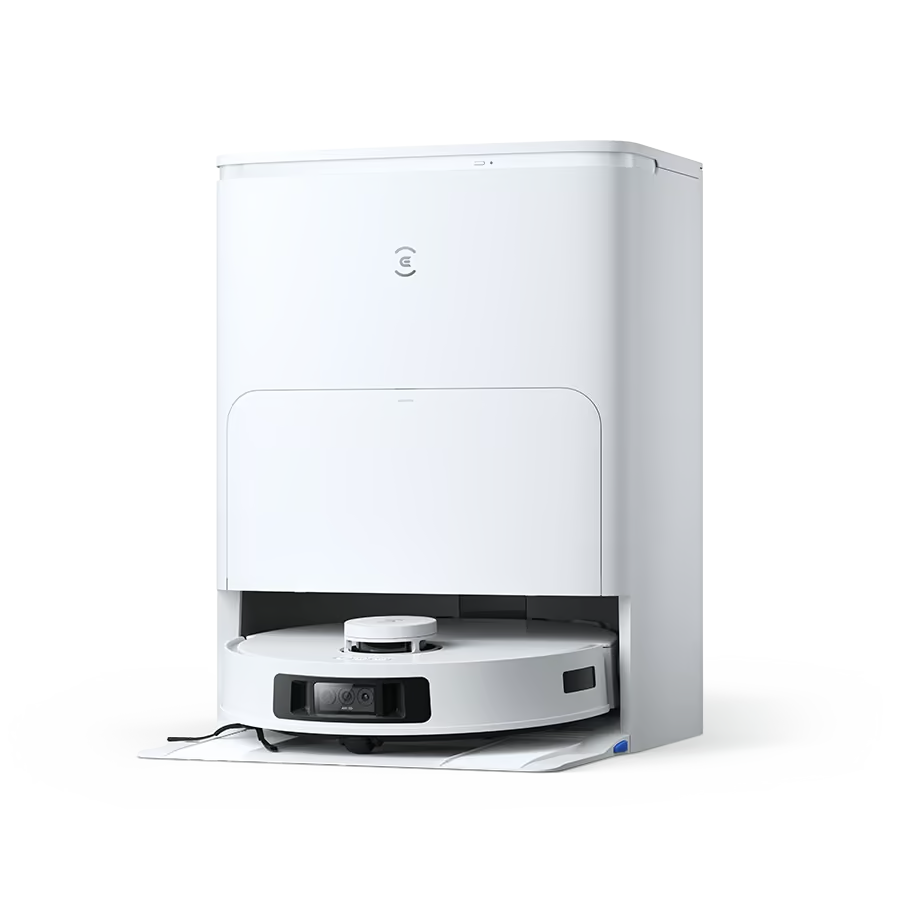
Best for: Best for edges and corners.
The Ecovacs Deebot T30S Pro leans on a TruEdge extendable mop plate that swings out along walls, plus AI edge cleaning, to reach the strips most round robots leave behind. It maps with TrueMapping 2.0 (dToF) and 3D perception, and runs dual rotating mops that lift on carpet.
The station is a full 10-in-1 unit: it auto-empties the bin, washes the mops with 70C hot water, dries them with warm air, and refills and drains water automatically. Suction is quoted at 11,000Pa and the ZeroTangle anti-static brush is designed to shed hair rather than wind it up. Owners report strong all-round results, with the YIKO voice assistant plus Alexa and Google in the app.
The trade-offs are physical and financial: this is a premium model, and the all-in-one station is tall and needs a dedicated corner. For most NZ buyers it is a step up in both capability and dock size over the mid-range picks.
Pros:
- TruEdge extendable mop plate cleans right to the skirting
- 10-in-1 station with 70C hot-water mop wash
- ZeroTangle brush suits pet households
Cons:
- Premium price
- Tall station needs a dedicated corner
Key specs: Model: Ecovacs Deebot T30S Pro (White). Suction: 11,000Pa. Navigation: TrueMapping 2.0 dToF with 3D perception. Dock: 10-in-1, 70C mop wash, warm-air dry, auto-empty and refill.
7. Roborock Q7B
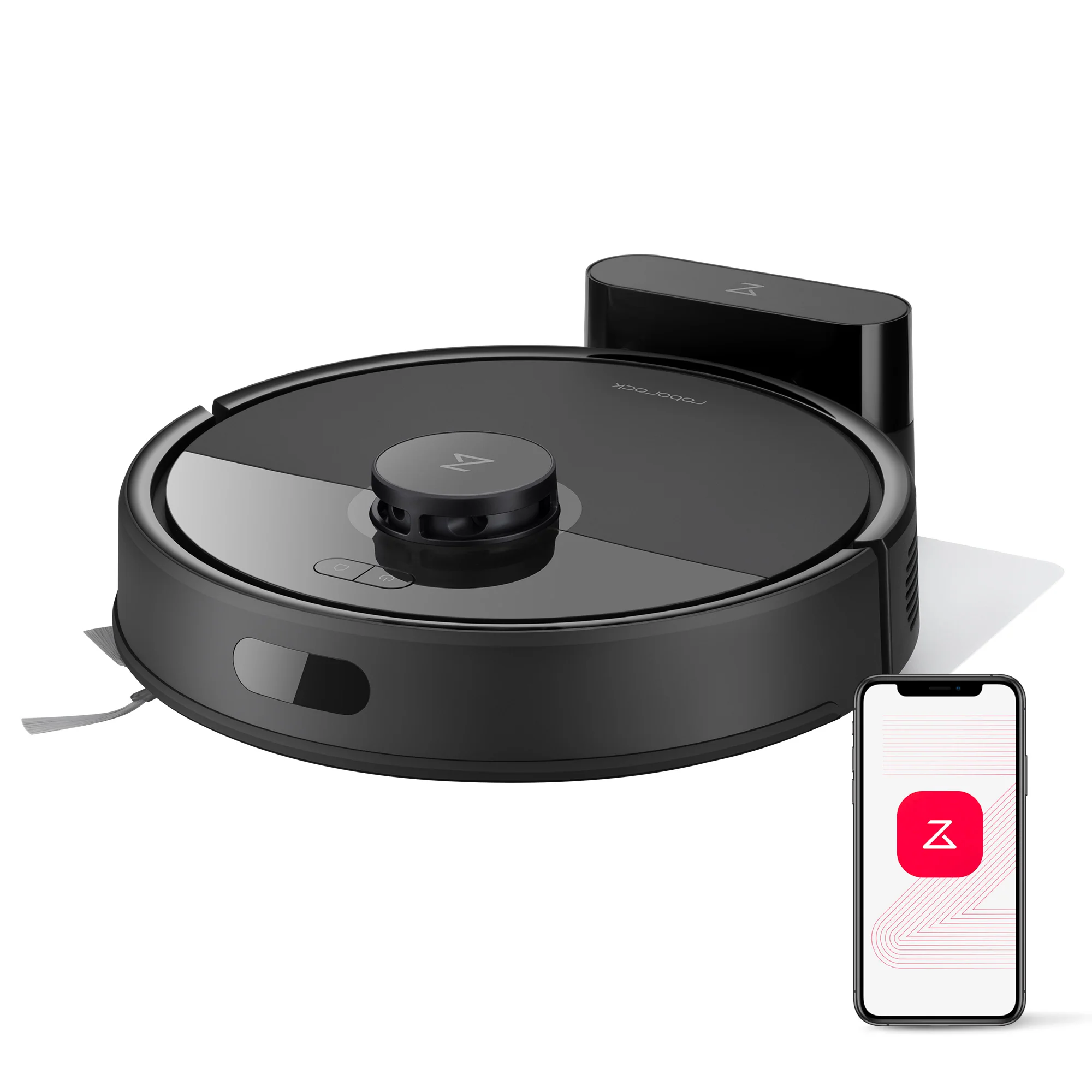
Best for: Best mid-range LiDAR without a dock.
The Roborock Q7B is an ANZ-focused member of the Q7 family that keeps the useful parts, 360-degree LiDAR mapping and multi-level maps, while dropping the bulky auto-empty station to lower the entry cost. Suction is rated at 8,000Pa.
Roborock fits its dual anti-tangle system: JawScrapers comb teeth on the main brush and a V-shaped zero-tangle side brush that has passed TUV and SGS zero-tangle tests. That combination is a genuine draw for pet households. Mopping is the basic 2-in-1 drag type with three water-flow levels and carpet detection that boosts suction.
The obvious trade-off is the dock: with a plain charging base you empty the bin by hand every few cleans, which suits smaller homes more than large ones. The app supports Alexa and Google. It is a sensible pick for anyone who wants Roborock mapping and anti-tangle hardware without paying for a station they will not use.
Pros:
- 360-degree LiDAR mapping with multi-level maps
- Dual anti-tangle system certified zero-tangle
- Lower entry cost by skipping the auto-empty dock
Cons:
- No self-emptying dock
- Basic drag-pad mopping only
Key specs: Model: Roborock Q7B (Black). Suction: 8,000Pa. Navigation: 360-degree LiDAR. Dock: charging base only. Brushes: JawScrapers main brush plus zero-tangle side brush.
8. Xiaomi Robot Vacuum S40C
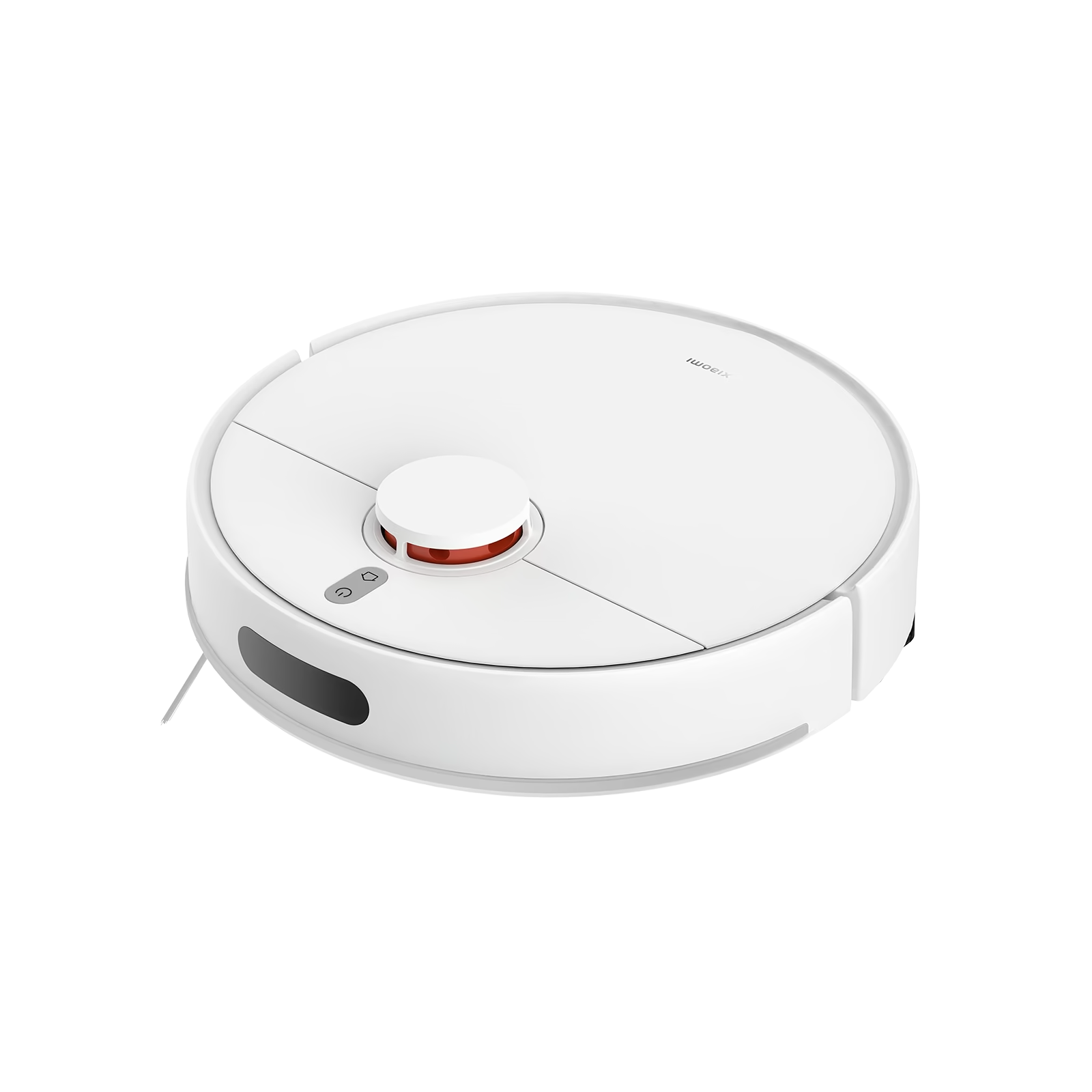
Best for: Best entry-level LiDAR 2-in-1.
The Xiaomi Robot Vacuum S40C brings LDS laser navigation, so it scans and maps a room and cleans in tidy rows rather than bumping about randomly, which is unusual at the entry level. It is a 2-in-1 vacuum and mop with 5,000Pa suction, four power modes and a 260mL water tank.
You can set virtual walls and no-go zones in the Xiaomi Home app, with Alexa and Google support. It climbs thresholds up to about 20mm, so it handles most NZ door strips.
The trade-offs are the ones you expect at this price: the 520mL dustbin and 260mL tank need frequent manual emptying and refilling, there is no self-emptying dock, and mopping is the simple drag-pad style. There is no headline anti-tangle brush either, so pet owners with long-haired animals may need to clear the roller more often. As a low-cost introduction to mapped robot cleaning, it is hard to fault.
Pros:
- LDS laser mapping is rare at this price
- Virtual walls and no-go zones in the app
- Climbs thresholds up to about 20mm
Cons:
- No self-emptying dock; frequent manual refills
- No dedicated anti-tangle brush
Key specs: Model: Xiaomi Robot Vacuum S40C. Suction: 5,000Pa. Navigation: LDS laser. Tank: 260mL. Dustbin: 520mL. Dock: charging base only.
9. Lefant M1
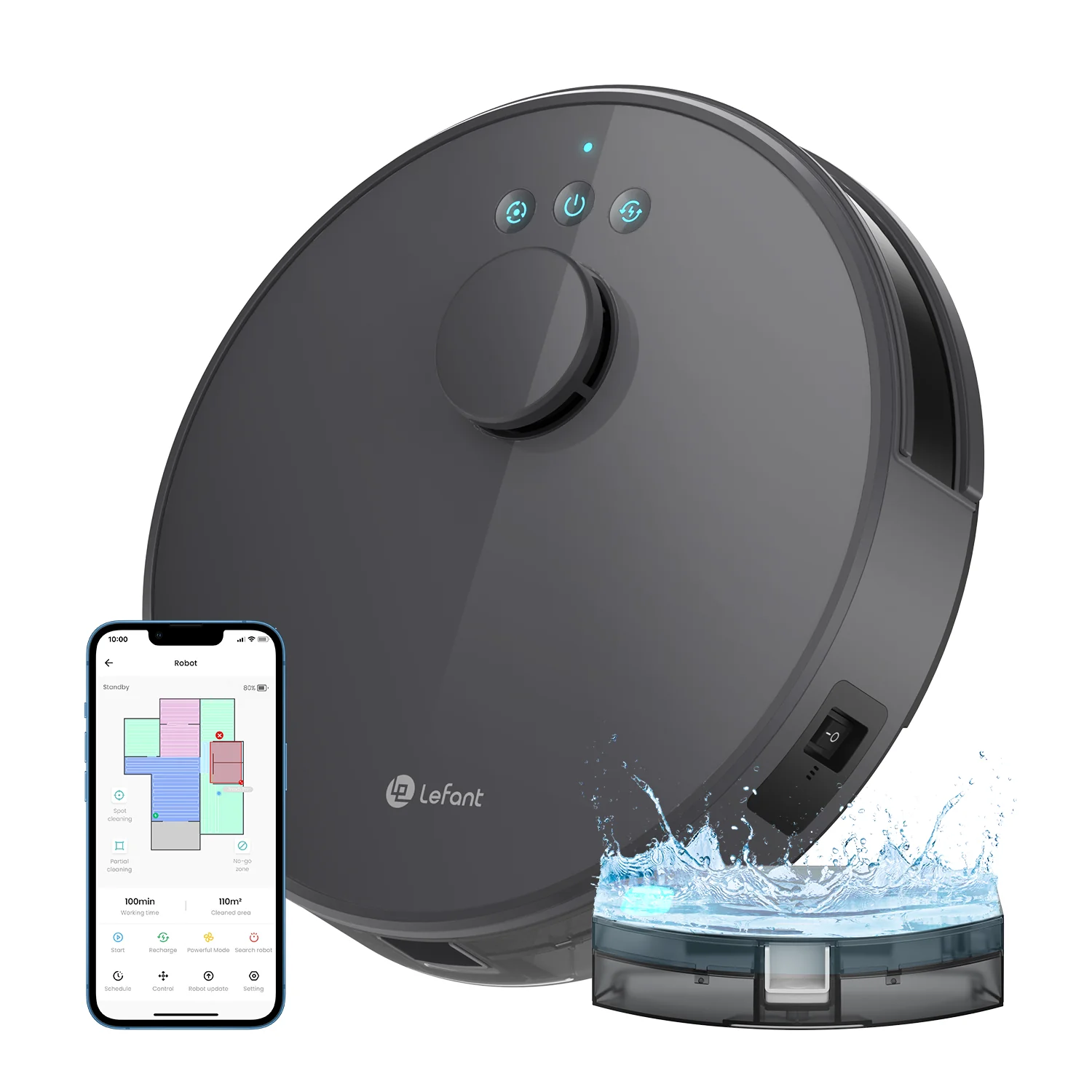
Best for: Best compact for small apartments.
The Lefant M1 is a compact robot, around 32cm wide, that still runs upgraded dToF LiDAR with FreeMove 3.0 path planning, multi-floor mapping and app-set no-go zones. It is a 2-in-1 vacuum and mop with a 160mL water tank, three electronic water levels and a peristaltic pump for steadier flow.
Suction depends on the regional variant: the version pitched to AU and NZ buyers is listed at 5,500Pa, while some overseas listings show a 4,000Pa model, so confirm the exact SKU before buying. Battery is a 3,200mAh cell rated at roughly 150 to 200 minutes depending on mode.
The trade-offs are the small water tank, which limits how much floor it can mop in one go, and the plain charging base with no self-emptying, so you handle the bin yourself. Anti-tangle is not a headline feature, so long hair may need clearing. For a compact footprint with real mapping, it is a tidy small-space option.
Pros:
- Compact 32cm footprint for tight spaces
- dToF LiDAR with multi-floor mapping and no-go zones
- Peristaltic pump for steadier mop flow
Cons:
- Small 160mL water tank
- No self-emptying; suction varies by regional SKU
Key specs: Model: Lefant M1 (Grey). Suction: 5,500Pa (AU/NZ variant). Navigation: dToF LiDAR, FreeMove 3.0. Tank: 160mL. Battery: 3,200mAh.
10. Monsga MR1
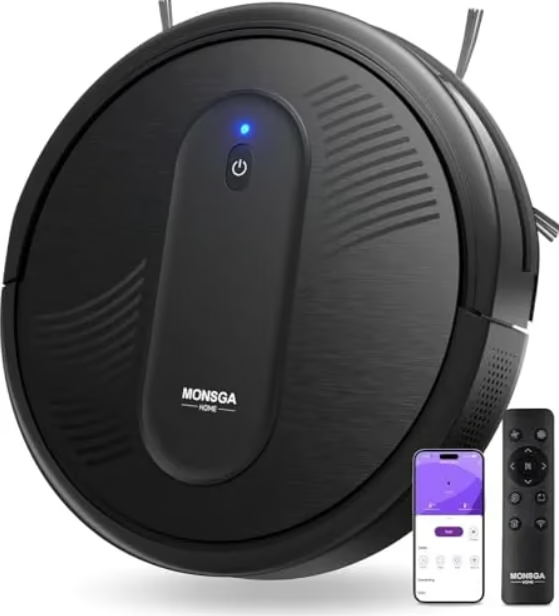
Best for: Best budget pick for hard floors.
The Monsga MR1 is a slim, low-cost 3-in-1 that vacuums, sweeps and mops, with a 3.2in (about 81mm) body, an auto carpet boost and a quiet sub-55dB run. Suction is modest at 3,000Pa and runtime is up to about 140 minutes, with app and remote control plus Alexa and Google.
The important limitation is navigation: the MR1 uses sensor and gyro-style movement rather than LiDAR, so it cannot map your home and will clean in a less systematic pattern, sometimes missing spots or repeating others.
Editorial note: this is an obscure brand with little to no New Zealand retail presence, and we could not source a non-Amazon product image, so confirm availability and add a manufacturer image before publishing. Mopping is a basic drag pad. It earns a place only as a rock-bottom entry point for small, mostly hard-floored spaces where mapping and strong suction are not priorities.
Pros:
- Slim 81mm body and quiet sub-55dB run
- 3-in-1 vacuum, sweep and mop
- App and remote control
Cons:
- No LiDAR mapping, so cleaning is less systematic
- Obscure brand, no confirmed NZ retail or non-Amazon image
Key specs: Model: Monsga MR1. Suction: 3,000Pa. Navigation: sensor and gyro-style (no LiDAR). Height: about 81mm. Dock: charging base only.
How we chose
This guide is independently researched, not sponsored, and the rankings are never sold. To build this list we compared manufacturer specifications from Roborock, Dreame, Eureka, Ecovacs, Xiaomi, Lefant and Monsga against listings from New Zealand and Australian retailers, then cross-checked them with verified owner reviews and independent review sites to sanity-check real-world performance.
We prioritised suction, navigation quality (LiDAR and laser mapping over random movement), dock features such as self-emptying and mop washing, anti-tangle hardware for pet households, and how well each robot suits typical NZ homes and furniture heights. If you would rather compare full-size cleaners, see our guide to the best vacuum cleaners. Where a model’s name, specification or local stock could not be confirmed on a non-Amazon source, we have flagged it in the write-up. Prices change often and are not shown here, so tap through to check the current price.
The verdict
For most New Zealand homes, the Roborock Qrevo L is the best all-round choice, balancing strong suction, reliable LiDAR mapping and a dock that empties and washes itself. If hygiene and a truly hands-off routine matter most and space allows, the Qrevo L Pro’s heated mop wash and warm-air drying are the upgrade to reach for. Buyers who want mapping without a bulky station should look at the Roborock Q7B, while the Xiaomi S40C and Lefant M1 are sensible entry points for smaller homes.
Whichever you choose, a robot vacuum handles the daily maintenance clean, but for stairs and upholstery a cordless stick vacuum is easier to steer. Keep a handheld vacuum for quick spills in the cupboard for messes the robot should not chase. Hard floors that need more than a wipe respond better to a dedicated steam mop. And if you would rather empty a bin than buy bags, our roundup of bagless vacuum cleaners is worth a look.
Frequently Asked Questions
Are robot vacuums worth it in New Zealand?
For most Kiwi households, yes. A robot vacuum takes over the daily maintenance clean on hard floors and low-pile carpet, so dust and pet hair never build up between deeper cleans. Mid-range models now include LiDAR mapping and self-emptying docks. You will still want a full-size vacuum for stairs and deep cleaning.
Do robot vacuums work on carpet?
Yes, on low-pile carpet and rugs. Look for suction of around 4,000 to 8,000Pa or higher to lift debris from the fibres, and choose a model that auto-lifts its mop on carpet. Most robots struggle with thick, high-pile or shag carpet, and very deep pile can stop them or leave marks.
How often do you empty a self-emptying robot vacuum?
With a self-emptying dock you typically empty the base every few weeks rather than after each clean. Bagged docks often hold around seven weeks of debris, and higher-capacity or bagless docks can stretch to 45 to 90 days. You still rinse mop pads and clear the brush regularly for best results.
What is the difference between LiDAR and gyroscope navigation?
LiDAR uses a spinning laser to map your home, so the robot cleans in efficient rows and remembers no-go zones, even in the dark. Gyroscope or sensor navigation estimates position without mapping, so the robot moves more randomly and can miss spots. LiDAR is the better choice for larger or multi-room homes.
Do you still need a regular vacuum if you have a robot vacuum?
Usually, yes. A robot vacuum is excellent for daily floor maintenance, but it cannot clean stairs, furniture, car interiors or high shelves. Most owners keep a stick or handheld vacuum for those jobs, plus a mop or cloth for large spills. Think of the robot as a helper, not a full replacement.
Which robot vacuum is best for pet hair?
Look for strong suction and genuine anti-tangle hardware, such as rubber main brushes and zero-tangle side brushes that shed hair instead of winding it up. In this guide, the Roborock Qrevo L, the Roborock Q7B and the Eureka E20 Evo Plus all use anti-tangle designs that suit homes with shedding cats or dogs.
How long do robot vacuums last?
Most robot vacuums last around four to six years, depending on build quality, how often they run and basic upkeep like cleaning sensors and brushes. The battery is usually the first part to fade, with lithium-ion cells holding strong capacity for about two to three years before runtime drops noticeably.
