
The best knife sharpener in NZ overall is the 2-in-1 sharpener and glove set below, thanks to a three-stage system that repairs, restores and polishes a blade in one pass, backed by a bundled cut-resistant glove for safer sharpening at home.
A sharp knife makes almost every kitchen task faster and safer, but the right sharpener depends on the knives you own and how much control you want over the edge. This guide compares seven knife sharpeners sold in NZ, from simple pull-through designs to a dual-grit whetstone and a magnetic rolling sharpener, each picked for a different kitchen and skill level.
Many of these sharpeners work well alongside other kitchen upgrades. If you are rounding out the rest of the kitchen, a good set of food processors covers the prep side of things that a sharp knife can’t.
Quick Comparison
| Sharpener | Best for | Type | Stages / Grit | Angle |
|---|---|---|---|---|
| 1. 2-in-1 Knife Sharpener & Glove Set | Best Overall | Pull-through | 3-stage | Fixed |
| 2. 3-Stage Knife Sharpener | Best Budget Pick | Pull-through | 3-stage | Fixed |
| 3. Premium Whetstone Sharpening Stone | Best for Precision Sharpening | Whetstone | 1000 / 6000 grit | Guide included |
| 4. Walnut Rolling Knife Sharpener | Best for Angle Control | Rolling | N/A (roller) | 15 deg / 20 deg |
| 5. 4-Stage Manual Knife Sharpener | Best for Knives & Scissors | Pull-through | 4-stage | Fixed |
| 6. 4-in-1 Knife Sharpener & Glove Set | Best 4-in-1 Kit | Pull-through | 4-stage | Fixed |
| 7. Compact 3-Stage Knife Sharpener | Best for Everyday Touch-Ups | Pull-through | 3-stage | Fixed |
How We Chose
Every sharpener here was confirmed as a live, in-stock listing online in NZ at the time of research, then cross-checked against comparable products sold on other NZ and international retailer sites for genuine design, use and performance detail, since none of the seven carry a stated brand name on their own listing page. Each pick was given a distinct role so the shortlist covers different sharpening styles and skill levels rather than repeating the same mechanism.
The Best Knife Sharpeners in NZ
1. 2-in-1 Knife Sharpener & Glove Set – Best Overall
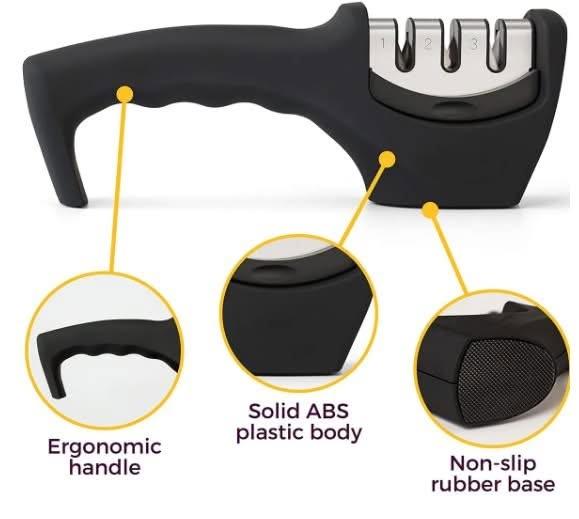
The best knife sharpener in NZ overall is this 2-in-1 pull-through set, because its three-stage system repairs, restores and polishes a blade in one pass while the bundled cut-resistant glove adds a genuine safety net for less confident cooks.
It is a compact handheld pull-through unit with an ergonomic handle sized to work in either hand, finished in matte black plastic that reads as a practical kitchen tool rather than a display piece, styled to match the black glove that comes in the box. Inside are three sharpening slots run in the standard order for this class of sharpener: a diamond stage first, then a carbide or tungsten stage, then a ceramic finishing stage, so it is built to take on a genuinely damaged edge as well as a mildly dull one.
Using it is a case of pulling the blade through each slot in sequence from stage one to stage three, working from repair to polish, with no clamping or calibration needed before the first pass. Designs using this same three-stage layout have tested well in independent trials, producing some of the smoothest edges among pull-through sharpeners, though the same testing found the process slower to show results than a single-stage sharpener, so a very dull knife may need several passes through each stage before it feels transformed.
The trade-offs are the usual ones for this style of sharpener. Buyers of closely related sharpener-and-glove bundles have reported the glove occasionally missing from the box, so it’s worth checking the contents on arrival, and like all pull-through designs this uses a fixed sharpening angle that will not suit every knife equally well.
Pros
- Three-stage diamond, carbide and ceramic sequence in one tool
- Cut-resistant glove included for safer sharpening
- No setup, clamping or angle guesswork
- Works equally well in either hand
Cons
- Fixed angle won’t match every knife
- Some buyers of similar bundles report the glove missing on arrival
Key specs: 3-stage pull-through sharpener (diamond / carbide / ceramic), black finish, includes 1x cut-resistant glove.
2. 3-Stage Knife Sharpener – Best Budget Pick
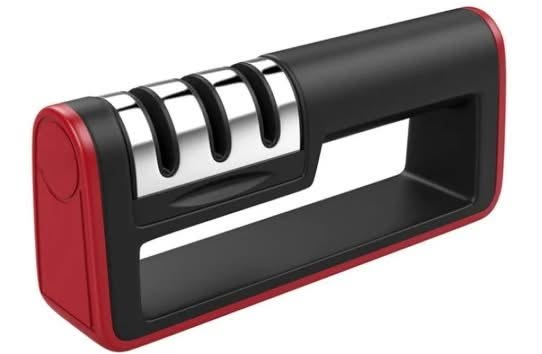
The best budget knife sharpener in NZ is this straightforward 3-stage sharpener, because it strips the format back to the essentials, a non-slip base and three sharpening slots, at one of the lowest prices in this list.
It’s a compact handheld unit that sits on the countertop rather than being held in the air, with a wide non-slip base underneath to keep it planted while the blade is drawn through. The housing is plain moulded plastic with none of the extras bundled into some of the other picks here, aimed squarely at buyers who want a cheap, functional sharpener rather than a kit. Inside are three sharpening slots in the same diamond-then-ceramic style sequence used across this category, restoring a damaged edge in the first slot before refining and polishing it in the following two.
The non-slip base is the standout feature at this price, since it stops the whole unit sliding across the bench mid-pull, a common complaint with cheaper sharpeners that skip this detail. This style of 3-stage, non-slip-base sharpener has passed informal tomato-test and paper-slicing trials in third-party reviews, producing a smooth, even edge because the stable base keeps the sharpening rods braced during the pull stroke.
Pull-through sharpeners in general remove less material per pass than a whetstone, so this is better suited to touch-ups on knives that aren’t severely damaged, and it won’t restore a badly chipped edge in a single session.
Pros
- Non-slip base keeps the sharpener planted during use
- Simple 3-stage sequence with no setup
- One of the cheapest options in this list
- No glove or fixed accessories to fuss over
Cons
- No accessories bundled in
- Best for touch-ups, not badly damaged edges
Key specs: 3-stage pull-through sharpener, non-slip base, no additional accessories.
3. Premium Whetstone Sharpening Stone – Best for Precision Sharpening
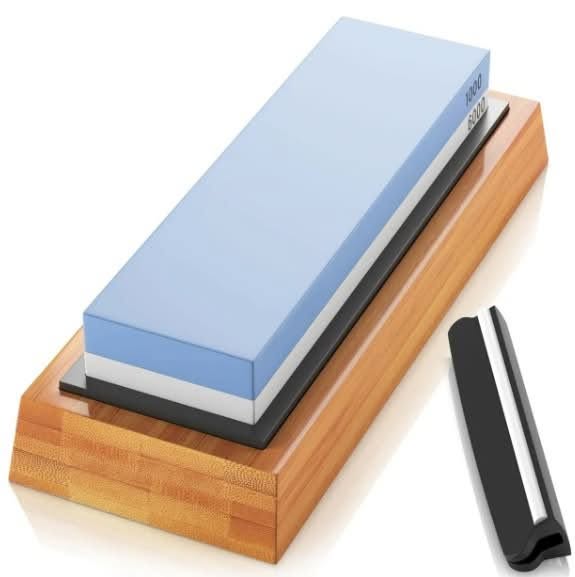
The best knife sharpener in NZ for anyone who wants full control over the edge is this dual-grit whetstone, because its 1000-grit and 6000-grit faces cover both repair and polish, with an angle guide to help hold a consistent line.
It is a rectangular sharpening stone that sits inside a non-slip bamboo base, with two usable faces, a coarser 1000-grit side and a finer 6000-grit side, plus a clip-on angle guide that attaches to the spine of the knife. The natural bamboo base with visible wood grain gives it a warmer, more traditional look than the plastic pull-through sharpeners in this list, and it sits flat on the bench rather than being held in the hand. The stone needs only water to use, no oil, and the bamboo cradle holds it steady while the blade is worked back and forth across the surface.
Using it starts with a brief soak, then the 1000-grit face for a dull or damaged edge, flipping to the 6000-grit face to polish and refine once the edge is restored. The angle guide takes some of the guesswork out of holding a consistent angle, though whetstones still have a steeper learning curve than a pull-through design since the user is controlling the angle and pressure themselves. Owners of this grit combination report knives coming out sharper than new when the technique is followed correctly, and the fine 6000-grit face in particular draws praise for its polish, though some reviewers of similarly priced 1000/6000 combo stones note the coarse face needs more passes and pressure than a premium stone to make an impression on a very dull blade.
This is the slowest and most hands-on sharpener in this list, better suited to someone willing to learn the technique than a cook who wants a quick fix, and results depend heavily on maintaining a consistent angle throughout each stroke.
Pros
- Dual 1000/6000 grit covers repair and polish
- Angle guide helps hold a consistent line
- Non-slip bamboo base
- No motor or moving parts to wear out
Cons
- Steeper learning curve than a pull-through sharpener
- Coarse face needs more effort on very dull blades
Key specs: Dual-sided waterstone, 1000/6000 grit, non-slip bamboo base, angle guide included.
4. Walnut Rolling Knife Sharpener – Best for Angle Control
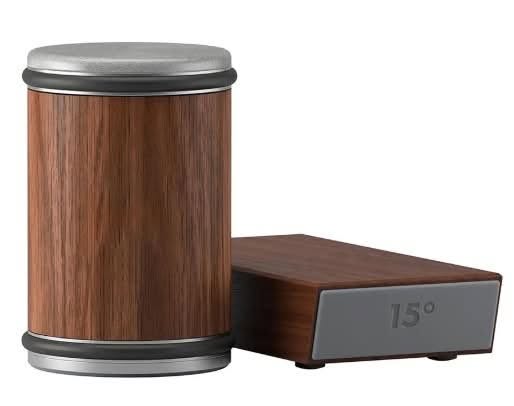
The best knife sharpener in NZ for consistent angle control without the learning curve of a whetstone is this walnut rolling sharpener, because the magnetic holder locks the blade at a preset 15 or 20 degree angle every time.
It’s a two-piece rolling system built from walnut wood, a roller section paired with a magnetic holder that grips the blade and guides it across the abrasive surface at a fixed angle. The walnut finish is the most premium-looking material in this list, giving it a look closer to a display-worthy kitchen accessory than a purely functional tool, though the wood also means it needs a little more care than a plastic housing. The magnetic holder is the mechanism that sets this apart, using magnets to hold the knife at whichever of the two preset angles suits the blade, removing the need to hold a steady hand angle yourself.
In use, the 15 degree setting suits thinner Japanese-style blades and the 20 degree setting suits thicker Western knives; clip the blade into the magnetic holder and roll it across the sharpening surface in smooth passes. This is faster and less technique-dependent than a whetstone while still giving more angle precision than a fixed pull-through slot, and rolling sharpeners of this wood-and-magnet construction are praised for being fast and low-skill to use since the angle is locked in for you.
Reviews of similarly built budget rolling sharpeners have flagged magnets that feel weaker than premium metal-bodied rivals and occasional fit issues where the wood roller sits against the frame, and some dedicated reviewers question whether the rolling format achieves quite the same edge quality as a whetstone for serious enthusiast use. Narrower blades can also sit less securely on the magnetic holder than a standard chef’s knife would.
Pros
- Magnetic holder locks in a 15 or 20 degree angle
- Faster and easier than freehand whetstone sharpening
- Walnut wood finish looks premium on the bench
- No batteries or power needed
Cons
- Budget rolling designs can have weaker magnets than premium models
- Narrow blades may not sit as securely on the holder
Key specs: Walnut wood rolling sharpener, magnetic blade holder, preset 15 / 20 degree angles.
5. 4-Stage Manual Knife Sharpener – Best for Knives & Scissors
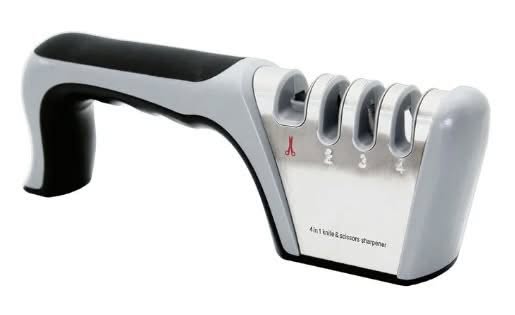
The best knife sharpener in NZ for a mixed knife block, including scissors and ceramic blades, is this 4-stage manual sharpener, because it adds a dedicated stage for scissors on top of the usual repair-to-polish sequence.
It’s a compact handheld pull-through unit with four sharpening slots rather than the usual three, built to cover ceramic knives, standard steel knives and kitchen scissors from a single tool. The housing is functional plastic without the added glove or bamboo detailing seen elsewhere in this list, styled purely around the four-slot mechanism rather than looks. The four stages typically run a ceramic rod for scissors, a carbide or tungsten stage for the bluntest knives, a diamond rod for repairing or straightening damaged edges, and a final ceramic rod for honing and polish, the standard layout for this class of 4-stage sharpener.
Working through the stages in order suits a badly dulled knife, or the ceramic honing stage alone can be used for routine touch-ups. The scissors slot is the genuine point of difference here and means one drawer tool covers more of the kitchen than a knife-only sharpener. Hands-on tests of this stage-by-stage mechanism found an obvious improvement on a chef’s knife that previously struggled to cut chicken cleanly, needing only three or four passes through each stage before it cut meat and paper noticeably more easily.
The bestdeals.co.nz listing itself gives very little descriptive detail beyond the stage count, so buyers should treat this as a functional, no-frills sharpener rather than a premium finish, and as with any pull-through design the sharpening angle is fixed rather than adjustable.
Pros
- Dedicated scissors stage alongside knife stages
- Works on both ceramic and steel blades
- Four-stage sequence from repair to polish
- Compact and simple to store in a drawer
Cons
- Fixed sharpening angle
- Minimal styling or extra accessories
Key specs: 4-stage manual sharpener, compatible with scissors, ceramic and steel knives.
6. 4-in-1 Knife Sharpener & Glove Set – Best 4-in-1 Kit
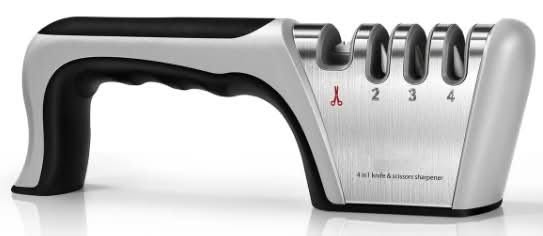
The best all-in-one knife sharpener in NZ for anyone who wants the widest coverage in a single kit is this 4-in-1 sharpener, because it pairs the same four-stage sequence with a bundled pair of cut-resistant gloves.
It’s a compact pull-through unit built around four sharpening stages, sold with a pair of cut-resistant gloves rather than the single glove included with the cheaper bundle earlier in this list. The housing is practical plastic, unbranded like the rest of the picks here, positioned as a complete kit rather than a single-purpose sharpener. It uses the same four-stage logic as the other 4-stage sharpener in this list: a ceramic stage for scissors, a carbide or tungsten stage for very dull knives, a diamond stage for repair, and a ceramic finishing stage, working on ceramic knives, steel knives and scissors.
Running a badly dulled blade through all four stages in sequence handles the toughest jobs, while the final ceramic stage alone covers quick maintenance. The pair of gloves means two people can sharpen or handle freshly sharpened blades safely at the same time, useful if sharpening is a shared kitchen chore. This is the only one of the seven picks here sold at a flat price with no discount shown at the time of research, which is worth flagging as a pricing quirk rather than a performance detail, though the mechanism itself follows the same well-documented 4-stage design used elsewhere in this list.
Buyers of closely related sharpener-and-glove bundles have reported gloves occasionally missing from the box, a recurring complaint across this general product family rather than one specific listing, so it’s worth checking the contents on arrival.
Pros
- Four-stage sequence covers ceramic, steel and scissors
- Comes with a pair of cut-resistant gloves
- Simple pull-through operation, no setup
- Complete kit for a shared kitchen
Cons
- Fixed sharpening angle like all pull-through designs
- Some buyers of similar bundles report a glove missing on arrival
Key specs: 4-stage pull-through sharpener, compatible with scissors, ceramic and steel knives, includes 2x cut-resistant gloves.
7. Compact 3-Stage Knife Sharpener – Best for Everyday Touch-Ups
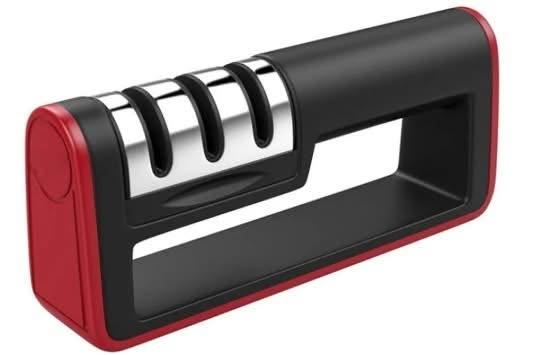
The best knife sharpener in NZ for quick, everyday touch-ups is this compact 3-stage sharpener, because it keeps the same non-slip, no-fuss design as the budget pick in this list at a similarly accessible price.
It’s a compact handheld pull-through sharpener with a non-slip base, built to sit on the counter while the blade is drawn through its three sharpening slots. The housing is plain moulded plastic with no glove, bamboo, or wood detailing, matching the practical, no-frills style of the other budget pull-through pick in this list rather than aiming for a premium look. Inside are three sharpening stages in the standard diamond-then-ceramic sequence, designed to repair a damaged edge before refining and polishing it in the later stages.
Holding the non-slip base steady on the bench and drawing the blade through each slot from stage one to stage three is the entire process, with no clamping, calibration or angle guide to think about, which makes it one of the fastest sharpeners in this list to pick up and use. This style of 3-stage, non-slip-base sharpener has passed informal cutting and slicing trials in third-party reviews, producing a smooth, even edge, since a stable base keeps the sharpening rods braced during the pull stroke rather than wobbling.
The bestdeals.co.nz listing gives almost no descriptive detail beyond the stage count and non-slip base, so buyers are choosing this largely on price and simplicity rather than a documented list of features, and like the rest of the pull-through picks here it uses a fixed angle rather than an adjustable one.
Pros
- Non-slip base for stable sharpening
- Straightforward 3-stage sequence
- No setup, angle guides or clamping needed
- Competitively priced
Cons
- Minimal on-page detail beyond the basics
- Fixed angle won’t suit every knife
Key specs: 3-stage pull-through sharpener, non-slip base.
How to Choose a Knife Sharpener in NZ
Sharpener type matters most. Pull-through sharpeners are the fastest and easiest option, using fixed slots to repair, restore and polish an edge with almost no skill required. Whetstones give the most control over angle and finish but take practice to use well, while a rolling sharpener with a magnetic holder sits in between, locking in a preset angle without needing a freehand technique.
Sharpening angle affects both sharpness and durability. Most Western kitchen knives are sharpened around 20 degrees per side, while thinner Japanese-style blades usually suit closer to 15 degrees. A steeper angle cuts keener but chips more easily, and a shallower angle lasts longer between sharpens but feels less razor sharp. Sharpeners with 15 and 20 degree presets suit a mixed knife block best.
Grit level decides how aggressive a stone or stage is. Coarse grits under 1000 repair chips and very dull edges, medium grits from 1000 to 3000 handle routine maintenance, and fine grits from 3000 upward polish and refine an edge that is already sharp. A dual-sided 1000/6000 whetstone covers both ends in one purchase.
Consumer NZ advises against regular use of electric or pull-through sharpeners, since both remove a little metal on every pass, and recommends against motorised belt or wheel sharpeners unless you are experienced with them. For occasional home use, a pull-through or rolling sharpener used sparingly is fine; for daily professional-style use, a whetstone used correctly removes less metal overall.
Buying a sharpener also has to compete with paying a professional. NZ knife-sharpening services typically charge somewhere from 8 to 15 dollars per knife depending on length and edge type, with some offering courier drop-off for rural customers. A home sharpener pays for itself quickly once you are sharpening more than a couple of knives on any sort of regular basis.
Match the sharpener to what else is in the block. A basic pull-through sharpener will not touch true ceramic-bladed knives, which need a diamond-specific sharpener, and serrated bread knives need a tapered rod worked into the scalloped edge rather than a flat stone. If your kitchen is stocked with mixed steel, ceramic and serrated blades, the 4-stage sharpeners in this list cover more ground than a basic 3-stage design.
A sharpener is only one part of a well-equipped kitchen. On the same benchtop, coffee grinders are one of the most common daily-use companions. A good air fryer is another easy next appliance for anyone who cooks often, and both are worth weighing up alongside whichever sharpener makes this list.
Related Guides
Rounding out the kitchen further, a dedicated juicers guide is worth a look for anyone after fresh drinks at home. For bigger meals, electric frypans are also a solid next appliance for anyone who cooks for a crowd.
If you are building out the prep side of the kitchen, the guide to can openers is a useful next read.
Sharpening is maintenance rather than cooking, and it tends to happen on the same quiet evenings that the best popcorn makers get switched on.
Verdict
For most NZ kitchens, the 2-in-1 sharpener and glove set is the safest all-round buy, covering repair through to polish with a safety glove included. Buyers on a tight budget should look at the 3-stage non-slip sharpener or the compact 3-stage alternative, sharpening enthusiasts who want full control over the edge should choose the dual-grit whetstone, and anyone who wants a consistent preset angle without the learning curve of a stone will get the most out of the walnut rolling sharpener. Kitchens with scissors or ceramic blades in the mix are better served by one of the two 4-stage sharpeners.
Frequently Asked Questions
What type of knife sharpener should I buy?
It depends on effort versus control. Pull-through sharpeners are the fastest and easiest, whetstones give the most control over angle and finish but take practice, and rolling sharpeners with a magnetic holder sit in between, locking in a preset angle without needing a freehand technique.
What angle should I sharpen my kitchen knife at?
Most Western kitchen knives sharpen best around 20 degrees per side, while thinner Japanese-style blades usually suit 15 degrees. Steeper angles cut keener but chip more easily, shallower angles last longer but feel less sharp. Rolling and guided sharpeners offering both 15 and 20 degree presets suit a mixed knife block.
How often should I sharpen my kitchen knives?
Most home cooks only need a full sharpening every one to two months, or roughly every six months if honing regularly between sharpens. Heavier daily use, such as cutting a lot of meat, can wear an edge down faster and may call for sharpening closer to every four to six weeks.
What’s the difference between honing and sharpening?
Honing realigns a blade’s existing edge without removing metal, and takes seconds with a steel or ceramic rod before each use. Sharpening actually removes metal to create a new edge and is needed far less often. A dull knife that won’t hold an edge after honing needs sharpening, not just honing.
Can a pull-through sharpener damage my knives?
Fixed-angle pull-through sharpeners can round an edge or remove more metal than necessary if used too often, and are not ideal for premium or Japanese knives with thinner factory edges. They suit everyday steel knives well, but a whetstone or angle-guided sharpener is gentler on expensive or delicate blades.
What grit whetstone do I need for kitchen knives?
Coarse grits under 1000 are for repairing chips or very dull edges, medium grits from 1000 to 3000 suit routine maintenance sharpening, and fine grits from 3000 upward polish and refine an already-sharp edge. A dual-sided 1000/6000 stone covers both repair and polish in a single purchase.
How much does professional knife sharpening cost in NZ?
NZ sharpening services typically charge around 8 to 15 dollars per knife, depending on blade length and whether it’s a standard or Japanese edge, with some offering nationwide courier drop-off. Buying a home sharpener pays for itself quickly if you’re sharpening more than a couple of knives regularly.
Are electric or motorised knife sharpeners bad for your knives?
Consumer NZ advises against regular use of electric or pull-through sharpeners, since they remove a little metal every pass, and recommends against motorised belt or wheel sharpeners unless you’re experienced, as it’s easy to remove too much material or damage the edge geometry.
