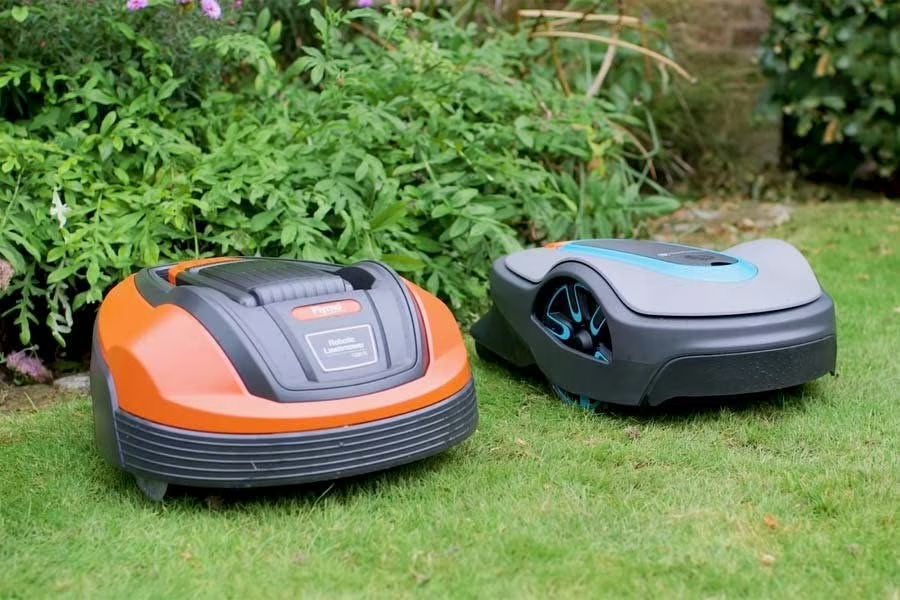
The best robot lawn mower for most NZ lawns is the Segway Navimow i206 AWD, thanks to genuine all-wheel drive that handles 45% slopes without slipping, wire-free setup, and built-in 4G that doesn’t rely on home Wi-Fi. Buyers wanting an established, award-winning brand should look at the Gardena SILENO Life 750, while the MOVA 1000 offers wire-free LiDAR mapping at a lower price. Smaller sections are covered too, from Husqvarna’s boundary-wire Automower 305 to the ECOVACS GOAT O600 RTK with AI obstacle avoidance and Bosch’s compact VisiMow for tiny lawns.
This guide compares six robot lawn mowers currently available in New Zealand, covering real specs, boundary systems (wire-free vs boundary-wire), slope handling and genuine trade-offs, not marketing copy.
Quick comparison
| # | Product | Best for | Coverage | Boundary system |
|---|---|---|---|---|
| 1 | Segway Navimow i206 AWD | Best overall / steep slopes | Up to 1,350 ft² (125m²) per charge, multi-zone up to 20 zones | Wire-free (RTK + Vision) |
| 2 | Gardena SILENO Life 750 | Best established brand | Up to 750m² | Boundary wire |
| 3 | MOVA 1000 | Best wire-free mid-size | Up to 1,000m² | Wire-free (LiDAR) |
| 4 | Husqvarna Automower 305 | Best for small, sloping lawns | Up to 600m² | Boundary wire (kit included) |
| 5 | ECOVACS GOAT O600 RTK | Best obstacle avoidance | Up to 600m² | Wire-free (RTK + AI camera) |
| 6 | Bosch VisiMow 18V-200 | Best budget for small lawns | Up to 200m² | Wire-free (camera vision) |
The 6 best robot lawn mowers in NZ
1. Segway Navimow i206 AWD – Best Overall / Best for Slopes
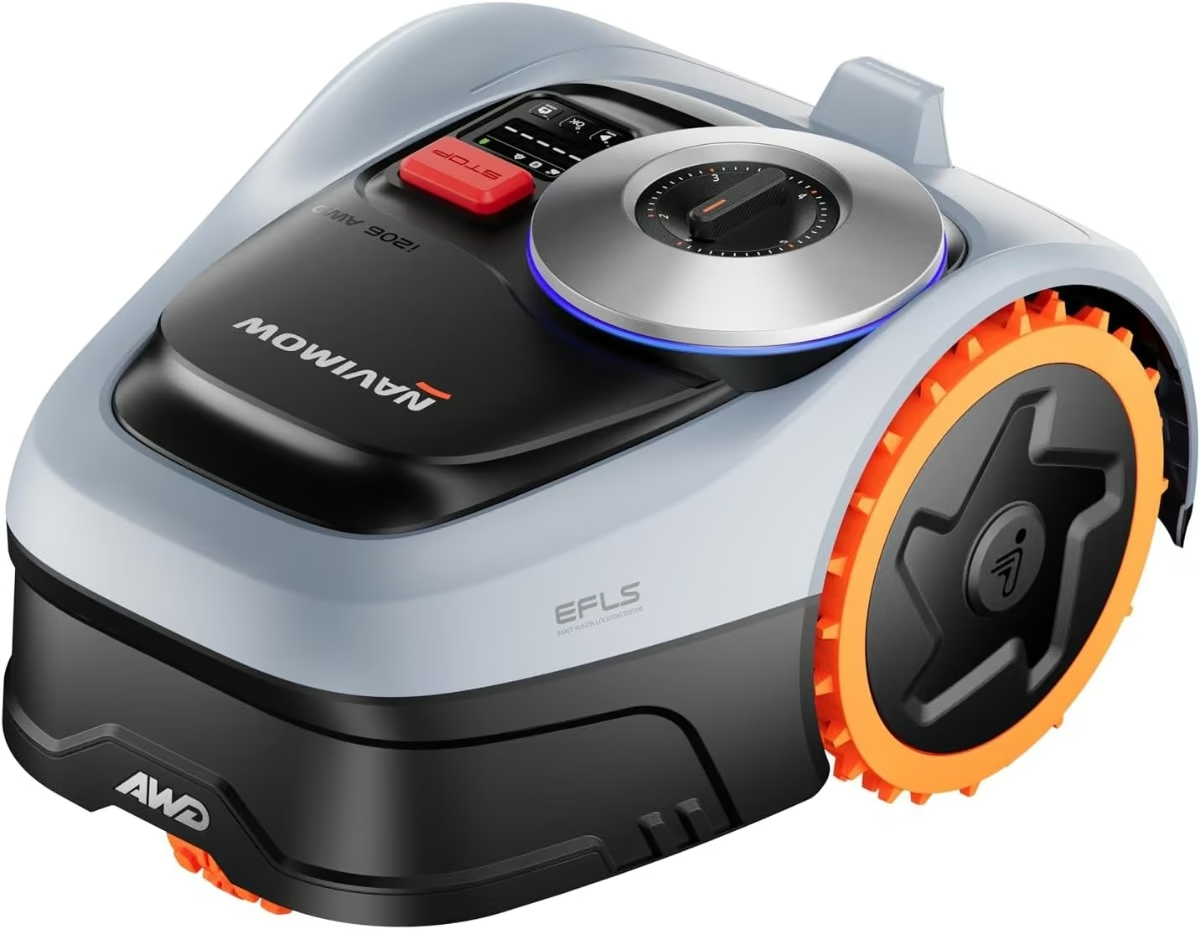
Segway’s Navimow i206 AWD is built around genuine all-wheel drive, a feature most robot mowers at this price simply don’t have. Automotive-grade electronic stability control keeps it stable and planted on slopes of up to 45% (24°), and a third-wheel design allows true zero-turn steering without scraping or tearing the grass underneath.
Setup is entirely wire-free: EFLS Network RTK combined with Vision positioning delivers centimetre-level accuracy for one-tap auto-mapping, so there’s no trench-digging or boundary cable to lay down. An adaptive drive system only draws extra power when the terrain demands it, which helps the 2.5Ah battery stretch further per charge, and up to 20 separate mowing zones can be managed and optimised from the app.
Where it genuinely stands apart from rivals is connectivity: built-in 4G comes standard, including the first year of service free, so GPS tracking and lift/leave-zone alerts work independently of home Wi-Fi. The trade-off is straightforward, this is the most expensive mower on this list, and its 1,350 ft² (about 125m²) per-charge coverage means larger properties will need multiple charge cycles across a mowing session.
Pros
- Genuine all-wheel drive handles 45% slopes with automotive-grade stability control
- Wire-free RTK + Vision setup, no boundary cable to install
- Built-in 4G included free for year one, no reliance on home Wi-Fi
Cons
- Highest price on this list
- Per-charge coverage is modest, larger lawns need multiple charge cycles
Key specs: All-wheel drive, 45% (24°) slope rating, 2–3.6in adjustable cutting height, 7.1in cutting width, 2.5Ah battery, up to 20 zones, built-in 4G.
2. Gardena SILENO Life 750 – Best Established Brand
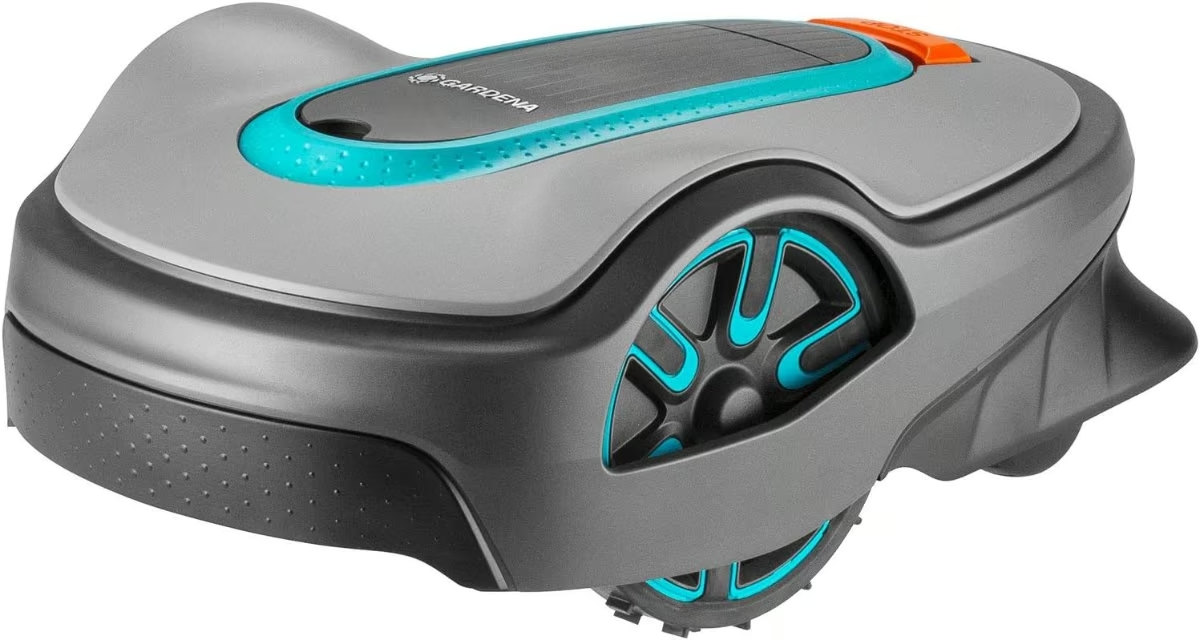
Gardena’s SILENO Life 750 is an award-winning robotic mower from one of the longest-standing names in garden equipment, and it’s built to cover lawns up to 750 square metres without day-to-day intervention. Programming runs either through Gardena’s Bluetooth app from up to 10 metres away, or directly from the control panel on the machine itself.
Unlike the wire-free picks on this list, the SILENO Life 750 uses a traditional boundary wire to keep it inside its mowing area, and it handles inclines up to 35% along with narrow corridors and tight passageways without getting stuck. It’s rated to run in any weather, including heavy rain, and at a maximum of 58 decibels it’s quiet enough to schedule for overnight mowing without disturbing anyone.
Safety and security are well covered: a highly sensitive collision sensor lets it navigate around obstacles, a lift sensor stops the blades immediately if the mower is picked up, and PIN code protection plus an alarm help deter theft, directly answering one of the most common robot-mower concerns. The genuine trade-off is that a boundary wire needs to be installed around the lawn perimeter before first use, more setup effort than the wire-free options here.
Pros
- Award-winning, established Gardena engineering
- PIN code protection and alarm for genuine anti-theft security
- Rated for any weather including heavy rain, quiet enough for night mowing
Cons
- Requires a boundary wire installed around the lawn before first use
- 750m² coverage is more modest than some wire-based rivals here
Key specs: Covers up to 750m², 35% slope rating, max 58 decibels, PIN code + alarm anti-theft, Bluetooth app control.
3. MOVA 1000 – Best Wire-Free for Mid-Size Lawns
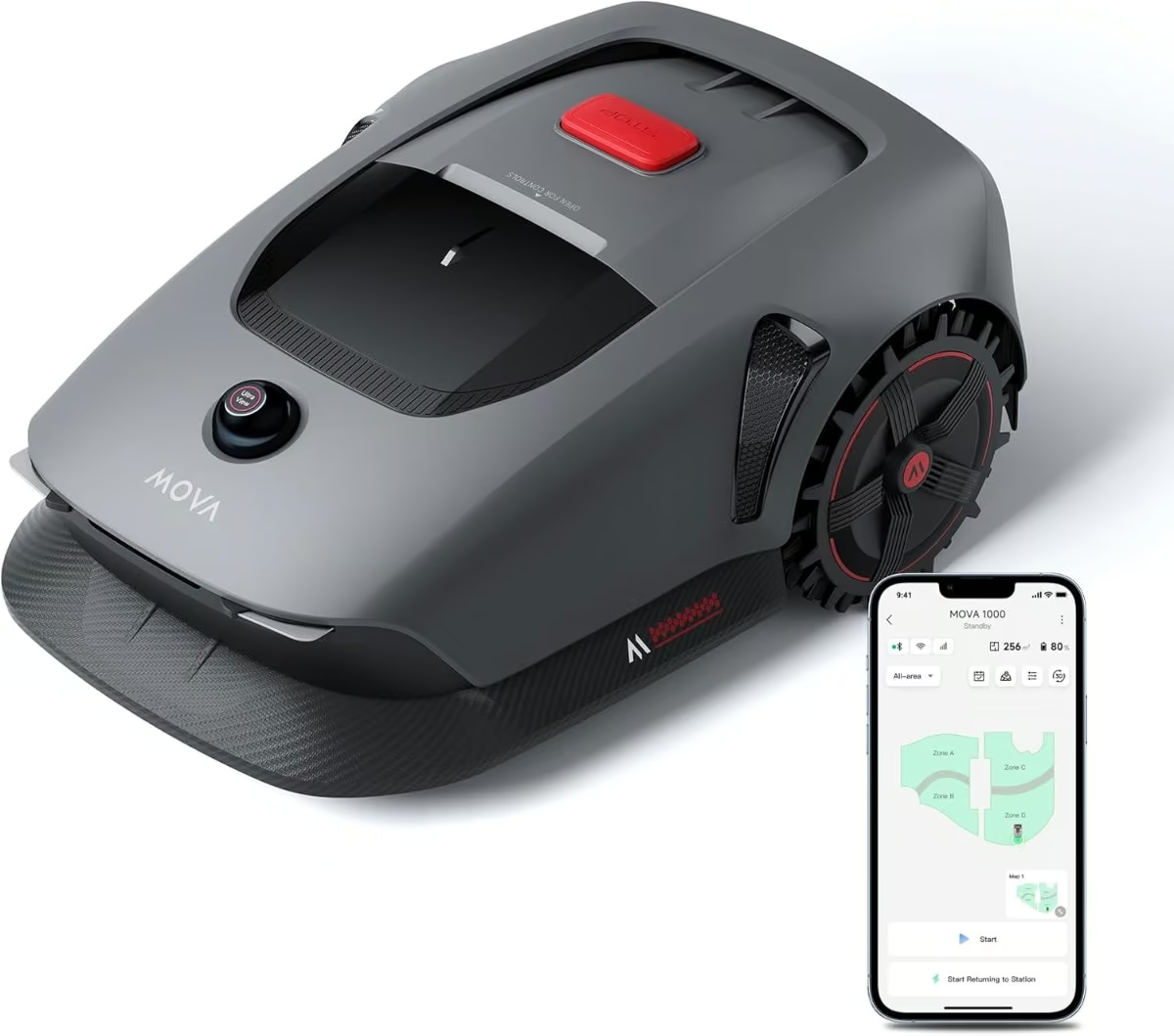
MOVA’s 1000 model uses genuine 3D LiDAR, called UltraView by the brand, to map a lawn up to 1,000 square metres without any boundary wire or RTK base station to install. The sensor detects up to 30 metres away across a 360° × 59° field of view, building a real-time point-cloud map of the yard as it moves.
Setup is done remotely through the app: virtual boundaries are set by driving the mower around the perimeter once, and from then on it navigates and re-maps autonomously. That same LiDAR system is what lets it hold accurate positioning on slopes up to 45% (24°) and in both low light and bright sun, conditions that trip up cheaper GPS-only mowers.
Durable off-road wheels reduce slipping on slopes and flat ground alike while minimising lawn damage, and the MOVAhome app supports a dual-map function for handling disconnected lawn areas, useful for an L-shaped section or a front-and-back yard split by a driveway. The trade-off is that this is a newer brand without the multi-decade track record of Gardena or Husqvarna, so buyers are trusting a shorter history of field reliability.
Pros
- Wire-free 3D LiDAR mapping, no boundary cable or RTK station needed
- Handles 45% slopes and works reliably in both low light and bright sun
- Dual-map function suits lawns split into disconnected sections
Cons
- Newer brand without the long field track record of Gardena or Husqvarna
- Mid-pack pricing, not the cheapest wire-free option on this list
Key specs: Covers up to 1,000m², 3D LiDAR (UltraView) mapping, 45% slope rating, 30m detection range, off-road wheels, dual-map support.
4. Husqvarna Automower 305 – Best for Small, Sloping Lawns
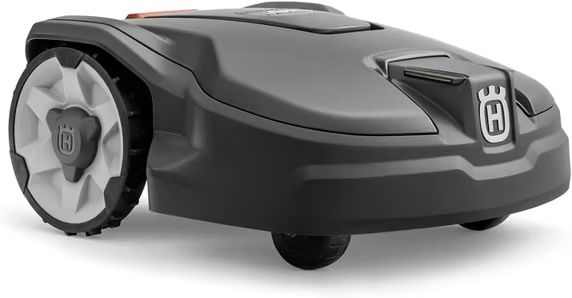
The Husqvarna Automower 305 brings one of the best-known names in robot mowing to smaller NZ sections. It is rated for lawns up to 600 square metres, so it suits a typical suburban front and back lawn rather than a lifestyle block, but it copes with slopes up to 40%, which is steep for a mower this size.
Setup is the traditional boundary-wire route, and the box includes the wire, connectors, pegs and charging station, so there is nothing extra to buy before the first mow. Husqvarna’s systematic passage mowing helps it work through narrow side paths between lawn areas, and it returns to charge on its own when the battery runs low. Scheduling and settings run through a Bluetooth app, and a weather timer and frost guard adjust how often it mows through the seasons.
It runs at a quiet 59 dB(A), and collision sensors, lift sensors and PIN code protection cover safety and theft. The honest trade-offs: Bluetooth app control means you need to be near the mower to change settings, the boundary wire takes time to lay out properly, and 600m² is the ceiling. It is also a higher-value order, so NZ import GST and charges are added at checkout.
Pros
- Trusted Husqvarna brand with a 40% slope rating
- Complete installation kit included
- Quiet 59 dB(A) running with PIN code protection
Cons
- Boundary wire must be laid before first use
- Bluetooth app only works within range of the mower
- NZ import GST and charges apply at checkout on higher-value orders
Key specs: Covers up to 600m², 40% slope rating, boundary wire with installation kit included, 59 dB(A), Bluetooth app control, weather timer and frost guard, PIN code.
5. ECOVACS GOAT O600 RTK – Best for Obstacle Avoidance
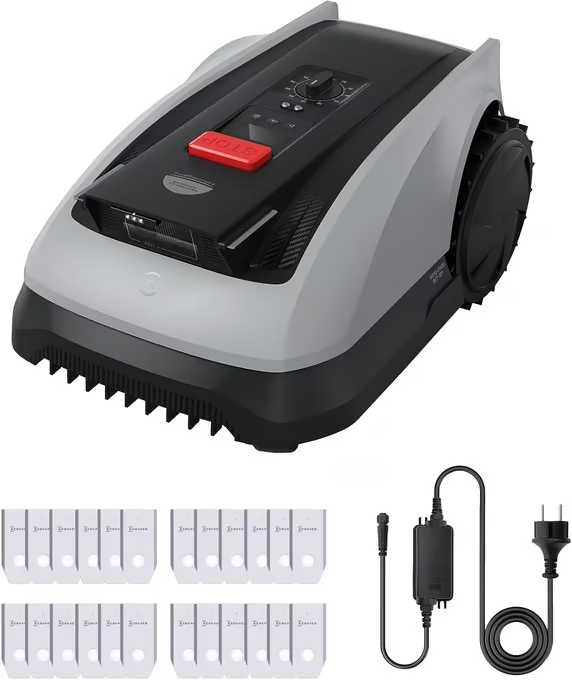
The ECOVACS GOAT O600 RTK is a wire-free mower for lawns up to 600 square metres that leans hard on smart navigation. Instead of a boundary cable it uses RTK satellite positioning to build a digital map of the section, with setup quoted at around ten minutes through the app.
Its AI camera is the standout. ECOVACS says it recognises more than 200 objects, including toys, garden tools and small animals, and steers around them, which matters in yards with kids and pets. It is rated for 45% slopes and passages as narrow as 0.7 metres, and cutting height adjusts from 3 to 8cm in half-centimetre steps from the app. Multiple zones can each get their own schedule, and the IPX6 rating means it can be hosed clean.
This Care Kit version adds 24 spare blades and an RTK power adapter. The trade-offs are worth weighing. Runtime is about 45 minutes per charge, with a similar time to recharge, so bigger lawns take several sessions. RTK needs a reasonable view of the sky, so heavily treed sections may struggle. Review numbers on the listing are still small, and as a higher-value order, NZ import GST and charges are added at checkout.
Pros
- Wire-free RTK mapping with quick app setup
- AI camera recognises and avoids 200+ objects
- Handles 45% slopes and 0.7m passages
Cons
- Around 45 minutes of mowing per charge
- RTK can struggle under heavy tree cover
- NZ import GST and charges apply at checkout on higher-value orders
Key specs: Covers up to 600m², wire-free RTK navigation, AI obstacle avoidance, 45% slope rating, 3-8cm cutting height, 19cm cutting width, IPX6, approx 45 min runtime.
6. Bosch VisiMow 18V-200 – Best Budget Pick for Small Lawns
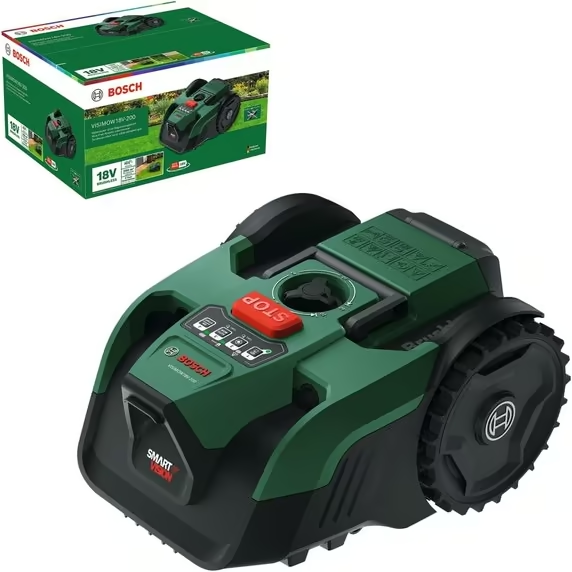
The Bosch VisiMow 18V-200 is the simplest and most affordable way into robot mowing in this guide, aimed squarely at small lawns of up to 200 square metres. It uses a camera-based vision system to see the lawn edge, so there is no boundary wire, no base station and no other infrastructure to install.
Bosch has kept the routine simple: a quick three-button start takes it from storage to mowing, and it can be carried between separate small lawns or zones, such as a front patch and a back courtyard. It runs on an 18V Power for All battery, the same system used across a large range of cordless garden tools, with an 18cm cutting width and a 20 to 60mm cutting height.
The important catch is that it is sold without a battery, so you need a compatible 18V Power for All battery, and a charger if you don’t already own one. Coverage is the smallest on this list, so it is not a fit for larger sections, and the listing has only a handful of reviews with a middling average so far. For a small, simple lawn it is an easy, low-fuss option.
Pros
- No boundary wire or base station to install
- Quick three-button start and easy to move between small lawns
- Uses the shared 18V Power for All battery system
Cons
- Sold without a battery (and charger)
- Smallest coverage on this list at 200m²
Key specs: Covers up to 200m², wire-free camera vision system, 18cm cutting width, 20-60mm cutting height, 18V Power for All battery (not included).
How to choose a robot lawn mower in NZ
Wire-free vs boundary wire changes the whole setup experience. Wire-free mowers like the Segway Navimow, MOVA 1000, ECOVACS GOAT O600 RTK and Bosch VisiMow use GPS/RTK, LiDAR or camera vision, so there’s no cable to bury or peg down, useful for rental properties or lawns that change shape often. Boundary-wire mowers like the Gardena SILENO Life 750 and Husqvarna Automower 305 need a one-off cable install around the perimeter, more upfront effort but a well-proven, reliable containment method.
Match coverage area to the actual lawn, not the total section size. Manufacturer coverage figures (200m² to 1,000m² across this list) assume a single, unobstructed area. Narrow side passages, garden beds, and multiple disconnected lawn zones all reduce real-world coverage, so it pays to measure the actual mowable area rather than going by total property size.
Slope rating matters more in NZ than flatter markets. Many New Zealand sections have some grade to them, and a mower rated for only 20-25% slopes can lose traction or stall on a genuinely sloped back lawn. The Segway Navimow’s all-wheel drive and the ECOVACS GOAT O600 RTK are both rated for 45% slopes and the Husqvarna Automower 305 for 40%, so check the rating against the steepest part of your lawn.
Anti-theft features are worth checking, not assuming. A robot mower spends hours unattended outdoors, so PIN codes, alarms, anti-theft passwords and app-based lift/leave-zone alerts are genuine security features, not gimmicks. The Gardena SILENO Life 750 and Husqvarna Automower 305 both use PIN code protection.
Boundary wires and coops do not mix, so if the birds free-range across the lawn, plan the best chicken coop run placement before the mower maps the section.
Battery push mowers suit mid-size lawns and are the usual comparison for a robot, as covered in battery push mowers. A robot mower is the hands-off route, whereas a conventional lawn mower is the traditional one.
Verdict
For most NZ lawns, the Segway Navimow i206 AWD is the strongest all-rounder, its all-wheel drive and wire-free RTK setup handle slopes and awkward layouts that would stall cheaper mowers. Buyers who want an established, long-standing brand name should look to the Gardena SILENO Life 750, while the MOVA 1000 is the best wire-free option for mid-size, flatter lawns. For smaller sections, the Husqvarna Automower 305 brings a trusted name and a 40% slope rating, the ECOVACS GOAT O600 RTK adds wire-free RTK mapping and AI obstacle avoidance, and the Bosch VisiMow 18V-200 is the simplest low-cost option for lawns up to 200m².
Related guides:
- Need to tackle overgrown edges too? See our best line trimmer guide.
- Clearing bigger sections before the mower takes over? Check our best chainsaw picks.
- Keeping the rest of the garden tidy? Browse our best leaf blower guide.
Frequently Asked Questions
Are robot lawn mowers worth it in New Zealand?
Yes, for households that want consistent, hands-off lawn care and are prepared to pay a premium upfront. Robot mowers cut little and often, which typically produces a healthier, denser lawn than weekly mowing with a push mower, and they save real time over a season.
Do robot lawn mowers need a boundary wire?
Not always. Wire-free models like the Segway Navimow, MOVA 1000 and ECOVACS GOAT O600 RTK use GPS/RTK, LiDAR or camera vision instead. Other mowers, including the Gardena SILENO Life 750 and Husqvarna Automower 305, still rely on a physical boundary wire installed around the lawn perimeter.
Can robot lawn mowers cut wet grass and work in the rain?
Most modern robot mowers, including several in this guide, are sealed and rated to run in the rain. Wet grass clippings can build up on the blades and undercarriage though, so brands generally recommend an occasional clean even on rain-rated models.
What slope can a robot lawn mower handle?
It varies significantly by model. The Husqvarna Automower 305 is rated to 40%, while the Segway Navimow i206 AWD is rated to 45% thanks to genuine all-wheel drive with automotive-grade stability control, a meaningful step up for genuinely sloped NZ sections.
Are robot lawn mowers easy to steal?
Manufacturers build in real deterrents: the Gardena SILENO Life 750 uses PIN code protection and an alarm, and the Husqvarna Automower 305 also has PIN code protection. Wire-free models with GPS also alert the owner’s app if the mower is lifted or leaves its mapped area.
How much does a robot lawn mower cost in NZ?
Robot lawn mowers in this guide range from compact budget models up to premium all-wheel-drive units like the Segway Navimow i206 AWD. Larger coverage, wire-free navigation and established brand names all push the price up, and higher-value orders shipped from Australia attract NZ import GST at checkout.