
A fibre supplement is a capsule, powder or sachet that adds dietary fibre to your diet, usually from psyllium husk, sterculia, guar gum or inulin. The New Zealand and Australian adequate intake for dietary fibre is 25 g a day for women and 30 g for men, and a supplement is one way to top up when food alone falls short.
There are three main types of fibre supplement here. Psyllium husk products such as NOW, Yerba Prima, Lotus and Fybogel are bulking fibres taken with water. Sterculia such as TUMME is a gum-based alternative to psyllium. Prebiotic fibres such as LABO and MicroNutrition (PHGG) and Nature’s Aid (inulin) dissolve into drinks and are fermented in the gut.
The most useful checks are the fibre type, the grams of fibre per serving, and how you like to take it, whether capsule, powder or sachet. Always take bulking fibres with plenty of water, increase the dose slowly, and keep them away from prescription medicines by one to two hours. Speak to a GP or pharmacist first if you take regular medicines, are pregnant or have a bowel condition.
This guide compares eight fibre supplements available to New Zealand buyers across psyllium, sterculia, PHGG and inulin formats.
Best fibre supplements comparison
| Product | Best for | Fibre type | Form |
|---|---|---|---|
| NOW Foods Psyllium Husk Caps 700mg | Best Overall Psyllium Capsules | Psyllium husk | Capsule |
| Yerba Prima Psyllium Husks Veg Caps | Best High-Capacity Capsule Bottle | Psyllium husk | Capsule |
| Lotus Psyllium Husks 700g | Best Psyllium Husk Powder | Psyllium husk | Powder |
| Fybogel Hi-Fibre Orange Sachets | Best Orange-Flavoured Sachet Drink | Ispaghula husk | Sachet |
| TUMME Natural Fibre Caps | Best Non-Psyllium Capsule | Sterculia | Capsule |
| LABO Nutrition Bioactive Organic Fiber | Best Low FODMAP Fibre Sachets | PHGG (Sunfiber) | Sachet |
| MicroNutrition PHGG Prebiotic Fibre | Best Unflavoured PHGG Powder | PHGG (Sunfiber) | Powder |
| Nature’s Aid Inulin Powder | Best Inulin Prebiotic Powder | Chicory inulin | Powder |
1. NOW Foods Psyllium Husk Caps 700mg – Best Overall Psyllium Capsules
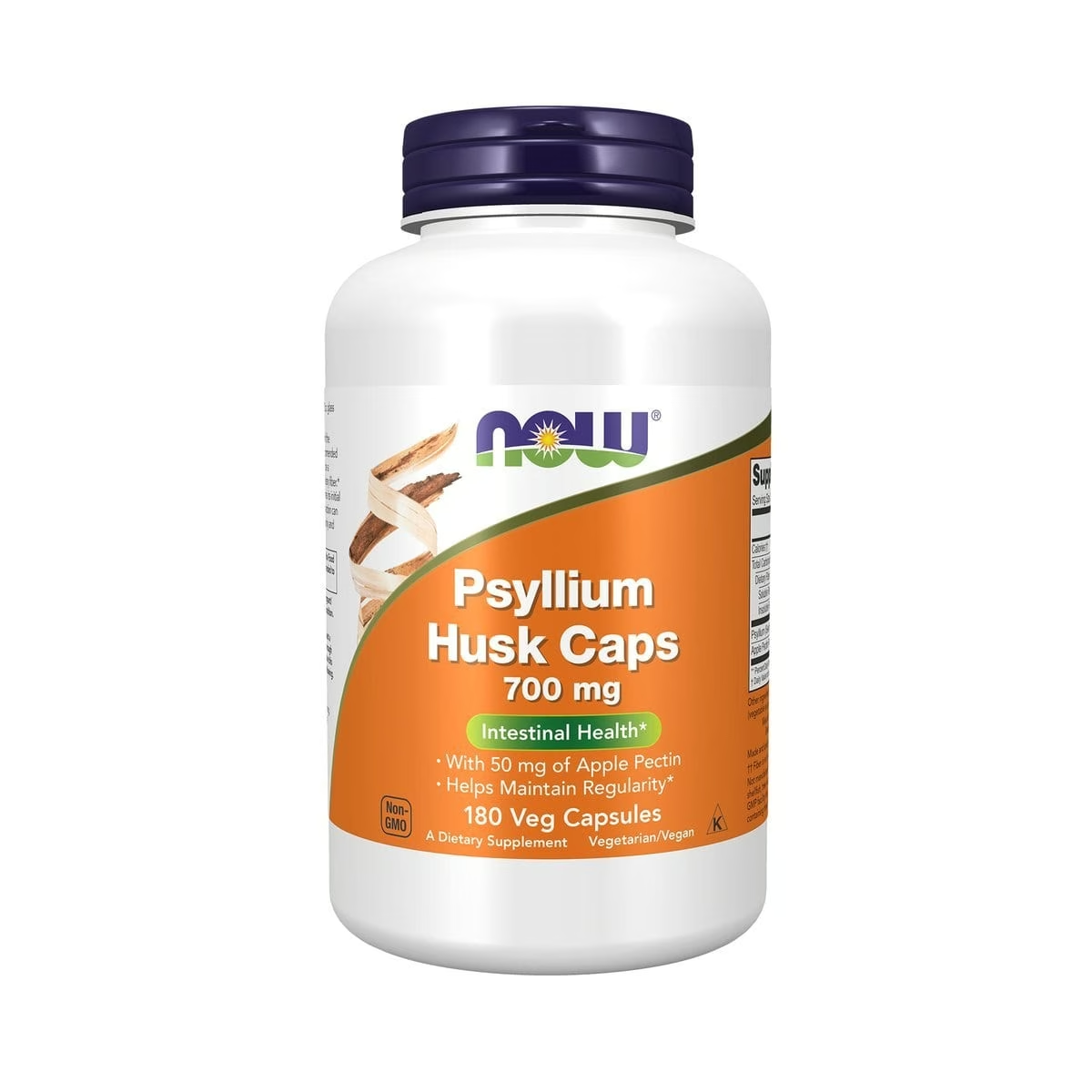
NOW Foods Psyllium Husk Caps are the best fibre supplement in this guide for most adults who prefer capsules. It is the best-reviewed psyllium capsule here, with more than 2,600 customer reviews and a 4.6 out of 5 rating, and it comes from a long-established US supplement brand.
Each serving is two capsules, which gives 1.4 g of psyllium seed husk plus 100 mg of apple pectin and about 1 g of fibre. A bottle holds 180 capsules, or 90 servings. The capsule shell is hypromellose, and the retailer listing describes the product as vegan, halal, kosher and made without gluten.
NOW’s directions are two capsules with a full glass of liquid, two to three times a day. The warnings say to take it with at least a full glass of liquid and not to use it if you have difficulty swallowing. It may contain traces of sesame.
Pros
- Two capsules give about 1 g of fibre per serving
- 180 capsules, or 90 servings, per bottle
- Vegan hypromellose capsule, per the retailer listing
- Made without gluten, per the retailer listing
- Long-established brand with a large review base
Cons
- Only about 1 g of fibre per serving, so several servings are needed
- Needs a full glass of liquid with every dose
- May contain traces of sesame
Key specs: Psyllium husk 700mg capsules with apple pectin. 2 capsules per serving, 90 servings. About 1g fibre per serving. Hypromellose capsule. Adults only.
2. Yerba Prima Psyllium Husks Veg Caps – Best High-Capacity Capsule Bottle
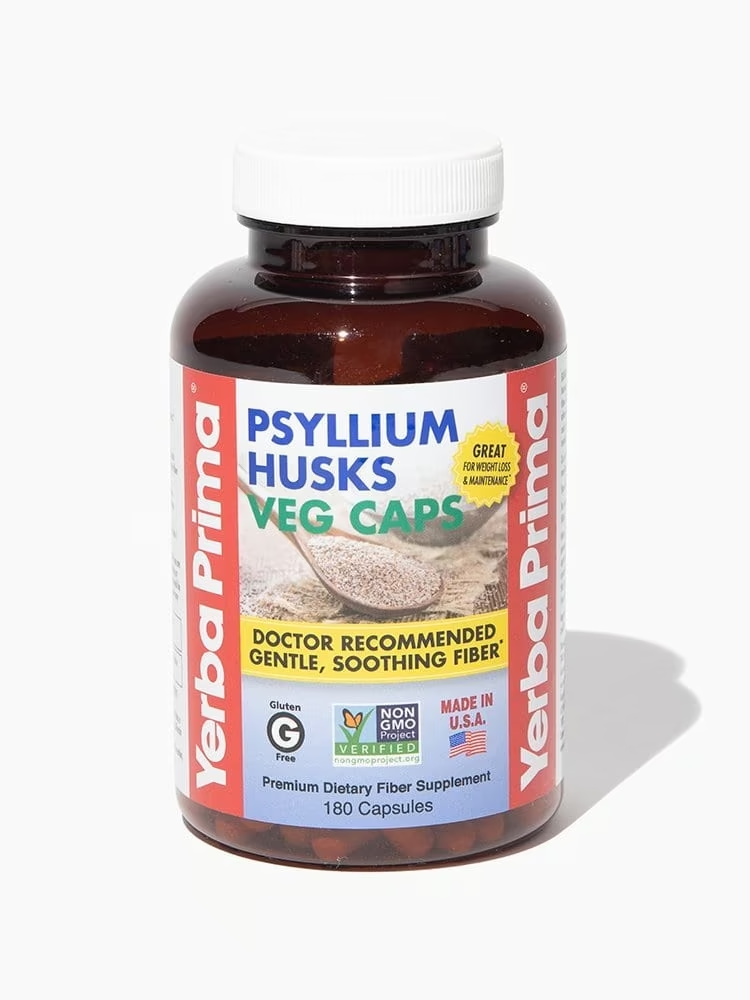
Yerba Prima Psyllium Husks Veg Caps are a straightforward psyllium capsule with a short ingredient list: psyllium husks in a vegetable cellulose capsule. This listing is the large 400-capsule bottle, which suits people who take psyllium every day.
The maker lists 625 mg of psyllium husk per capsule, with a serving of four capsules giving 2.2 g of fibre (1.8 g soluble and 0.4 g insoluble). Yerba Prima says the product has no added sugar, artificial flavour or colour, binders or fillers, and that it is gluten-free.
The directions are four or five capsules one to three times a day with food, with at least a full glass of liquid for each serving. The maker advises not taking it within one to two hours of prescription medicines, and a gelatin-capsule version also exists, so check you are buying the veg caps.
Pros
- Psyllium husk and a vegetable capsule only, per the maker
- No added sugar, artificial flavour, colour, binders or fillers, per the maker
- About 2.2 g of fibre per four-capsule serving
- Large 400-capsule bottle
- Gluten-free, per the maker
Cons
- Four or five capsules per serving is a lot to swallow
- Needs a full glass of liquid with each serving
- Not to be taken within one to two hours of prescription medicines
Key specs: Psyllium husk 625mg per veg capsule. Serving of 4 capsules gives 2.2g fibre (1.8g soluble, 0.4g insoluble). 400-capsule bottle. Gluten-free, per the maker.
3. Lotus Psyllium Husks 700g – Best Psyllium Husk Powder
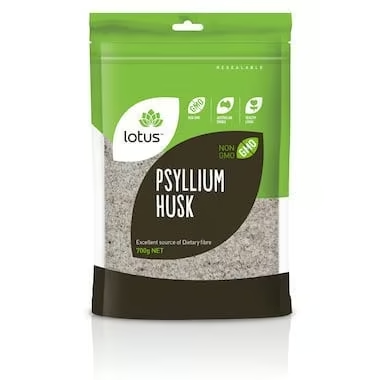
Lotus Psyllium Husks are the pick here if you want plain psyllium husk in bulk. The ingredient list is a single item, 100% psyllium husk, and the 700 g pouch is sold by an Australian brand and supplier.
The label lists a 10 g serve with 8.0 g of fibre and 13 mg of sodium, and 70 serves per pack. The distributor says the husk is sourced from India and packed in Australia, and describes the product as gluten-free and vegan with no artificial flavours, colours or preservatives.
Loose husk needs to be stirred into water and drunk straight away, and it thickens quickly. The pack we reviewed is marked non-GMO, and the listing title says organic, so check the pack you receive.
Pros
- Single ingredient: 100% psyllium husk
- 8.0 g of fibre per 10 g serve
- 70 serves in the 700 g pouch
- Gluten-free and vegan, per the distributor
- Resealable pouch
Cons
- Loose husk thickens quickly and needs to be drunk straight away
- No capsule option, so the texture is not for everyone
- Organic status is not confirmed on the pack we reviewed
Key specs: 100% psyllium husk. 10g serve gives 8.0g fibre. 70 serves per 700g pouch. Sourced from India, packed in Australia, per the distributor.
4. Fybogel Hi-Fibre Orange Sachets – Best Orange-Flavoured Sachet Drink
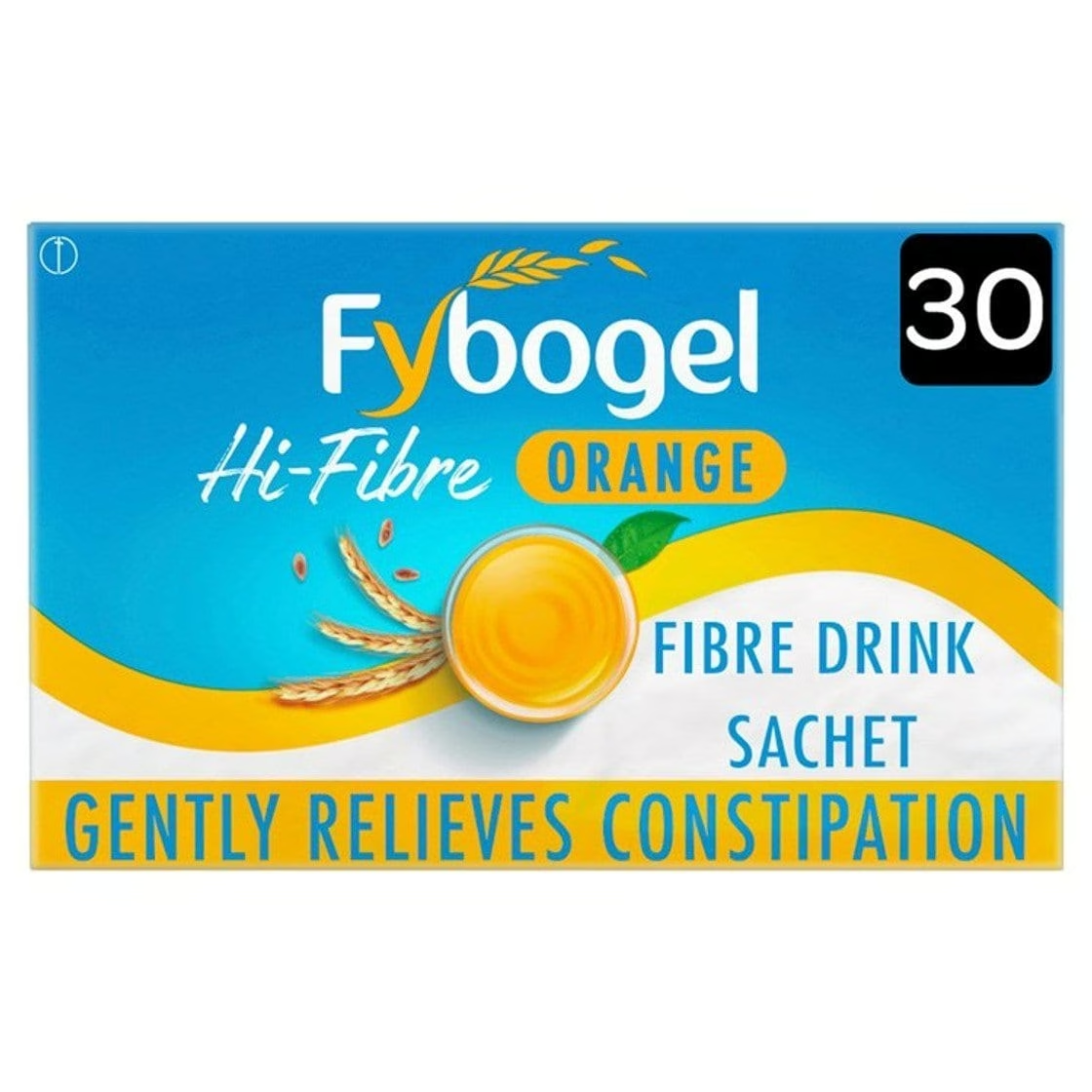
Fybogel is an orange-flavoured ispaghula husk (psyllium) drink made by Reckitt. You stir one sachet into a glass of water, and it comes in a 30-sachet box, which makes it an easy option for people who dislike capsules or loose husk.
Each sachet contains 3.5 g of ispaghula husk. In the UK it is a general sales list medicine for people who need a high-fibre regimen, according to the UK product information, and the maker states that it is gluten-free and sugar-free. The adult directions are one sachet in a full glass of water in the morning and evening.
The sachets contain aspartame, which is a source of phenylalanine and so not suitable for people with phenylketonuria. The UK product information advises seeing a doctor or pharmacist if there is no bowel movement after three days, and New Zealand packaging may differ from the UK carton.
Pros
- Flavoured drink in a pre-measured sachet
- 30 sachets per box
- Ispaghula husk, 3.5 g per sachet
- Gluten-free and sugar-free, per the maker
- Made by a major healthcare company
Cons
- Contains aspartame, so not suitable for people with phenylketonuria
- Sweetened and artificially flavoured
- Packaging may differ from the UK carton
Key specs: Ispaghula husk 3.5g per sachet. Orange flavour. 30 sachets. Contains aspartame. Gluten-free and sugar-free, per the maker.
5. TUMME Natural Fibre Caps – Best Non-Psyllium Capsule
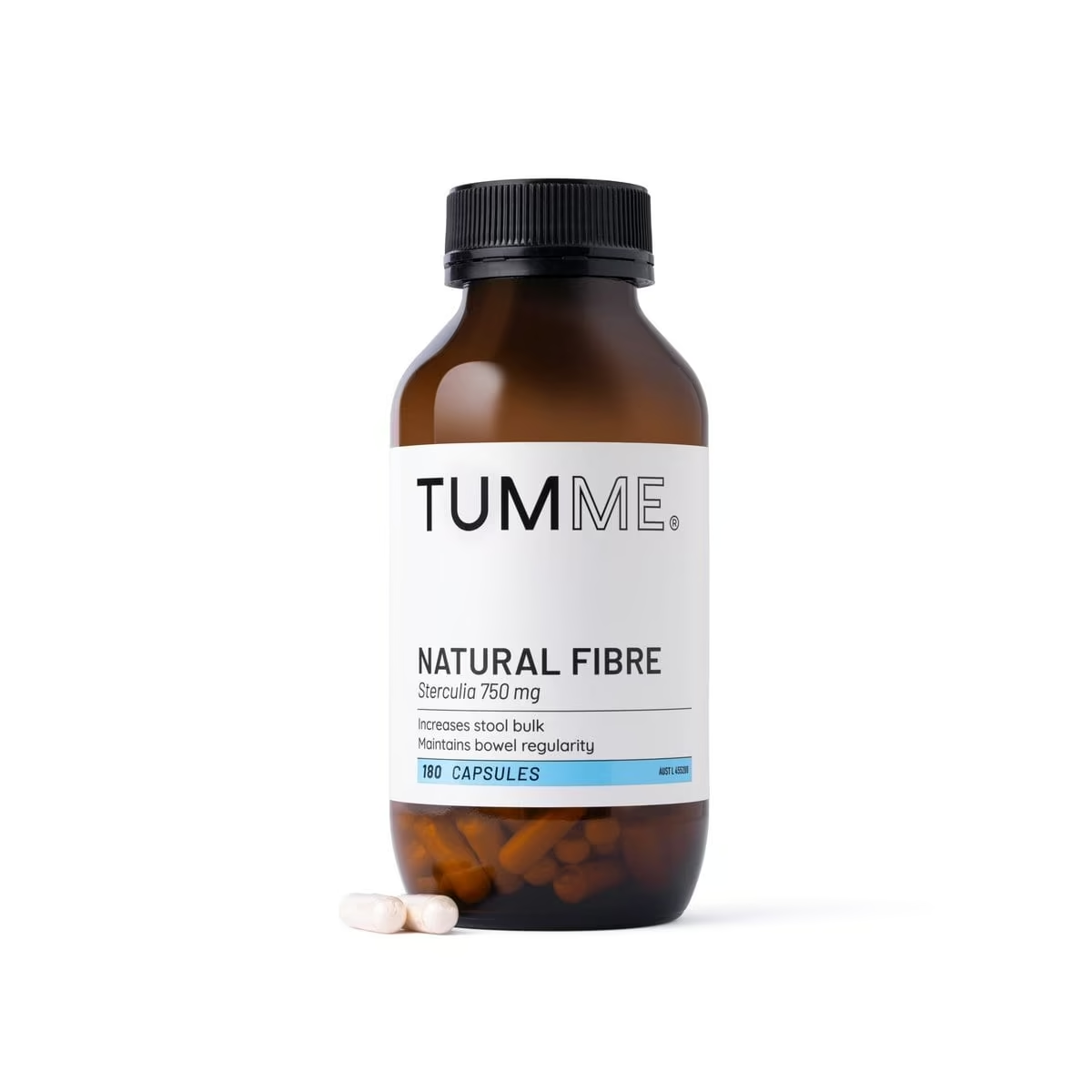
TUMME Natural Fibre Caps use sterculia (karaya gum) rather than psyllium, which makes them a useful alternative if you have not got on with psyllium. Each capsule contains 750 mg of sterculia, and the bottle holds 180 capsules.
The brand is sponsored in Australia and the product is listed with the Australian TGA. The label directions are two sets of three capsules a day for dietary fibre, or three sets of five capsules a day for stool bulk and regularity. TUMME says it is suitable for vegans and vegetarians, with no gluten, lactose, soy or nuts.
The label warns not to use it if you have abdominal pain, nausea, vomiting or diarrhoea, and to drink plenty of water. Ask a health professional first if you are pregnant, likely to become pregnant or breastfeeding.
Pros
- Sterculia (karaya gum) instead of psyllium
- 750 mg per capsule, 180 capsules per bottle
- Listed with the Australian TGA
- Vegan and vegetarian suitable, per the brand
- No gluten, lactose, soy or nuts, per the brand
Cons
- Up to 15 capsules a day on the higher dose
- Fewer reviews than the big-name psyllium options
- Not for anyone with abdominal pain, nausea, vomiting or diarrhoea
Key specs: Sterculia (karaya gum) 750mg per capsule. 180 capsules. Vegan and vegetarian suitable, per the brand. Australian TGA listed.
6. LABO Nutrition Bioactive Organic Fiber – Best Low FODMAP Fibre Sachets
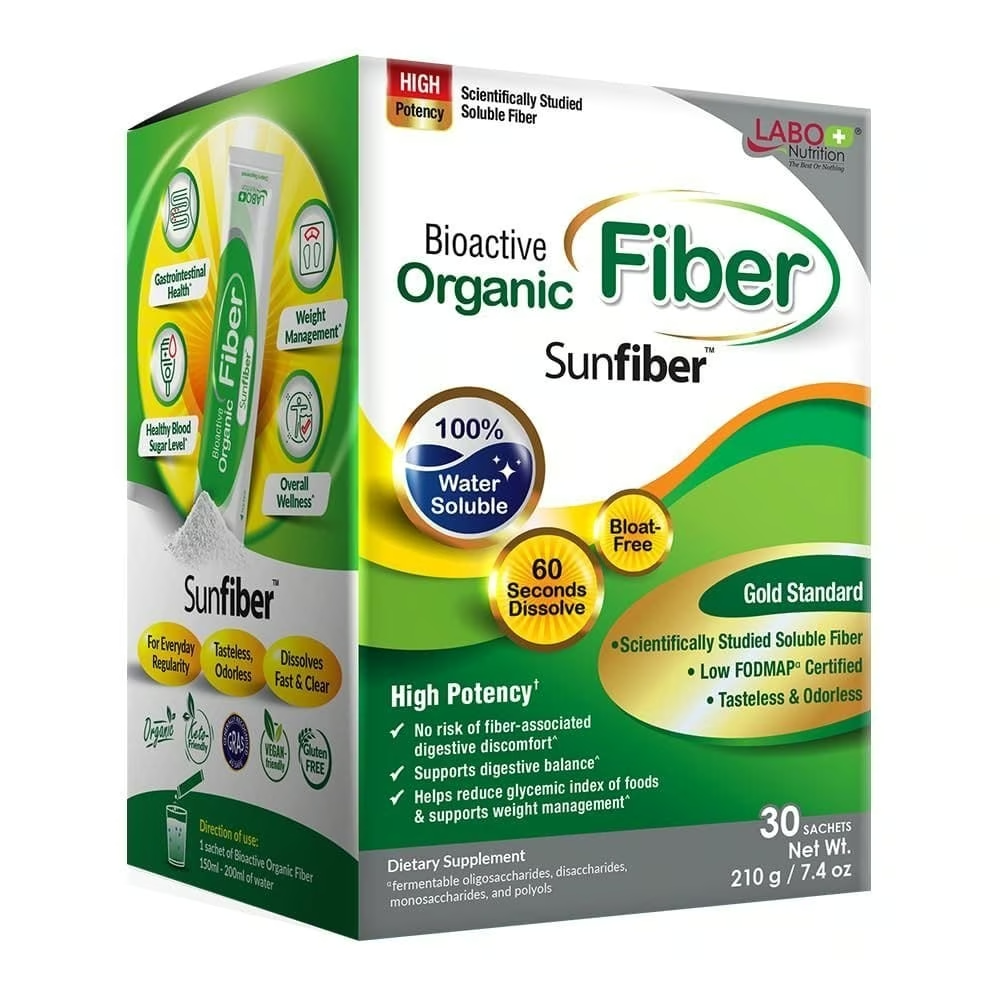
LABO Nutrition Bioactive Organic Fiber is a Sunfiber powder, a partially hydrolysed guar gum (PHGG), packed in single-serve sachets. The box shows 30 sachets and describes the powder as tasteless, odourless and fully water-soluble.
The directions on the box are one sachet stirred into 150 to 200 ml of water, and the box says it dissolves in about a minute. LABO states that it is Low FODMAP certified, vegan-friendly and gluten-free. Each sachet is 7 g according to the pack, even though some listing titles say 6 g.
Sachets are convenient for travel and for measuring a consistent dose. LABO is a Malaysian and Singaporean brand, and the retailers we found ship from the US or Singapore, so check New Zealand delivery before you order.
Pros
- Single-serve sachets for easy travel
- Dissolves in water with no taste, per the brand
- Low FODMAP certified, per the brand
- Vegan-friendly and gluten-free, per the brand
- 30 sachets per box
Cons
- Sachets create more packaging than a tub
- Brand sells through Asian and US retailers, so delivery can be slower
- Pack size is listed as 6 g in some titles and 7 g on the pack
Key specs: Sunfiber PHGG powder. 30 sachets, 210g. 1 sachet in 150 to 200ml of water. Low FODMAP certified, per the brand.
7. MicroNutrition PHGG Prebiotic Fibre – Best Unflavoured PHGG Powder
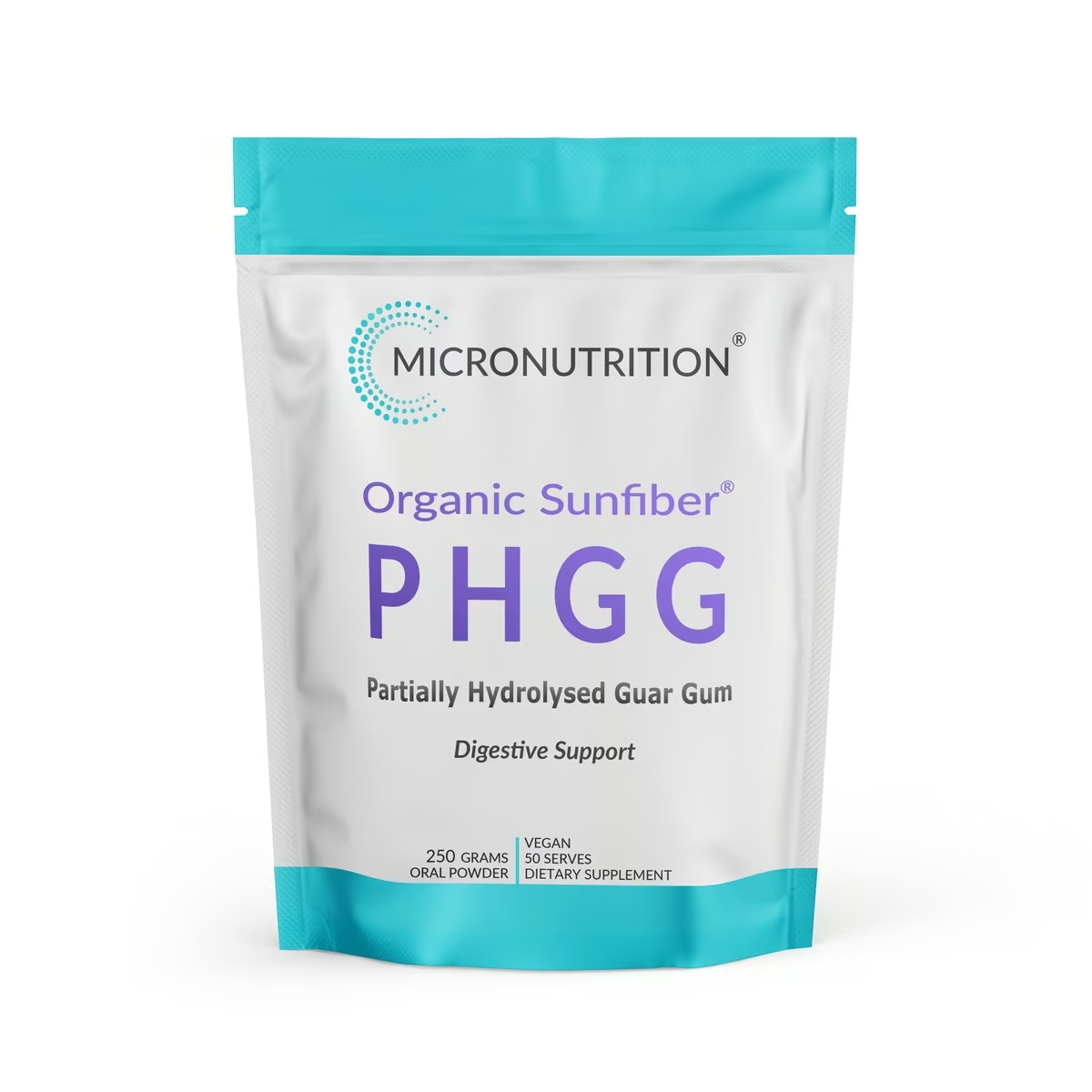
MicroNutrition PHGG is an Australian partially hydrolysed guar gum powder made from organic Sunfiber. The 250 g tub gives 50 servings, which makes it the better-value PHGG option here than the sachets.
Each 5 g serve contains 4.35 g of fibre and about 9.5 kcal, with no excipients. MicroNutrition says it has a neutral taste, is certified organic, is third-party batch tested, and is manufactured in Australia. It is listed as vegan, dairy-free and gluten-free.
The directions are 5 g, or one tablespoon, in a cold drink, one to three times a day. For sensitive people the label suggests starting at a quarter of a teaspoon and building up weekly. The page does not market it as Low FODMAP.
Pros
- 4.35 g of fibre per 5 g serve
- 50 servings per 250 g tub
- Certified organic and third-party batch tested, per the brand
- Neutral taste, dissolves in cold drinks
- Vegan, dairy-free and gluten-free, per the brand
Cons
- Loose powder is measured by spoon
- Not marketed as Low FODMAP
- Fewer reviews than the big-name options
Key specs: PHGG (organic Sunfiber) powder. 250g, 50 serves of 5g. 4.35g fibre per serve. Made in Australia, per the brand.
8. Nature’s Aid Inulin Powder – Best Inulin Prebiotic Powder
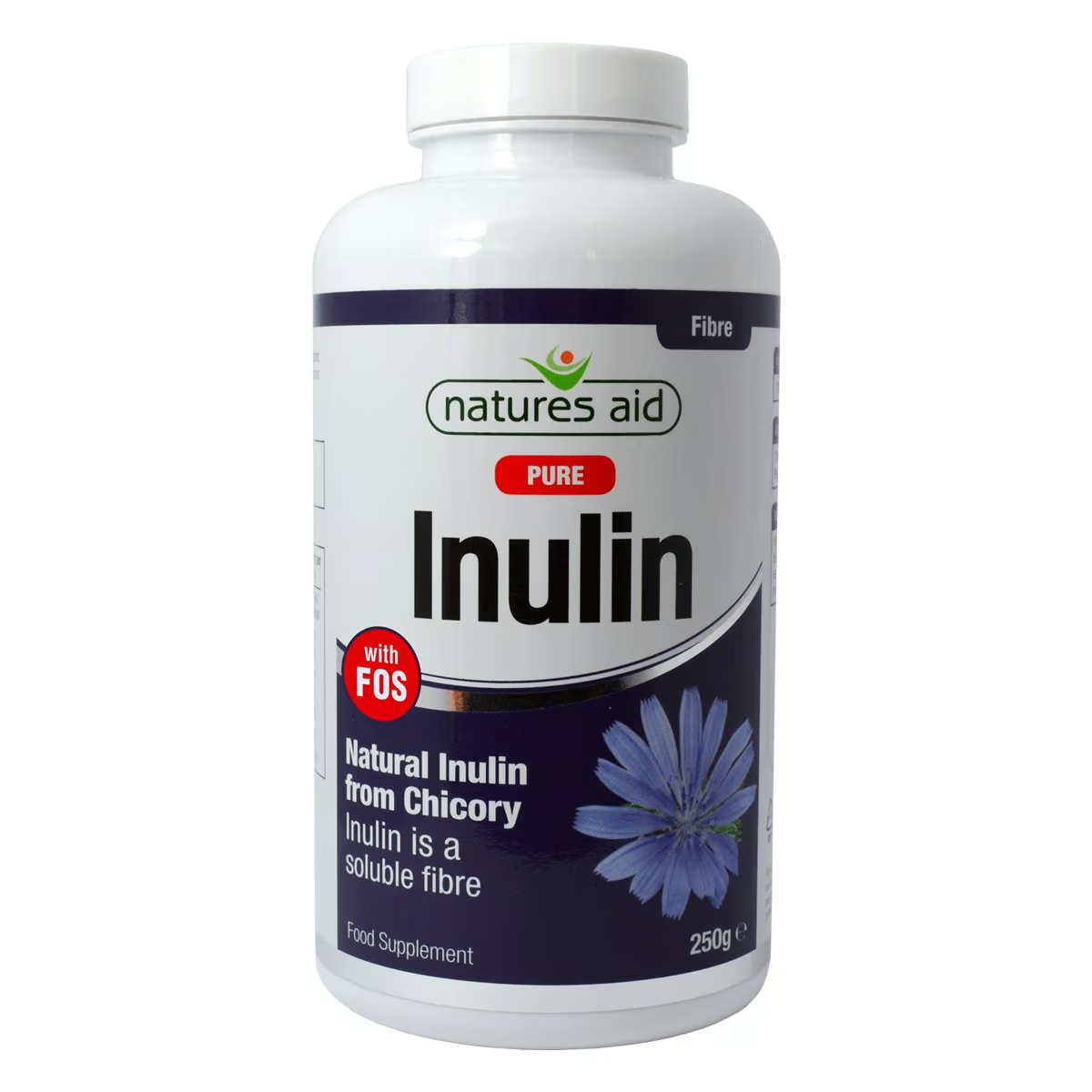
Nature’s Aid Inulin Powder is a 250 g tub of chicory inulin, a prebiotic fibre rather than a bulking fibre. The pack says it contains FOS, and retailers describe it as vegan and free from gluten, lactose, soy and nuts.
The usual serving is one to two teaspoons mixed into water, juice, a shake or yoghurt. Inulin has a mildly sweet taste and dissolves readily, so it is easy to add to food. The listing says it is made in the UK.
Inulin is a fermentable, high-FODMAP fibre, so it can cause wind or bloating, particularly at the start. Begin with a small amount and increase slowly. It suits people who want a prebiotic rather than a psyllium-style bulking fibre.
Pros
- Pure chicory inulin, with FOS on the pack
- Mild sweet taste that dissolves easily
- Easy to add to drinks, shakes or yoghurt
- Vegan and free from gluten, lactose, soy and nuts, per retailers
- 250 g tub
Cons
- High-FODMAP fibre that can cause wind or bloating
- Fibre per serving is not confirmed on the pages we could check
- Ships from the UK on this listing
Key specs: Chicory root inulin powder with FOS. 250g tub. 1 to 2 teaspoons per serving. Vegan, per retailers.
How to choose a fibre supplement in NZ
Start with the fibre type. Psyllium is the most widely used bulking fibre, sterculia is the alternative if psyllium does not suit you, and PHGG and inulin are prebiotic fibres that dissolve into drinks. If you have irritable bowel symptoms, ask a GP or dietitian before choosing, since inulin in particular is high in FODMAPs.
Then check the grams of fibre per serving and the form you will actually take. Capsules are easy but give a small dose per capsule, while powders and sachets deliver more fibre per serving. Whatever you choose, build up slowly, drink plenty of water, and keep fibre away from your prescription medicines by one to two hours.
For more health and wellbeing guides, see our best multivitamins, the best meal replacement shakes and the best probiotics.
Verdict
NOW Foods Psyllium Husk Caps are the best fibre supplement for most adults who prefer capsules, with a long-established brand and the biggest review base here. The Lotus Psyllium Husks are the best bulk powder, and the Fybogel sachets are the easiest flavoured drink.
If psyllium does not suit you, try the TUMME sterculia capsules. For a prebiotic fibre choose the LABO sachets for convenience, the MicroNutrition PHGG for a tub, or the Nature’s Aid inulin if you want a sweeter prebiotic. Start with a small dose and speak to a GP or pharmacist if you are unsure.
FAQs
What is the best fibre supplement in NZ?
NOW Foods Psyllium Husk Caps are the best all-rounder for most adults who prefer capsules. For powder choose the Lotus Psyllium Husks, and for a prebiotic fibre choose the MicroNutrition PHGG or LABO Sunfiber.
What is the best fibre supplement for regularity?
Bulking fibres such as psyllium husk, ispaghula (Fybogel) and sterculia are the types that makers describe as supporting regularity. Take them with plenty of water and build up slowly. If you have ongoing bowel problems, see a GP.
What is the best fibre supplement for IBS?
There is no single best choice, and it depends on your symptoms. PHGG such as Sunfiber is marketed as gentle, and the LABO sachets are Low FODMAP certified, per the brand. Speak to a GP or dietitian before starting a fibre supplement for IBS.
Is psyllium or inulin better?
They do different jobs. Psyllium is a bulking fibre that absorbs water, while inulin is a fermentable prebiotic fibre that can cause wind or bloating at first. Choose by how your body responds and start with a small dose.
How much fibre do I need a day in NZ?
The adequate intake for dietary fibre in Australia and New Zealand is 25 g a day for women and 30 g for men. Wholegrains, fruit, vegetables, legumes and nuts are the main sources, and a supplement is an optional top-up.
Can I take a fibre supplement with medicines?
Take fibre one to two hours apart from prescription medicines, because it can slow the absorption of some of them. Always take bulking fibres with a full glass of water, and speak to a GP or pharmacist if you take regular medicines.
