A cordless home phone is a landline handset that talks to a base station by radio, so calls can be made and answered around the house without being tied to a wall socket.
Nearly all modern sets use DECT, a dedicated radio band that does not share airtime with Wi-Fi. Single handset sets suit a flat. Twin and three handset packs suit a typical home. Four handset packs suit larger or multi-storey homes. Every phone in this guide includes a built-in answering machine.
New Zealand permits DECT at 1880 to 1900 MHz, the same band used in Australia and Europe, and Consumer NZ advises against using DECT 6.0 devices bought overseas because that version runs at 1.9 GHz and can interfere with mobile networks. Panasonic lists NZ-coded versions of the KX-TG6822, KX-TGD320 and KX-TGC222.
This guide compares six cordless home phones from Panasonic and VTech available to New Zealand buyers, with pros, cons and key specs for each.
| Product | Best For |
|---|---|
| Panasonic KX-TGD320 | Best Single Handset with Answering Machine |
| Panasonic KX-TG6822 | Best Twin Pack with Power Back-Up |
| Panasonic KX-TGD323 | Best Three Handset Set |
| Panasonic KX-TGD324 | Best for Larger Homes |
| Panasonic KX-TGC222 | Best Budget Answering System |
| VTech CLS22052 | Best Basic Three Handset Pack |
1. Panasonic KX-TGD320 – Best Single Handset with Answering Machine
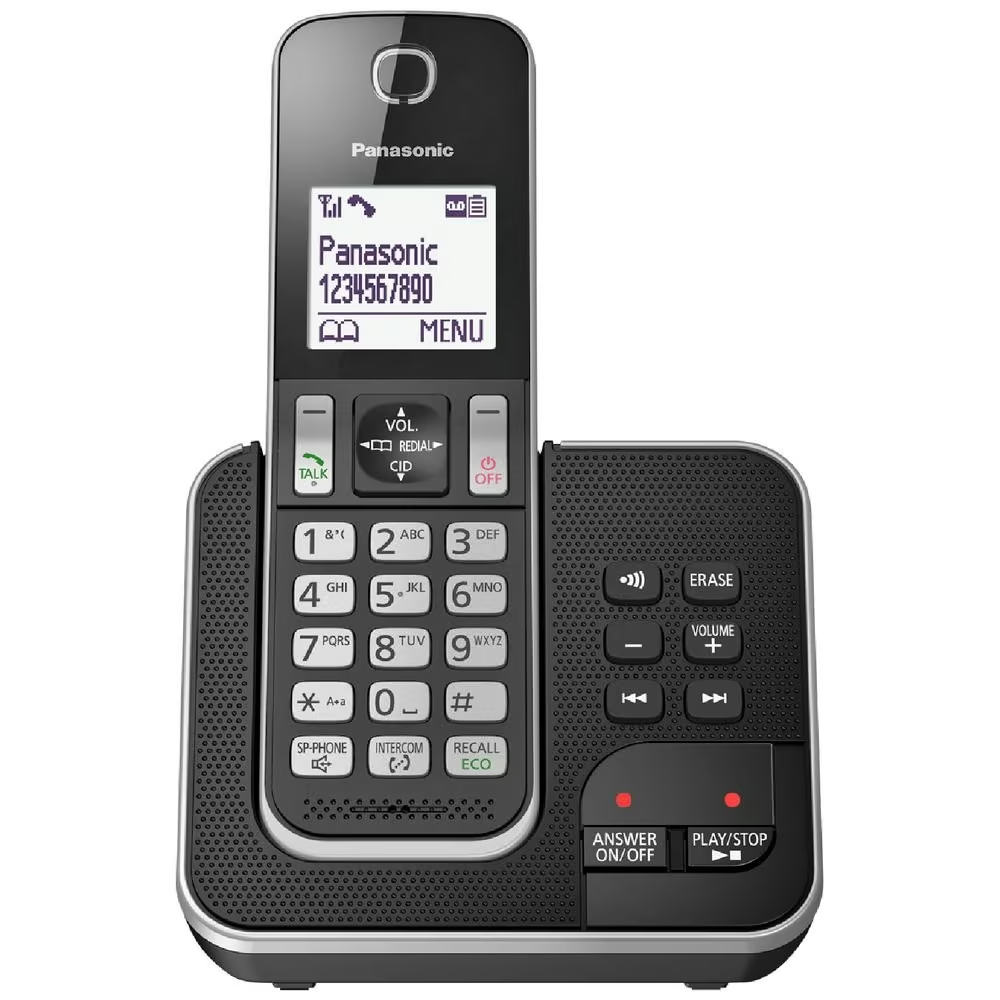
The Panasonic KX-TGD320 is a single handset DECT phone with a digital answering machine built into the base. The handset has a white backlit LCD screen, and Panasonic NZ lists the model as KX-TGD320NZ. It suits a household that wants one phone and a message machine without extra handsets.
Retailer listings give a talk time of up to 16 hours and about 8 days of standby on the long-life battery. The answering machine records for about 30 minutes, and the phonebook holds 120 entries according to most listings. Nuisance call blocking and a power back-up operation are both listed by Panasonic NZ.
Extra handsets can be added later, with Panasonic NZ listing the KX-TGDA30AZ as the matching accessory. The trade-off is that a single handset means no intercom out of the box, and at least one European retailer marks the model as end of life.
Pros
- Single handset keeps the setup simple
- Up to 16 hours of talk time
- About 8 days of standby
- Digital answering machine in the base
- Nuisance call blocking and power back-up operation
- Extra handsets available as accessories
Cons
- No second handset in the box
- European retailer flags it as discontinued
- Phonebook size varies between listings (120 versus 50)
- Call block capacity not confirmed
Key specs: Handsets: 1 in box, expandable (accessory handset KX-TGDA30AZ) | Talk time: up to 16 hours | Standby: about 8 days | Phonebook: 120 entries (one listing says 50) | Answering machine: about 30 minutes | Call block: yes, nuisance call block (capacity not verified) | Display: 1.8 inch, white backlit LCD | Battery: NiMH AAA | Power back-up: yes
2. Panasonic KX-TG6822 – Best Twin Pack with Power Back-Up
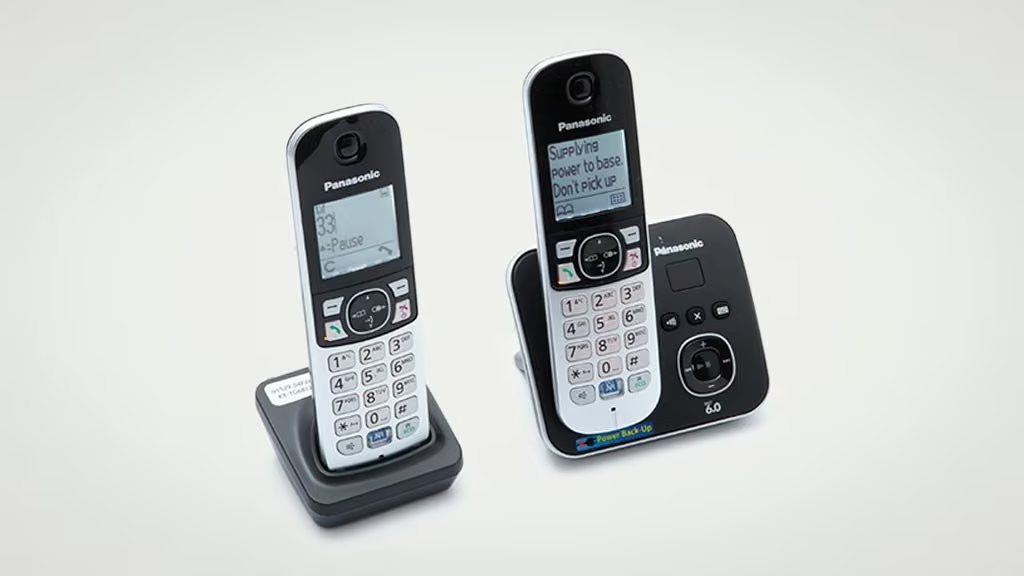
The Panasonic KX-TG6822 is a DECT twin set with a base that carries a built-in digital answering machine. The box holds two handsets, one sitting on the answering base and one on a small charging stand. Each handset has a 1.8 inch monochrome screen and a backlit keypad.
On the features side, the phonebook is shared across all registered handsets and stores 120 entries according to CHOICE. The answering machine records for about 30 minutes, and a noise reduction button cuts background sound for the person on the other end. A power back-up mode lets a handset draw power from the base so calls can still be made during a blackout, although CHOICE notes this does not apply on NBN connections.
The system can be expanded to six handsets. The main trade-off is age, since the design predates Panasonic’s newer TGD range and it lacks a documented call block capacity figure. Standby is claimed at seven days, which is shorter than the 200 hour figure quoted for the newer sets.
Pros
- Two handsets and a digital answering machine in the box
- Expandable to six handsets
- Power back-up mode for blackouts on a copper line
- Noise reduction button for noisy calls
- Shared phonebook across handsets
Cons
- Power back-up does not help on NBN connections, per CHOICE
- Older design than the TGD series
- Standby claim of seven days is short
- Call block capacity not confirmed from a reliable source
Key specs: Handsets: 2 in box, expandable to 6 | Talk time: not verified | Standby: 7 days (CHOICE claim) | Phonebook: 120 entries (CHOICE) | Answering machine: 30 minutes | Call block: yes, requires Caller ID (capacity not verified) | Display: 1.8 inch monochrome, backlit | Battery: 2 x NiMH AAA 550mAh | Power back-up: yes
3. Panasonic KX-TGD323 – Best Three Handset Set
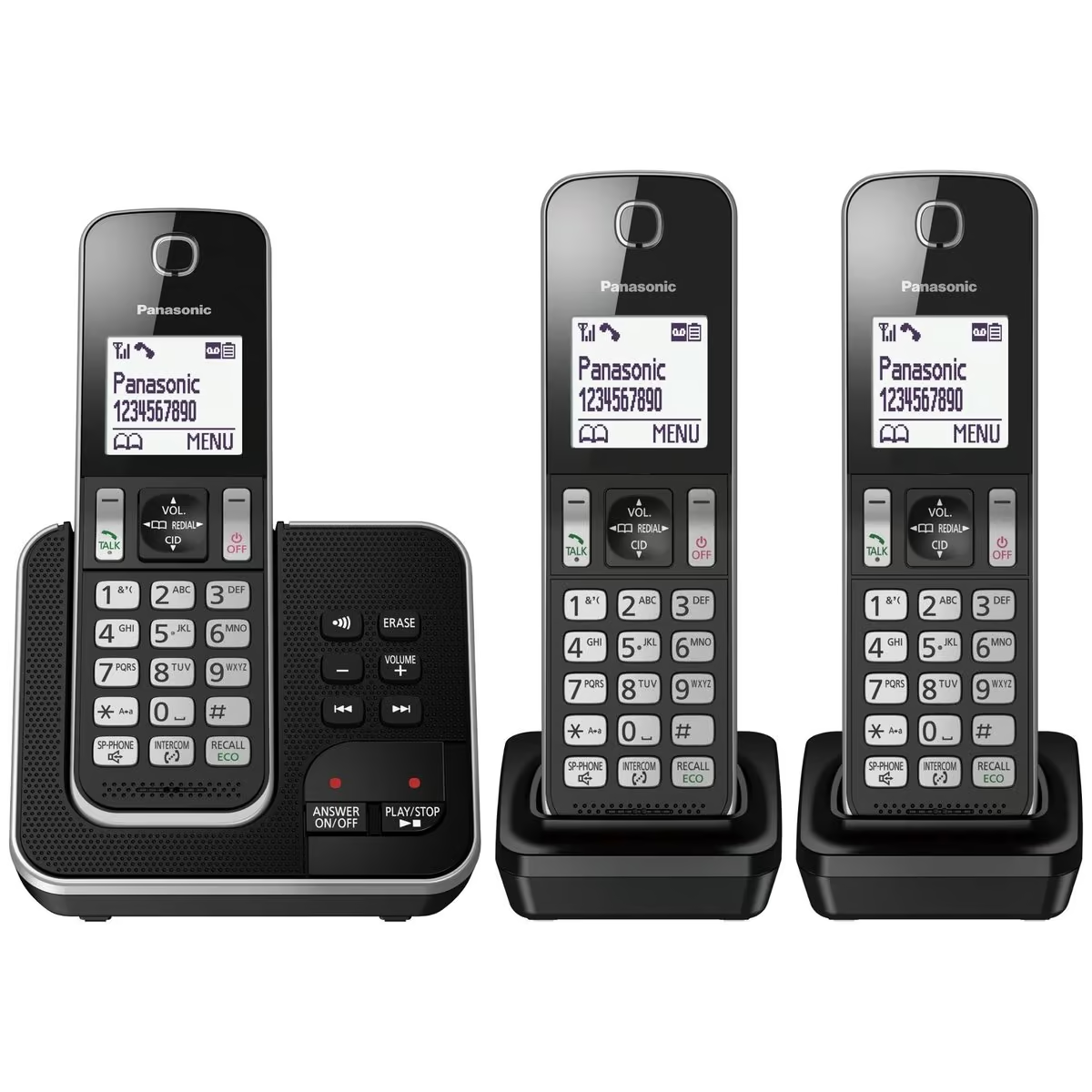
The Panasonic KX-TGD323 is the three handset version of the TGD series, with the answering machine built into the base. The box holds three handsets, two of them with their own charging cradles. All handsets share a 120 entry phonebook automatically.
Talk time is rated at up to 16 hours, and a handset can be left idle for about 8 days between charges. The answering machine records for about 30 minutes and plays messages through a large speaker. A speakerphone key and an intercom key sit on each handset, and power back-up operation is listed.
Call blocking covers single numbers, number prefixes of 2 to 8 digits and numberless calls, and it needs a Caller ID service. The system can grow to six handsets in total. The trade-off is that a backlight is not confirmed on the listings seen, and no NZ-coded version was found.
Pros
- Three handsets cover a larger home
- Expandable to six handsets
- Up to 16 hours of talk time
- Call block by number, prefix or withheld number
- Intercom between handsets
- Shared phonebook of 120 entries
Cons
- Needs a Caller ID service for call blocking
- Backlight not stated on listings seen
- No NZ-coded variant found
- Call block capacity not confirmed
Key specs: Handsets: 3 in box, expandable to 6 | Talk time: up to 16 hours | Standby: about 8 days (200 hours) | Phonebook: 120 entries | Answering machine: about 30 minutes | Call block: yes, numbers, 2 to 8 digit prefixes, numberless (capacity not verified) | Display: 1.8 inch, 103 x 65 | Battery: long-life NiMH (exact type not confirmed for this model) | Power back-up: yes
4. Panasonic KX-TGD324 – Best for Larger Homes
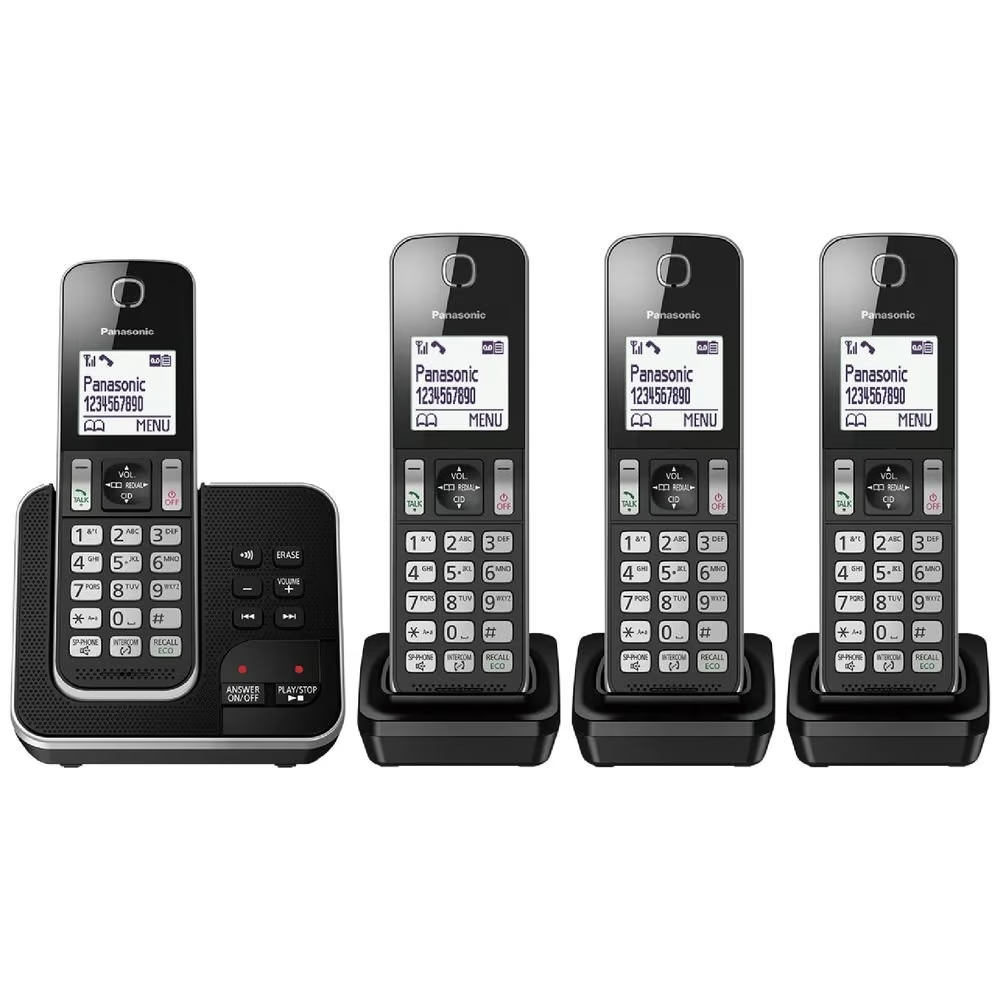
The KX-TGD324 is the four-handset version of the TGD answering system range, sold in Australia as the KX-TGD324ALB and in Europe as the KX-TGD324E. The pack contains a base and four handsets, which suits multi-storey homes or households that want a phone in several rooms. Retailer listings state a 1.9 GHz DECT frequency and a backlit white display.
Listings give 16 hours of maximum talk time and about 8 days of standby. Communication between each handset and the base is encrypted, any number or any 2 to 8 digit number prefix can be blocked, and each handset has a do not disturb mode with a baby monitor function. The range supports power back-up operation during a blackout.
The trade-offs are the usual ones for a larger pack. Four handsets need four charging positions on the bench, and sources disagree on message memory, with one listing 17 minutes and another 30 minutes. A New Zealand specific KX-TGD324NZ code was not found, so confirm with the retailer which version is supplied.
Pros
- Four handsets included for larger homes
- Encrypted DECT link between handsets and base
- Block numbers by full number or by a 2 to 8 digit prefix
- Do not disturb and baby monitor functions
- Power back-up operation listed
Cons
- Message recording time conflicts between sources (17 or 30 minutes)
- Four chargers take up bench space
- No NZ model code found for this exact set
- Call blocking needs a Caller ID service
Key specs: Handsets: 4 | Talk time: up to 16 hours | Standby: about 8 days | Answering machine: 17 to 30 min (sources conflict) | Call block: any number or 2 to 8 digit prefix (capacity not verified) | Frequency listed: 1.9 GHz DECT | Display: white backlit LCD
5. Panasonic KX-TGC222 – Best Budget Answering System
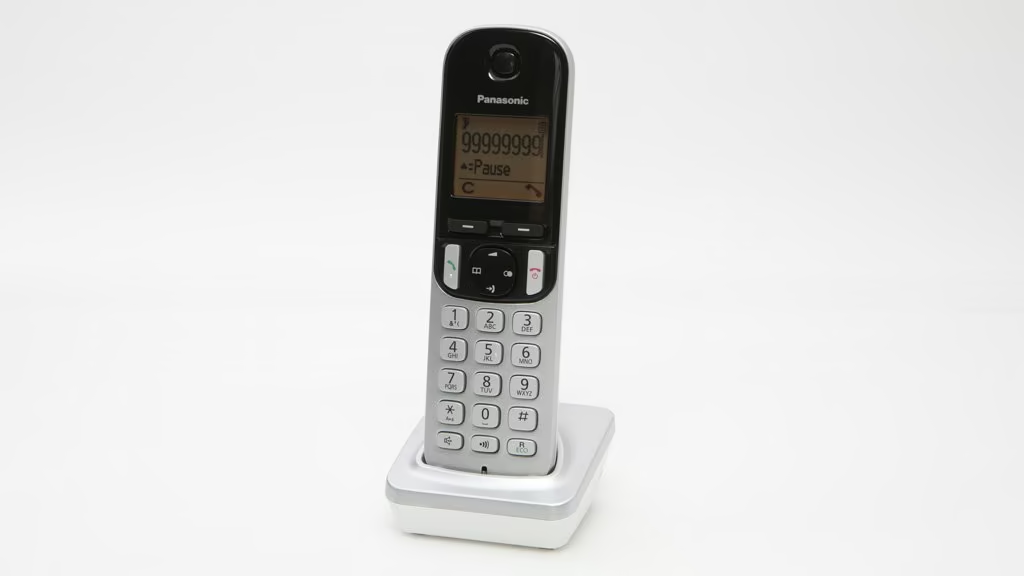
The KX-TGC222 is a twin-handset DECT set with a built-in answering machine in the older, simpler Panasonic TGC range. Panasonic New Zealand has a KX-TGC222NZ specification page, and the base phonebook holds 50 name and number entries. Handsets use a 1.6 inch display and the base includes an alarm clock with snooze.
Listings give up to 18 minutes of message recording and standby of up to 170 hours, while talk time figures differ between regions, from 10 to 20 hours. Each handset has a hands-free speaker, and Any Key Answer is supported. Caller ID and call block features depend on the provider’s Caller ID service.
The trade-offs are a smaller phonebook, a shorter message memory and a smaller screen than the TGD range. Independent testing lists the keypad as not backlit, which may matter for use in a dark hallway. Panasonic New Zealand now files this model among its product pages for older units, so check that the NZ version is still supplied.
Pros
- Panasonic NZ page exists for the KX-TGC222NZ
- Built-in answering machine of about 18 minutes
- Includes two handsets and an alarm clock on the base
- Any Key Answer and hands-free speaker
- Simple, familiar Panasonic menus
Cons
- Only 50 phonebook entries
- Keypad not backlit per independent test data
- Talk time figures differ between regions (10 to 20 hours)
- Shorter message memory than the TGD models
Key specs: Handsets: 2 | Talk time: 10 to 20 hours (varies by region) | Standby: up to 170 hours | Phonebook: 50 | Answering machine: about 18 min | Display: 1.6 inch | Hands-free speaker: yes | Backlit keypad: no (per CHOICE) | DECT
6. VTech CLS22052 – Best Basic Three Handset Pack
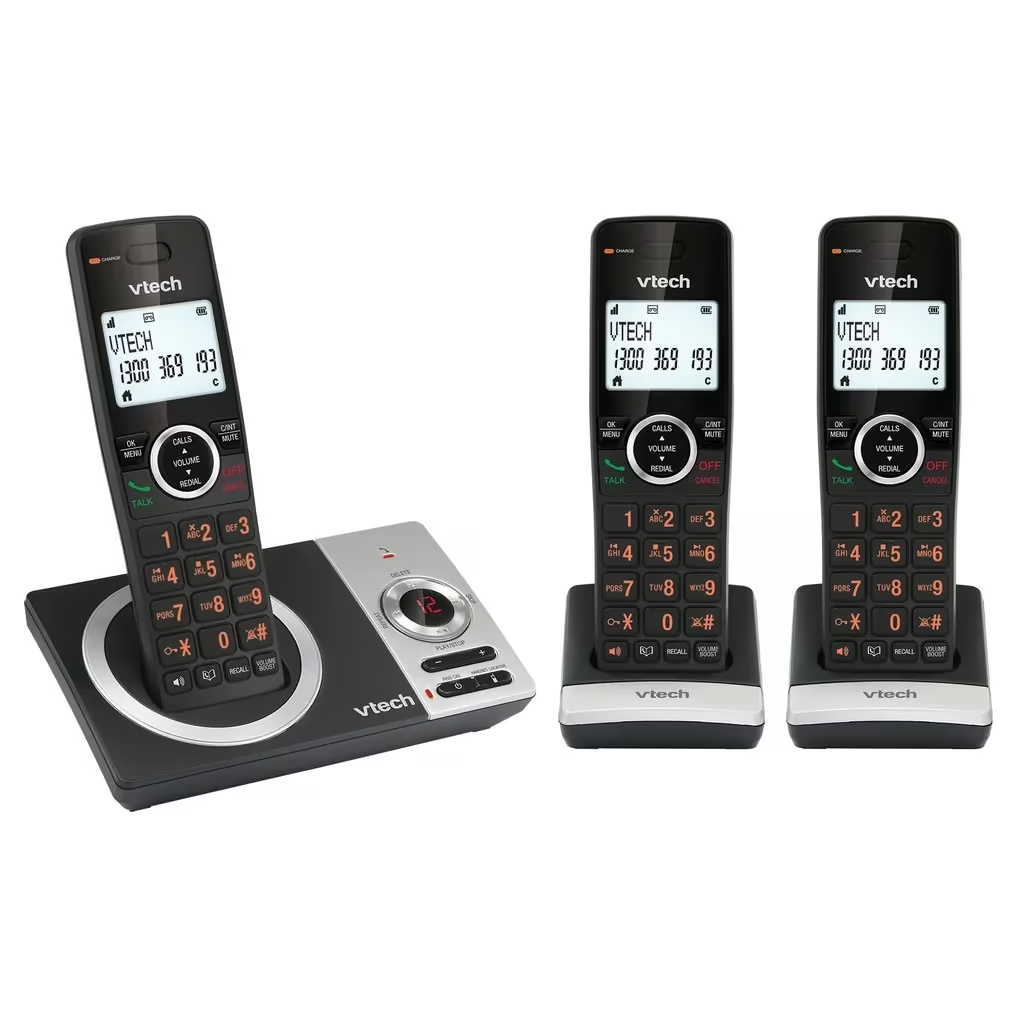
The VTech CLS22052 is the three-handset pack of the CLS22050 range, a straightforward DECT set with a built-in answering machine. Handsets have a white backlit display, an orange backlit keypad, a hands-free speakerphone, a volume booster and hearing aid compatibility. The base can sit on a bench or hang on a wall.
Retailer listings give up to 12 hours of talk time and 160 hours of standby, a 70 entry phonebook and a 30 number call list. The call block feature handles private and unavailable callers plus a block list of up to 70 numbers, and the answering machine records for about 12 minutes with call screening and a message counter.
The trade-offs are smaller memories than the CLS22150, with a 70 name phonebook and a 12 minute message limit. There is no MobileConnect or Bluetooth. Caller ID call display and call block need a Caller ID service from the provider.
Pros
- Three handsets in the box
- Call blocker covers private and unavailable callers plus 70 numbers
- Backlit display and keypad
- Call screening on the answering machine
- Wall mountable base and hearing aid compatibility
Cons
- Only a 70 entry phonebook
- Answering machine limited to about 12 minutes
- No Bluetooth or mobile pairing
- Retailer pages disagree on some dimensions and the AU site lists a different pack
Key specs: Handsets: 3 | Talk time: up to 12 hours | Standby: up to 160 hours | Phonebook: 70 | Answering machine: about 12 min | Call block: up to 70 numbers plus private and unavailable | Call list: 30 | Hands-free speaker: yes | Backlit display and keypad: yes | DECT
How to Choose a Cordless Home Phone
Check the radio band first. New Zealand permits DECT at 1880 to 1900 MHz, and Consumer NZ advises against DECT 6.0 sets bought overseas. A base labelled for the 1880 to 1900 MHz band, or a New Zealand coded Panasonic model, avoids the problem.
Decide whether built-in messages matter. Every model in this guide includes an answering machine, with roughly 12 to 30 minutes of memory. A network voicemail service can replace it, but a built-in machine works without a plan.
Match the call blocker to the nuisance call problem. Some models block single numbers, number prefixes or withheld numbers, and the VTech also covers private and unavailable callers. Remember that number display and blocking need a Caller ID service from the provider.
Think about handset count and battery type. Two to four handsets cover most homes, and extra handsets can usually be registered later. Standard AAA rechargeable batteries are easy to replace when capacity fades.
Many households now connect a landline through fibre, so our best Wi-Fi routers guide is a useful companion, and our phones for seniors guide covers easy-to-use mobiles if a cordless phone is for an older relative.
If a mobile handset is also on the shopping list, see our best smartphones and cheap smartphone guides.
Verdict
For most New Zealand homes, the Panasonic KX-TGD323 is the most practical set here, with three handsets, a 30 minute answering machine and call blocking by number, prefix or withheld number. The KX-TGD320 suits a single phone, the KX-TG6822 is a twin pack with power back-up on a copper line, and the KX-TGD324 covers larger homes with four handsets. The KX-TGC222 is the simpler budget answering system, while the VTech CLS22052 offers a three handset pack with a nuisance call blocker from a second brand. Check that the base is for the 1880 to 1900 MHz DECT band and that the phone cord fits a New Zealand socket before buying, as an adapter may be needed.
Frequently Asked Questions
Do cordless home phones work with fibre in New Zealand?
Yes, in most cases. A DECT base station plugs into the phone port on the fibre ONT or router, or into a wall socket that has been wired to that port. Some providers do not enable the voice port by default, so it pays to confirm with the provider before buying.
What is the difference between DECT and Wi-Fi phones?
DECT phones use a reserved radio band of 1880 to 1900 MHz in New Zealand, so they do not compete with home Wi-Fi traffic. Wi-Fi or app based phones rely on the router and internet connection. DECT sets keep working for local handset to base calls even when the internet is down.
Do these phones block nuisance calls?
Most models here include a call blocker that rejects saved numbers. The Panasonic KX-TGD323 also blocks number prefixes of 2 to 8 digits and numberless calls, and the VTech CLS22052 covers private and unavailable callers plus up to 70 numbers. Number based blocking depends on a Caller ID service from the provider.
How many handsets does a home need?
One handset suits a small flat, while two or three suit a typical home with a couple of living areas. Larger or multi-storey homes can use a four handset pack. Most bases can be expanded by registering extra handsets, so starting with a smaller pack is reasonable.
How long do the batteries last, and can they be replaced?
Listings quote around 12 to 16 hours of talk time and between 8 days and about 170 hours of standby on a full charge. Handsets use standard AAA NiMH rechargeable cells that can be replaced when run time falls, and Consumer NZ advises choosing models with standard replaceable batteries. Replacement cells should be rechargeable types, not standard alkaline batteries.
Can an Australian cordless phone be used in New Zealand?
Panasonic lists New Zealand versions of its models, which is the safest option. Imported sets sold as DECT 6.0 are a concern because that version uses a different band, so the base label should show the 1880 to 1900 MHz DECT band. An adapter may also be needed for the phone line plug.
